Editorial Team
8 min read
Anthropic's seven founders plan equal IPO share sales worth about $250 million each at the proposed midpoint. Their sales make up 2.9% of the public offering, while the company seeks much larger financing under a structure that limits public investors' voting influence.
Anthropic’s seven founders plan to sell about $1.75 billion of stock at the midpoint of the artificial intelligence company’s proposed IPO range, according to its November 10 amended prospectus. Founded in 2021 by former colleagues at AI developer OpenAI, Anthropic makes the Claude family of models and applications and focuses on bringing AI into business workflows.
The sales would give the founding team substantial liquidity while leaving most of its holdings invested. Incoming shareholders face a separate question: what price to pay for a rapidly growing, infrastructure-intensive business whose founders and mission-focused trust would retain decisive governance powers.
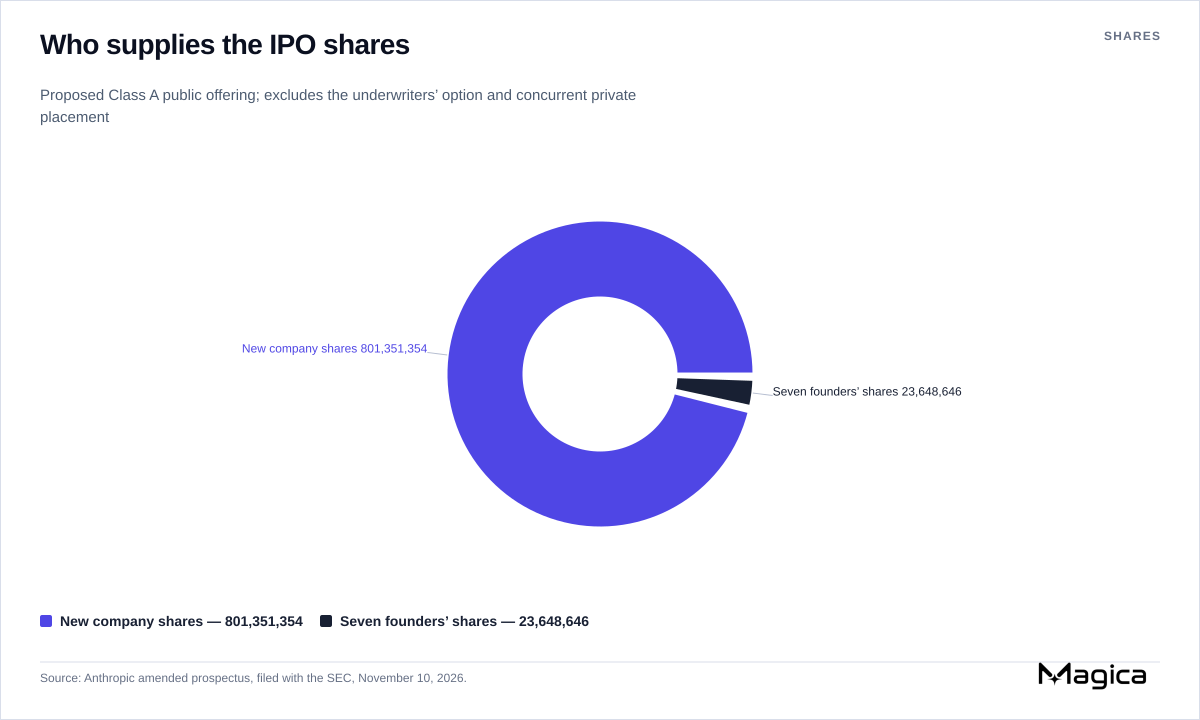
Company-reported IPO shares offered by Anthropic and its founders, excluding the underwriters’ option and private placement. Anthropic receives no proceeds from founder sales. Chart: Magica. Source: SEC.
Each founder is offering exactly 3,378,378 shares. At the proposed $70–$78 price range, that would produce approximately $236.5 million to $263.5 million per person before underwriting discounts and any taxes. The $74 midpoint puts each sale just below $250 million; the final price remains unsettled.
Together, the founders are offering 23,648,646 shares. Dividing that figure by the IPO’s 825 million shares puts their contribution at approximately 2.9% of the offering. Anthropic itself is issuing the remaining 801,351,354 shares and will receive no proceeds from the founders’ sales, the prospectus says.
Anthropic also plans a concurrent $26 billion private placement of nonvoting Class N shares at the IPO price, subject to closing conditions. The filing names AMD, Broadcom, Google, Micron, Microsoft, Nvidia and TSMC Partners as purchasers, with Google and Nvidia investing $10 billion apiece. These investors include companies supplying the chips and cloud capacity on which Anthropic depends.
At the $74 assumed IPO price, Anthropic estimates combined net proceeds to the company of $84.6 billion from its public share issuance and the private placement, after estimated underwriting discounts, commissions and offering expenses. That estimate rises to $93.7 billion if underwriters fully exercise their option to buy 123.75 million additional company shares. Both estimates assume the same $74 price; the difference is the underwriters’ option.
At the $78 upper end, Anthropic would be valued at $1.404 trillion on a fully diluted basis, according to the report on the updated filing. That exceeds the reported $965 billion valuation in its May fundraising but falls below the $2 trillion it was reportedly targeting months earlier.
Chief executive Dario Amodei previously served as OpenAI’s vice president of research. His sister, Daniela Amodei, Anthropic’s president and board chair, previously held senior OpenAI roles including vice president of safety and policy. They co-founded Anthropic in January 2021 with the other five sellers, whose earlier work also spanned OpenAI research, engineering and policy.
The prospectus identifies those founders and their current responsibilities:
A report on the planned sales puts each disposal at about 1.5% of the founder’s total stake. It also notes that the Amodeis participated in earlier tender offers in June 2025 and April 2026. This would extend their access to liquidity rather than provide their first opportunity to sell. The filing shows each founder retaining roughly 3.2% of outstanding Class A shares after the offering; that is a percentage of one share class, not of Anthropic’s total equity, which also includes nonvoting Class N shares.
Founder selling at an IPO has precedents. In the same report, Jay R. Ritter, a University of Florida emeritus professor whose research focuses on public offerings, points to Google’s 2004 debut, when its co-founders Larry Page and Sergey Brin each sold about $41 million of stock. His assessment is that investors have become more comfortable with founders taking some money off the table.
The prospectus also says each founder has pledged 80% of their personal Anthropic equity to philanthropy. It explicitly describes those pledges as voluntary, revocable and legally nonbinding, with the timing and form of donations uncertain. The pledge does not establish how the proceeds of these particular IPO sales will be used.
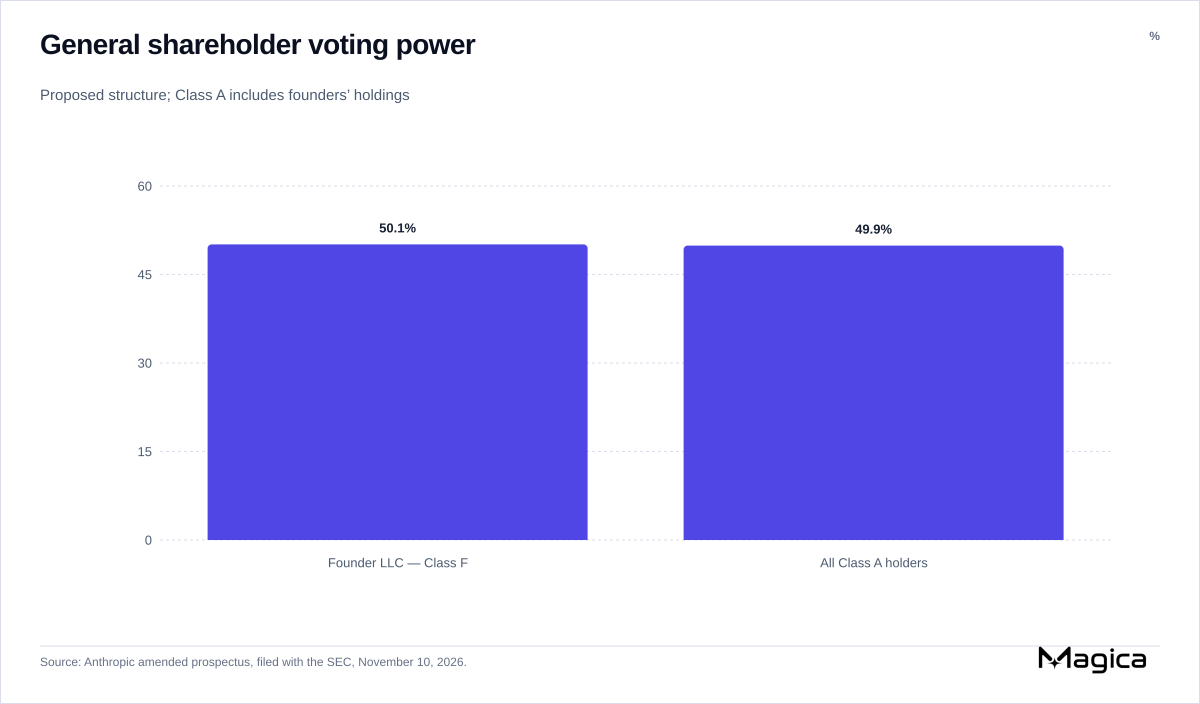
Company-reported general voting allocations. Class A includes founders’ holdings; the trust’s separate right to elect a board majority is outside this comparison. Chart: Magica. Source: SEC.
Selling economic interests does not translate directly into surrendering authority. The prospectus specifies that a single Class F share held by the founders’ LLC would carry 50.1% of voting power on matters submitted to shareholders generally. The founders would separately retain votes attached to their Class A holdings. This differs from Yahoo Finance’s account, which describes individual Class F shares and puts combined founder voting control at 51.1%.
The seven founders would initially be the LLC’s sole members, with its vote generally determined by a majority of eligible members. Class F has no economic rights. All Class A shares, including those held by founders, would collectively account for the remaining 49.9% of general voting power. Public buyers alone do not receive that entire allocation.
Board appointments have a further constraint. Anthropic’s Long-Term Benefit Trust, implemented in 2023 and intended to be an independent body of five financially disinterested voting trustees, would generally elect and remove a majority of authorized directors through Class T stock. The founders’ LLC and the trust together would be able to elect the entire board. Anthropic funds the trust’s operations; trustees are prohibited from directly owning its securities, and their compensation does not vary with company profits or decisions. The trust does not direct day-to-day management or strategy.
Anthropic says these arrangements support its mission as a Delaware public benefit corporation: responsible development of advanced AI for humanity’s long-term benefit, balanced with shareholders’ financial interests and the interests of people materially affected by its conduct. For public investors, the practical consequence is that buying shares provides economic exposure with restricted power to change the board or corporate direction.
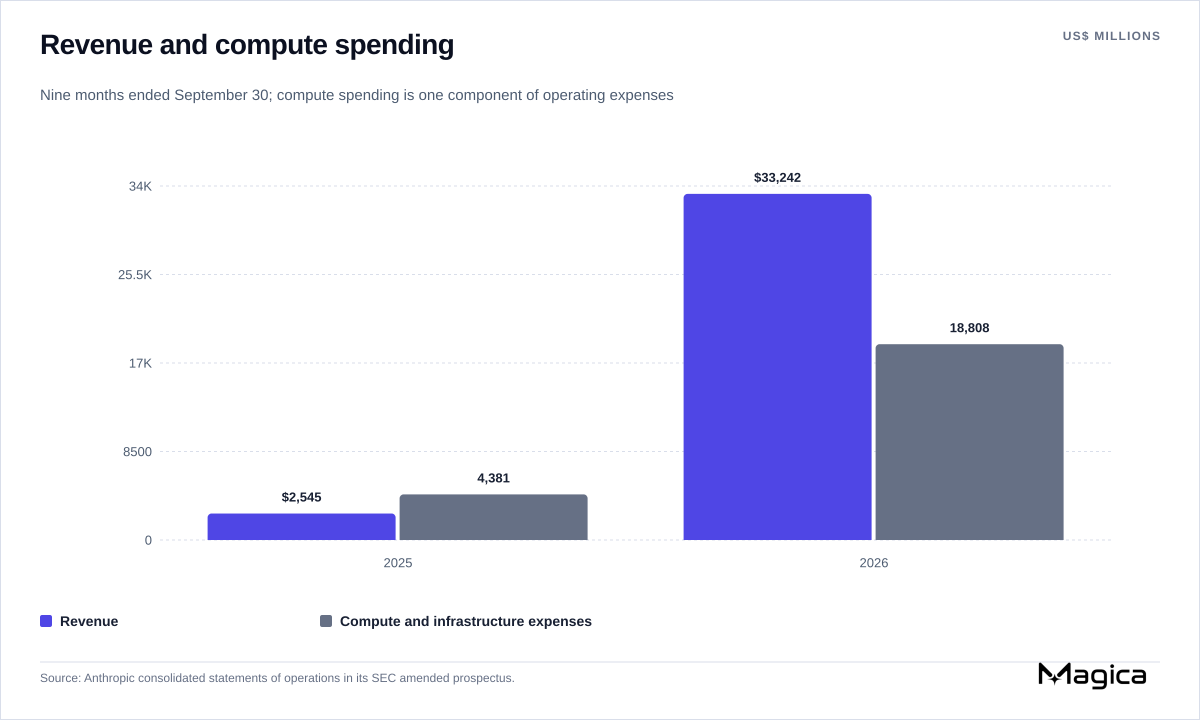
Company-reported revenue and compute and infrastructure expenses for matching nine-month periods. Compute expenses exclude other operating costs and future contractual commitments. Chart: Magica. Source: SEC.
The filing’s financial statements report $33.2 billion of revenue for the nine months ended September 30, 2026, up from approximately $2.5 billion in the corresponding 2025 period. Operating loss narrowed to $1.3 billion from $5.2 billion. The $104 billion net loss for the 2026 period included $94.3 billion of fair-value changes in financing instruments, primarily driven by its rising enterprise valuation.
That loss is not a measure of cash consumed. Operating activities generated $6.6 billion in the nine-month period, compared with $2 billion used a year earlier; vendor-payment and customer-receipt timing affect those cash flows. Anthropic held $131.8 billion in cash, cash equivalents and short-term investments at September 30. It nevertheless expects significant future operating and investing cash outflows as infrastructure expands.
Anthropic also says its revenue run rate reached approximately $81 billion at October 31, up $10 billion from September 30. This is an annualized operating metric, not revenue already earned or a full-year forecast: it combines trailing 28-day consumption fees multiplied by 13 with monthly subscription fees multiplied by 12.
Its approximately $900.9 billion of contractual obligations as of and subsequent to September 30 are substantially all related to compute and infrastructure. About $70.7 billion is expected to be paid in the following 12 months. Approximately $451.6 billion is expected to be incurred before the end of 2030, with substantially all the remainder between 2031 and 2045.
About $186.2 billion relates to arrangements subject to termination rights or conditions before commencement. The total excludes other arrangements without fixed dollar commitments, for which Anthropic estimates additional payments of $150 billion to $175 billion. Those estimates depend on capacity delivery, deployment and pricing terms.
The risk involves utilization as well as financing. For example, the filing says Anthropic committed to at least approximately $121.3 billion of Google hosting spending between April 2026 and July 2033 regardless of actual usage, subject to specified adjustments and exceptions. It also says demand for compute has historically exceeded available supply, and warns that some partners simultaneously supply infrastructure, provide capital and offer competing AI services. Its identified competitors include OpenAI, Google and open-weight or open-source model providers. More financing does not by itself establish that future capacity will arrive on time or be used profitably.
Anthropic has applied to list on Nasdaq under the symbol ANT. The reported deal timetable calls for pricing on November 18 and trading the following day. Those remain planned steps: the preliminary prospectus leaves the final offer price blank and says its information may change.
Final pricing and allocations will establish how much investors will pay under these governance terms and what the founders actually receive. Subsequent results will need to show whether customer spending and cash generation keep pace with the capacity Anthropic has contracted to buy. The IPO can supply capital; the filing leaves that operating test unresolved.
Alibaba’s Qwen4-Max preview gives developers a fixed model to test through November 25. API access requires Token Plan, while claimed coding gains remain unquantified in the launch materials.
Railway estimates stolen customer keys generated about $740,000 in unauthorized AI spending after an October intrusion. Secrets from up to about 100,000 workspaces could have been decrypted, and the company says it will cover losses providers decline to refund.
Anthropic expects retail investors worldwide to receive up to 20% of its IPO, potentially $12.9 billion at the proposed upper price. Access through six brokerage channels depends on demand and broker rules, while a separate technology-company investment would help finance vast infrastructure commitments and founders and a special trust retain control.
Nvidia’s independent directors retained Wachtell Lipton partner Joon H. Kim for an investigation into reports of a foreign intelligence effort targeting co-founder and CEO Jensen Huang. The board previously expressed confidence in Huang; the appointment provides no findings or timetable.
RRE Ventures led the funding for Graphon’s enterprise memory infrastructure. The startup is pitching connected, persistent context across different agents, but benchmark gains leave deployment costs and commercial scale unresolved.
Goldman Sachs, a lead bank on Anthropic’s IPO, reportedly forecasts $685 billion in annual revenue by 2030. The Claude developer has substantial cash reserves and rapidly growing sales, but rising compute costs, competitive pricing and delivery risks complicate the enterprise growth case.
Memories Upload pays contributors for accepted first-person video and sells annotated data to robotics developers. Its million-hour collection claim leaves open how much footage improves robot performance, while contributors surrender ownership without royalties.
OpenAI has acquired AI travel concierge Odessia and is bringing its founder, former Sonder chief Francis Davidson, into its travel effort. The standalone service has closed, leaving its future role alongside ChatGPT’s existing travel partners unclear.
Anthropic says expected advances from future models have triggered its research-acceleration threshold. An outside assessment finds faster progress but does not certify compliance with that threshold, while the voluntary policy leaves consequential decisions about safeguards and continued development with the company.
OpenAI’s free business-profile beta adds branded agents for eligible U.S. ecommerce and online service firms. The agents can also serve as paid-ad destinations, while OpenAI controls distribution and businesses bear responsibility for outputs.
Teleport has made Beams generally available with task-specific infrastructure permissions and a kill switch. Its access-security platform supplies an enterprise foothold, but established competitors and custom pricing for key controls complicate the buying decision.
New York will connect more than 80 researchers with Empire AI computing resources to evaluate advanced AI systems and advise state oversight, expanding a center first announced in January.
Anthropic’s amended IPO filing raises its Microsoft spending commitment while disclosing an exit right from a $34.9 billion Lambda agreement. Google’s larger commitment was already disclosed earlier, and expensive short-term computing continues to squeeze margins.
The cash deal would bring Oura’s existing AI and physician care partner under its ownership. The $159 annual integration already connects members to doctors, but geographic limits, extra service costs and unproven clinical benefits qualify the expansion.
Reddit is testing AI-organized review pages for roughly 10,000 products. The pages link back to users’ conversations, but lack purchase verification—a safeguard Amazon says it uses for its own AI review highlights.
The renamed MegaETH Foundation is funding its own products after an earlier shift away from its accelerator. Its December inference market must show how it improves on existing services that already route requests by price and reliability.
Cambridge startup Tendrils Compute has raised a Benchmark-led seed round to build processors based on interaction nets. Its backers see an opening in branching workloads, including AI agents, but theoretical parallelism has yet to establish a commercial hardware advantage.
Google and Artificial Analysis launched a 200-task test of AI agents working with visually dense professional files. Google's study finds close leading scores and sharply different API bills, as its new Carbon model reaches customers alongside the Argon alternative.
Google is widening paid access to Gemini 4 Carbon for complex coding, business and scientific work. Gemini API token rates double after November 30, while benchmark results show that its cost advantage depends on the task and reasoning setting.
MiniMax has released downloadable weights for H3-Image, a model combining image generation and editing at native 16-megapixel resolution. Local deployment offers an alternative to its paid API, but hardware demands and a restrictive community license qualify the promise of open access.