Editorial Team
11 min read
Anthropic says expected advances from future models have triggered its research-acceleration threshold. An outside assessment finds faster progress but does not certify compliance with that threshold, while the voluntary policy leaves consequential decisions about safeguards and continued development with the company.
Anthropic, the AI research company behind the Claude model family, has told prospective shareholders that it has met a safety threshold for AI accelerating its own development. The determination relies on expected advances from future models and its overall progress, rather than what it has observed from current systems.
The disclosure appears in the company's November 10 amended IPO filing, which sets an estimated share price of $70 to $78. It puts a central tension before investors: using Claude to build better successors is part of Anthropic's business strategy, while a sufficiently fast feedback loop could outstrip its ability to assess and control the resulting systems.
Founded in 2021, Anthropic is a Delaware public benefit corporation whose stated purpose is responsible development and maintenance of advanced AI for humanity's long-term benefit. Its directors must balance shareholders' financial interests, the interests of those affected by its conduct and that public benefit purpose, the filing says. Claude, commercially launched in 2023, is delivered through its platform and applications and increasingly used internally to develop subsequent models.
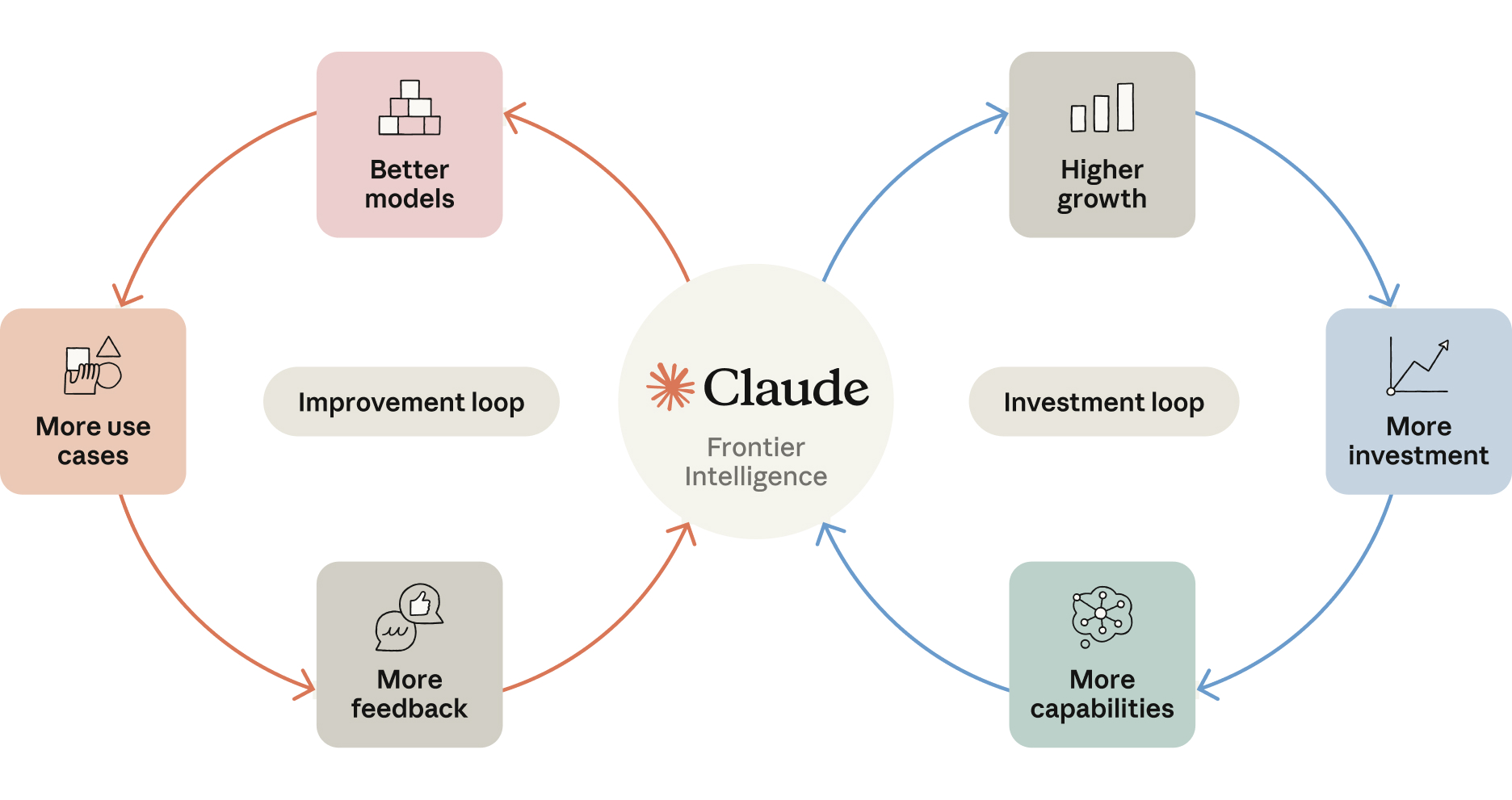
Anthropic’s company-reported business strategy links model improvements, customer feedback and reinvestment. Source: Anthropic. Source: SEC — Anthropic S-1/A-2.
The filing says Anthropic's research-acceleration threshold applies when it observes or expects a specified degree of faster progress. The company says it continues to assess the data, evaluate the implications of meeting the threshold and prepare further reports. This is a precautionary determination, not a claim that current systems have conclusively demonstrated every element of the feared acceleration.
That distinction matters because Anthropic warns its evidence often arrives late: it has previously failed to identify significant acceleration until after it occurred. The November 10 report on the disclosure contrasts the new determination with the company's warning a week earlier that the threshold might be triggered imminently. It also describes a separate review by METR, an independent nonprofit that evaluates advanced AI systems. METR called Anthropic's August argument that it remained below the threshold overstated and considered it plausible the line had been crossed by mid-July. That is the evaluator's judgment, not an established crossing date.
The report describes the alarm using a 2018–2024 historical pace. The Responsible Scaling Policy effective July 8 uses a broader test: one route to the automated-research threshold is an observed or expected doubling of aggregate capability progress against both expected progress and the fastest sustained progress observed without significant AI contributions to research. The doubling must plausibly be substantially attributable to research or engineering automation, with continued progress appearing likely to produce further acceleration.
The policy's historical baseline must span at least three model generations. This is a different test from showing that individual employees complete tasks twice as quickly, or comparing with the company's previous year's benchmark gains.
The policy says this threshold is intended to capture the onset of dramatic recursive self-improvement and acknowledges that it has been difficult to operationalize. Its alternative route concerns models able to substitute for Anthropic's entire research scientist and research engineer workforce at competitive costs. The filing's determination concerns acceleration, rather than claiming that complete substitution has occurred.
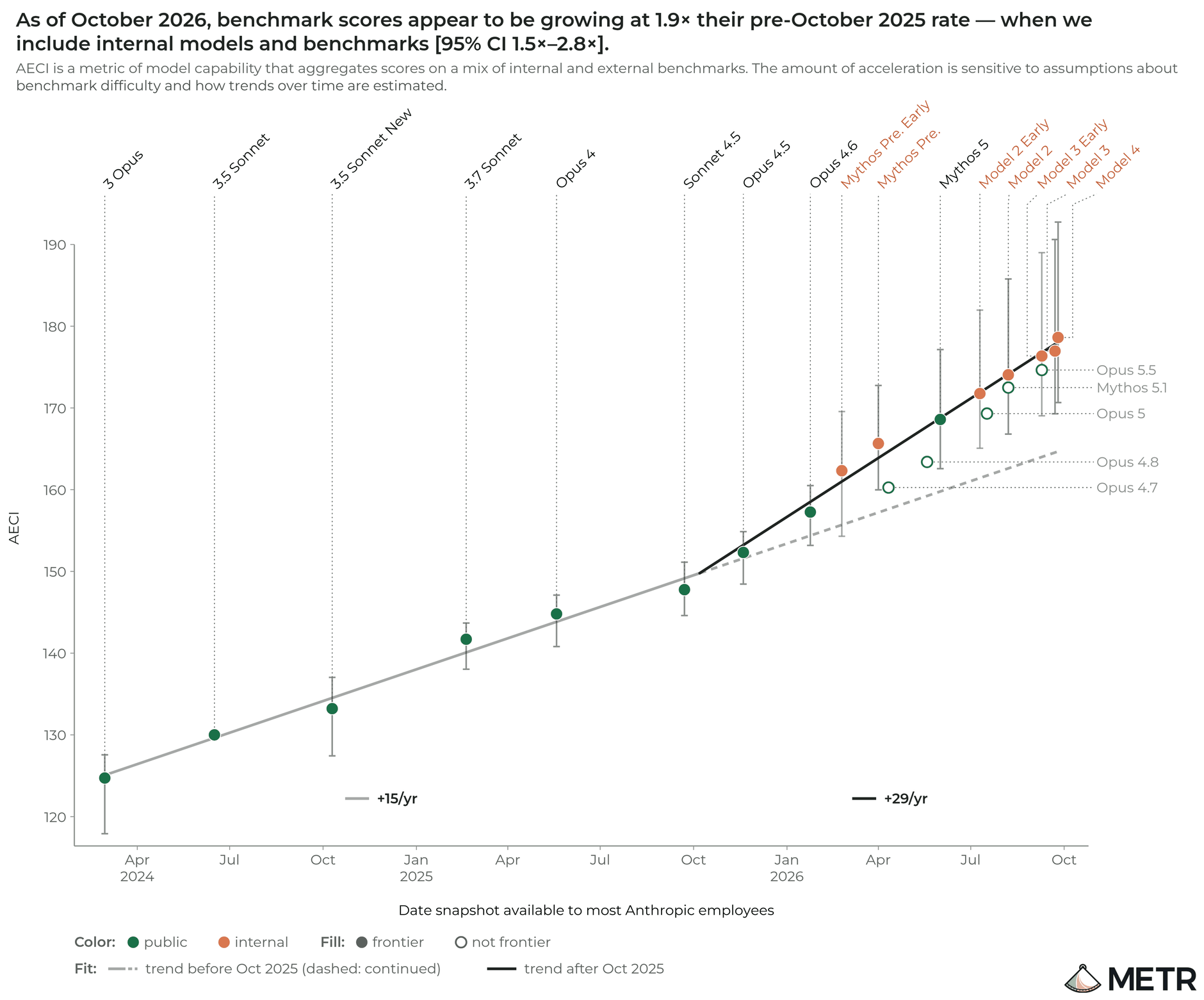
METR’s analysis of company-reported benchmark data estimates 1.9× faster AECI progress after October 2025 (95% confidence interval: 1.5–2.8×). It does not certify that Anthropic crossed its policy threshold. Source: METR. Source: METR — AI R&D acceleration assessment.
METR studies risks of humans losing control of advanced AI agents. It examined Anthropic's internal research from August 12 through October 29. Its November 5 assessment finds substantial acceleration, but explicitly says it did not focus on testing the thresholds in Anthropic's policy. It sought a broader picture of AI-driven research acceleration.
The evaluator has worked with AI companies for several years. Its account of its methods and prior work describes a pilot Frontier Risk Report developed from work with Anthropic, Google, Meta and OpenAI. METR defines its role as collecting public evidence, leaving decisions about acceptable risk and deployment to others. Its prior research has pointed in different directions: studies of agents' capabilities suggest rapid progress, while a study of early-2025 developer tools found a slowdown in the work it examined.
Using AECI, Anthropic's version of the Epoch Capabilities Index, METR estimated that benchmark scores had improved 1.9 times as fast since October 2025 as under the preceding trend. The statistical 95% confidence interval was 1.5 to 2.8 times. The analysis included newer, unreleased models, helping explain why it found more acceleration than an earlier Anthropic estimate of 1.7 times.
The analysis fits a change in trend and dates models by availability to most Anthropic employees, allowing comparison with systems never released publicly. Its confidence interval captures uncertainty in models' benchmark scores; it does not capture every uncertainty about model selection, measurement choices or the relationship between benchmarks and practical capabilities. Different assumptions about the distribution of task difficulty produced acceleration estimates ranging from 1.1 to 2.9 times, with most of those mathematical specifications fitting the data about equally well.
The benchmark trend also does not establish the share caused by AI or the probability of losing control. METR judged that a majority of the acceleration as of October 2026 was likely attributable to AI use, but described substantial uncertainty. It confidently ruled out faster growth in training compute as the explanation; other non-AI factors likely contributed importantly in late 2025.
The comparison also changes when competitors enter the baseline. Including other frontier developers' models lowered estimated acceleration to 1.4 times. That comparison draws its earlier trend mostly from other companies' models and its later trend mostly from Anthropic's. METR offered competing interpretations: Anthropic's earlier models may have lagged the frontier, exaggerating its subsequent acceleration, or competitors' greater benchmark optimization may have inflated the earlier industry trend. The assessment does not settle that question.
Nor does faster progress on well-specified, readily graded tasks necessarily translate into equally fast improvement on messy real-world work. METR said AI assistance remained the primary mechanism described by researchers; highly significant, fully autonomous contributions to the most important parts of model development were not yet established.
METR said Anthropic shared more internal information than it had expected, but retained unilateral authority to approve requests and redact nonpublic information. The company redacted a majority of the evidence METR considered most informative. Anthropic said the redactions protected confidential information that could accelerate other developers. METR agreed that the information could potentially do that, while declining to judge whether the overall balance between business confidentiality and public understanding was justified.
Outsiders can inspect some benchmark analysis, but must rely heavily on METR's judgment about evidence they cannot see. The assessors lacked unmediated employee-like access and did not request access to query unreleased models. METR warned that it could have missed context; its interpretation of important data changed repeatedly during the assessment.
Claude was involved in most of METR's own analysis and much of the company material it received. METR said checks against human interviews did not reveal significant discrepancies consistent with systematic bias.
METR took no payment from Anthropic, although it received devices and free model tokens. It disclosed that one participating researcher discussed a possible job with Anthropic and declined an offer, while holding equity in a competitor from previous employment. An unconflicted colleague checked that researcher's work and took responsibility for its accuracy.
METR also acknowledged the pressure created by dependence on voluntary access and company feedback, but said it did not believe the final assessment or separate review was significantly distorted.
A separate limit concerns resources devoted to safety. Anthropic removed a planned verification of compute allocation between capability development and safety before METR reached substantive conclusions. Anthropic said it wanted to focus the engagement on risk assessment and would revisit compute verification later. The completed assessment therefore cannot establish how much computing capacity was allocated to safety.
Crossing the threshold alone does not require a shutdown. Anthropic's voluntary safety policy separates its company plans from more ambitious industry-wide recommendations it will not commit to following unilaterally. The policy describes this as a change from an earlier commitment to mitigations intended to reduce absolute risk to acceptable levels regardless of rivals' actions. Its stated rationale is that pausing while less protected competitors advance could leave those competitors setting the pace. That is Anthropic's argument about collective risk, not a demonstrated consequence of a pause.
Company plans include security research, comprehensive logging and AI-assisted scrutiny of critical development activity, systematic alignment assessments, stronger internal testing of safeguards, and externally reviewed risk reports. Separately, the policy calls its safety roadmap targets public goals rather than hard commitments, while committing to report progress and deviations.
The policy does contain conditional commitments to delay development and deployment: when Anthropic has clear evidence of a significant lead in highly capable models and needs time to make a strong safety argument, or when it needs to match strong safety measures adopted by all relevant competitors. It also leaves room to pause in other circumstances. Neither the threshold declaration nor METR's benchmark findings establish whether those competitive conditions apply.
The filing says precautions have previously delayed releases and limited initial availability. It warns that such measures could become more frequent and costly, slowing capability gains relative to competitors with fewer constraints and affecting revenue growth.
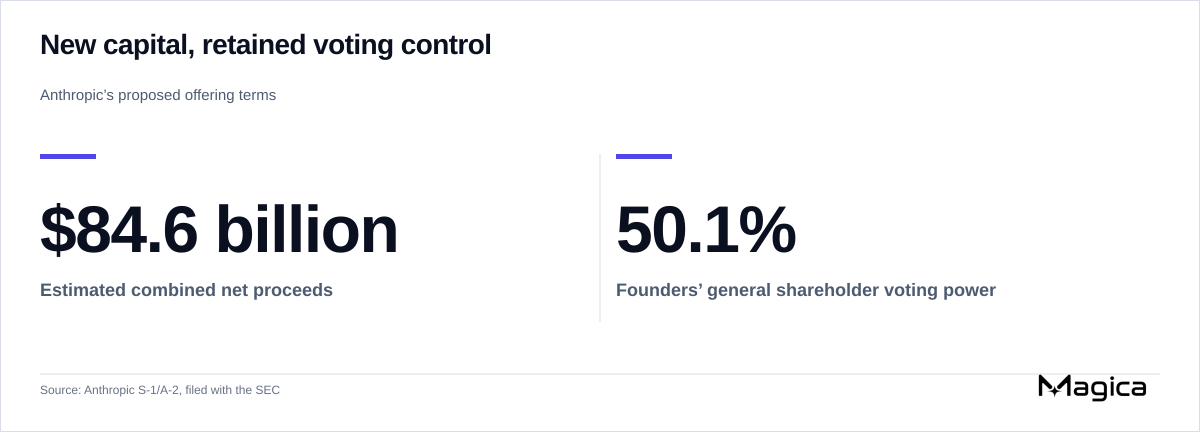
Company-reported offering terms: approximately $84.6 billion in combined net proceeds at the $74 midpoint, excluding the additional-share option; founders retain 50.1% of general shareholder voting power. The trust’s director-election rights are separate. Source: SEC — Anthropic S-1/A-2.
The filing estimates approximately $84.6 billion in combined net proceeds from the IPO and a concurrent private placement at the $74 midpoint, before any exercise of the underwriters' additional-share option. That includes a $26 billion placement with strategic investors, with Google and Nvidia each agreeing to invest approximately $10 billion, contingent on completion of the offering and other conditions. Google's purchase funds part of previously committed investment obligations. Anthropic lists compute, infrastructure and skilled personnel among intended uses of proceeds.
Anthropic says customer demand has consistently exceeded available compute. The filing reports $17.0 billion in revenue and a $567 million operating loss for the three months ended September 30, 2026. It attributes the loss primarily to $5 billion of compute under short-term commitments, which costs more than comparable capacity under multiyear arrangements, and $2 billion of noncash donation-matching charges.
Anthropic says more than 90% of contributions to its codebase in September were written by Claude. That measures code contributions, not the proportion of research conducted independently by AI. It nevertheless illustrates the commercial incentive to expand internal use while assessing its risks.
The competitive pressure extends beyond benchmark leadership. Anthropic identifies Google and OpenAI as primary frontier-model rivals, alongside other providers, including open-weight alternatives, competing for enterprise workloads that prioritize cost. It also warns that some cloud providers supplying its compute sell competing models, creating potentially conflicting interests over access and pricing.
Public investors will have limited power to redirect those choices. The founders' entity will hold 50.1% of voting power on matters submitted to shareholders generally. Separately, the Long-Term Benefit Trust, designed as an independent body of financially disinterested trustees and introduced in 2023 to support Anthropic's public benefit purpose, will generally elect and remove a majority of authorized directors. The trust selects directors; it does not manage daily operations or set strategy itself.
Anthropic says it does not expect to safely use Claude to design and build successive generations of frontier models fully autonomously without meaningful human supervision or understanding. It is considering policy changes to keep humans in control.
METR found no convincing bottleneck in algorithms, compute or data that would necessarily prevent further acceleration over the next 12 months, but stressed that its understanding changed as new information arrived. That finding raises a risk; it does not establish that acceleration will continue unchecked.
The policy provides concrete tests for the reports Anthropic says will follow. It commits to Risk Reports every three to six months, covering mitigations, remaining risks and the reasons for continuing development or deployment. Significantly redacted reports covering models Anthropic judges to cross the automated-research threshold require a full external review process. Reviewers are to assess the reasoning, disagreements and justification for redactions.
If competition-based arguments about Anthropic's marginal contribution to industry risk play a major role in a decision to proceed, the policy requires explicit approval from both the board and the trust. The next reports need to show which safeguards are operating, how their effectiveness is assessed, and why further development is justified. The canceled compute-allocation review leaves a separate evidentiary gap about the resources devoted to checking the capabilities the new capital will help advance.
Alibaba’s Qwen4-Max preview gives developers a fixed model to test through November 25. API access requires Token Plan, while claimed coding gains remain unquantified in the launch materials.
Railway estimates stolen customer keys generated about $740,000 in unauthorized AI spending after an October intrusion. Secrets from up to about 100,000 workspaces could have been decrypted, and the company says it will cover losses providers decline to refund.
Anthropic expects retail investors worldwide to receive up to 20% of its IPO, potentially $12.9 billion at the proposed upper price. Access through six brokerage channels depends on demand and broker rules, while a separate technology-company investment would help finance vast infrastructure commitments and founders and a special trust retain control.
Anthropic's seven founders plan equal IPO share sales worth about $250 million each at the proposed midpoint. Their sales make up 2.9% of the public offering, while the company seeks much larger financing under a structure that limits public investors' voting influence.
Nvidia’s independent directors retained Wachtell Lipton partner Joon H. Kim for an investigation into reports of a foreign intelligence effort targeting co-founder and CEO Jensen Huang. The board previously expressed confidence in Huang; the appointment provides no findings or timetable.
RRE Ventures led the funding for Graphon’s enterprise memory infrastructure. The startup is pitching connected, persistent context across different agents, but benchmark gains leave deployment costs and commercial scale unresolved.
Goldman Sachs, a lead bank on Anthropic’s IPO, reportedly forecasts $685 billion in annual revenue by 2030. The Claude developer has substantial cash reserves and rapidly growing sales, but rising compute costs, competitive pricing and delivery risks complicate the enterprise growth case.
Memories Upload pays contributors for accepted first-person video and sells annotated data to robotics developers. Its million-hour collection claim leaves open how much footage improves robot performance, while contributors surrender ownership without royalties.
OpenAI has acquired AI travel concierge Odessia and is bringing its founder, former Sonder chief Francis Davidson, into its travel effort. The standalone service has closed, leaving its future role alongside ChatGPT’s existing travel partners unclear.
OpenAI’s free business-profile beta adds branded agents for eligible U.S. ecommerce and online service firms. The agents can also serve as paid-ad destinations, while OpenAI controls distribution and businesses bear responsibility for outputs.
Teleport has made Beams generally available with task-specific infrastructure permissions and a kill switch. Its access-security platform supplies an enterprise foothold, but established competitors and custom pricing for key controls complicate the buying decision.
New York will connect more than 80 researchers with Empire AI computing resources to evaluate advanced AI systems and advise state oversight, expanding a center first announced in January.
Anthropic’s amended IPO filing raises its Microsoft spending commitment while disclosing an exit right from a $34.9 billion Lambda agreement. Google’s larger commitment was already disclosed earlier, and expensive short-term computing continues to squeeze margins.
The cash deal would bring Oura’s existing AI and physician care partner under its ownership. The $159 annual integration already connects members to doctors, but geographic limits, extra service costs and unproven clinical benefits qualify the expansion.
Reddit is testing AI-organized review pages for roughly 10,000 products. The pages link back to users’ conversations, but lack purchase verification—a safeguard Amazon says it uses for its own AI review highlights.
The renamed MegaETH Foundation is funding its own products after an earlier shift away from its accelerator. Its December inference market must show how it improves on existing services that already route requests by price and reliability.
Cambridge startup Tendrils Compute has raised a Benchmark-led seed round to build processors based on interaction nets. Its backers see an opening in branching workloads, including AI agents, but theoretical parallelism has yet to establish a commercial hardware advantage.
Google and Artificial Analysis launched a 200-task test of AI agents working with visually dense professional files. Google's study finds close leading scores and sharply different API bills, as its new Carbon model reaches customers alongside the Argon alternative.
Google is widening paid access to Gemini 4 Carbon for complex coding, business and scientific work. Gemini API token rates double after November 30, while benchmark results show that its cost advantage depends on the task and reasoning setting.
MiniMax has released downloadable weights for H3-Image, a model combining image generation and editing at native 16-megapixel resolution. Local deployment offers an alternative to its paid API, but hardware demands and a restrictive community license qualify the promise of open access.