Editorial Team
8 min read
Memories Upload pays contributors for accepted first-person video and sells annotated data to robotics developers. Its million-hour collection claim leaves open how much footage improves robot performance, while contributors surrender ownership without royalties.
Memories.ai, a San Francisco startup supplying video data infrastructure to robotics developers, announced Memories Upload on November 10. The platform pays people to record tasks such as preparing food, stocking shelves and repairing equipment, then turns accepted footage into annotated data for AI systems that act in the physical world. Its business extends beyond gathering video: it purchases the recordings and controls their subsequent use.
The company says in its launch announcement that the network has already recorded more than 1 million hours and aims to exceed 10 million by March 2027. Those are a company-reported collection figure and a target, respectively—not measures of successful robot learning. Memories.ai says it measures and sells only accepted hours, but the announcement does not specify how much of the recorded total has passed that filter.
The distinction matters because a recording of useful human work does not automatically supply the actions a robot needs to perform it. Developers must identify the relevant movements, trust the labels, and translate what a human body does into what a particular robot can do.
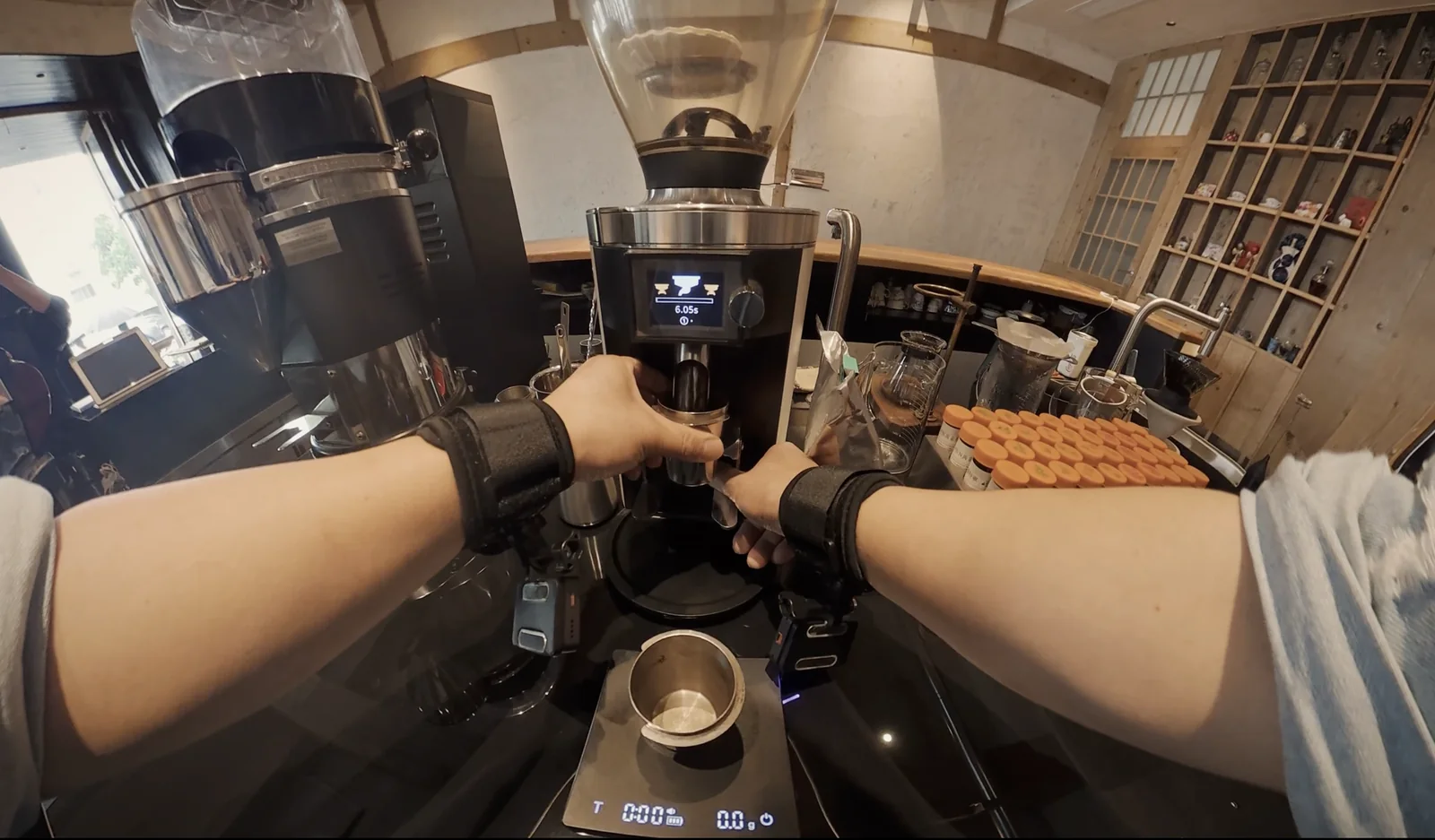
Illustrative first-person café footage used by Memories.ai to demonstrate its video data pipeline. Image: Memories.ai. Source: Memories.ai — Memories Upload.
Co-founder and CEO Shawn Shen and co-founder and CTO Ben (Enmin) Zhou previously worked at Meta’s Reality Labs, according to the company’s announcement, which says they helped build the AI system behind Meta’s Ray-Ban glasses. That background connects the team to AI for wearable devices and first-person perception.
The underlying visual memory technology predates this launch. In a July 24, 2025 announcement, Memories.ai introduced its Large Visual Memory Model, or LVMM, alongside an $8 million seed round. The company has since raised $16 million in total, including an $8 million seed extension in June 2026, according to a report on the launch. Venture investor Susa Ventures led the original seed round, whose investors included Samsung Next. In that 2025 announcement, Shen described applications in security-camera search, studio archives and social-video analysis. The robotics launch extends an existing video-search business.
Memories Upload adds a task-based supply network to that infrastructure. The company says the app is available on iOS and Android, although its website links point to beta access and the Android listing directs prospective camera users to a waitlist. In the launch report, Memories.ai says its million-hour collection came during the first month in beta. A separate account dates the launch to October 28; the company’s formal announcement is dated November 10.
Contributors choose assignments and record with the company’s LUCI Pin, a wearable camera weighing under 45 grams that attaches to head, chest or wrist mounts. Two cameras can be paired for stereo capture to help estimate depth. The app website says some assignments permit phone recordings, although the Android listing and terms describe the LUCI Pin as required. The product page also describes synchronized head and wrist views, automated and human quality checks, action labels, hand-pose data and delivery through its DataLake API, an interface for retrieving video and annotations.
The company says LVMM indexes footage into timestamped captions and embeddings, allowing developers to retrieve specific moments. It uses Nvidia’s Metropolis video-processing tools and Cosmos models for physical-world understanding. The launch report describes a captioning model fine-tuned from Cosmos, action-labeling models based on Cosmos, and further post-training on curated video for customers’ particular tasks.
That makes searchable, usable footage the commercial proposition. In the launch report, Memories.ai says its customers include three of the top five frontier AI labs, as well as robotics developers, but declined to identify them, citing nondisclosure agreements. The unnamed ranking and customers limit outside assessment of that adoption claim.
The contributor offer is narrower than payment for time spent working. The app’s explanation says participants earn Coins for qualified minutes after review, with the task’s rate and requirements locked when it is claimed. Idle, unclear or off-task footage does not count, and recordings can be partly accepted. Displayed earnings are examples rather than a published universal pay schedule.
The terms, updated October 4, specify a refundable deposit to borrow the camera, with the amount disclosed during signup. They classify contributors as independent contractors and generally leave them responsible for ingredients, tools, transport, internet access and taxes. Deposit deductions can apply for camera loss or damage, and amounts owed for an unreturned or damaged device can be offset against earnings. Accepting a task guarantees neither acceptance of its footage nor a minimum payment.
Qualified footage is measured in minutes and rounded down to whole minutes. Automated tools and human reviewers assess submissions, with review targeted within 10 business days. A rolling quality grade can change future rates and task access; contributors can request another review within 14 days of a result.
The same terms say payment is the full purchase price for accepted recordings and the associated rights. Contributors receive no royalty or revenue share. Memories.ai acquires worldwide ownership and can create annotations, synthetic data and other derived works, use accepted recordings for its own AI and robotics development, and supply de-identified recordings and derived data to third parties.
Rejected recordings receive no payment. The company says it will not use them for model training or product development, or provide them to third parties, although it may retain them for specified purposes including quality review, fraud prevention and disputes.
The arrangement therefore pays for an asset once, while allowing repeated downstream uses. A contributor’s eventual return depends on accepted minutes, the applicable rate and their costs—not simply on how long the camera records.

Memories.ai’s LUCI Pin rendering highlights its physical privacy switch. Image: Memories.ai. Source: Memories.ai — Memories Upload.
Memories.ai says it blurs faces before footage enters training datasets, never sells audio, and allows contributors to delete clips before payment. In the launch report, the company also describes obscuring identifying details such as badges, screens and license plates, with manual checks on sampled frames.
Those measures sit alongside obligations on the recorder. The terms require lawful recording and relevant consent, prohibit recording minors, and require written permission from workplace owners or operators and, where applicable, employers. They also prohibit confidential workplace information and sensitive personal material.
The company’s audio descriptions are not fully consistent. Recordings capture audio, including the contributor’s voice, according to the terms. The launch announcement says audio is never sold, but the product page lists audio with every clip in the package delivered through its API. The pages do not explain that discrepancy.
The app listing also offers a personal recording timeline and an AI memory assistant, giving contributors a personal use for their recordings.
Deleting an account does not necessarily undo a completed sale. The app website warns that deletion may not remove accepted recordings, derived data or models already trained on them. That boundary matters for workers recording in homes and businesses: control over purchased footage can persist after their participation ends.
Memories.ai is entering an existing market. Humanoid robot developer Figure pays people to capture everyday tasks for its Helix AI models. In its August 25 introduction of Index, Figure said contributors had earned $15 million and described a collection pipeline exclusive to Figure. It reported more than 44,000 weekly active users across 108 countries and committed to spend over $1 billion on data and compute over the following 12 months. The user counts and planned spending are company-reported; the spending commitment covers both data and compute and cannot be compared directly with Memories.ai’s venture funding.
Figure said it built that system after vendors failed to meet its throughput, diversity and quality requirements. Its pipeline includes automated filtering, human fraud review, deduplication, rebalancing and annotation. Memories.ai therefore faces competition in processing and quality control as well as recruitment, including from a robot developer collecting data internally.
The launch report also describes Physical Intelligence, which develops AI software for controlling different robots, testing human video alongside teleoperation data collected while people remotely control robots. Nvidia also works with Memories.ai. Its Cosmos product and engineering director, Rick Zhuang, told the launch report that human review remains essential for ambiguous actions and that human video is most useful alongside robot demonstrations and simulation. That assessment comes from a technology partner.
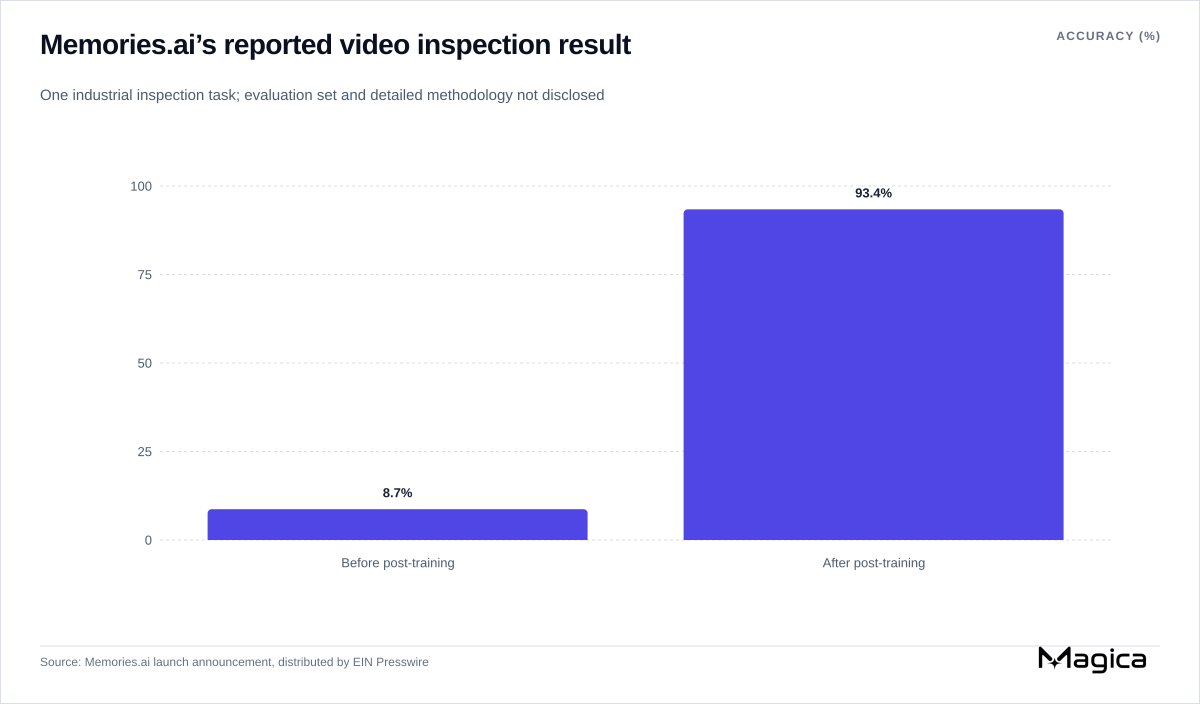
Company-reported industrial video inspection accuracy before and after post-training on Memories.ai’s curated video. Evaluation details were not disclosed; the result does not establish robot manipulation performance. Chart: Magica. Source: Memories.ai — launch announcement.
Memories.ai’s announcement offers one performance claim: post-training on its curated footage increased accuracy on an industrial video inspection task from 8.7% to 93.4%. It does not provide the evaluation set or enough methodology to assess generalization. An inspection result also does not establish that a robot can reliably manipulate objects in unfamiliar workplaces.
The launch materials give no customer price schedule or comparable cost per usable hour, leaving the economics of buying from Memories.ai versus collecting internally unresolved. The company’s March collection target will test how fast its network can grow. The more consequential evidence would show how many recorded hours become accepted, accurately annotated data; what contributors earn after rejected footage and expenses; and whether customers’ robots improve on clearly defined tasks. Those measures would distinguish a large video inventory from a dependable source of physical skills.
Alibaba’s Qwen4-Max preview gives developers a fixed model to test through November 25. API access requires Token Plan, while claimed coding gains remain unquantified in the launch materials.
Railway estimates stolen customer keys generated about $740,000 in unauthorized AI spending after an October intrusion. Secrets from up to about 100,000 workspaces could have been decrypted, and the company says it will cover losses providers decline to refund.
Anthropic expects retail investors worldwide to receive up to 20% of its IPO, potentially $12.9 billion at the proposed upper price. Access through six brokerage channels depends on demand and broker rules, while a separate technology-company investment would help finance vast infrastructure commitments and founders and a special trust retain control.
Anthropic's seven founders plan equal IPO share sales worth about $250 million each at the proposed midpoint. Their sales make up 2.9% of the public offering, while the company seeks much larger financing under a structure that limits public investors' voting influence.
Nvidia’s independent directors retained Wachtell Lipton partner Joon H. Kim for an investigation into reports of a foreign intelligence effort targeting co-founder and CEO Jensen Huang. The board previously expressed confidence in Huang; the appointment provides no findings or timetable.
RRE Ventures led the funding for Graphon’s enterprise memory infrastructure. The startup is pitching connected, persistent context across different agents, but benchmark gains leave deployment costs and commercial scale unresolved.
Goldman Sachs, a lead bank on Anthropic’s IPO, reportedly forecasts $685 billion in annual revenue by 2030. The Claude developer has substantial cash reserves and rapidly growing sales, but rising compute costs, competitive pricing and delivery risks complicate the enterprise growth case.
OpenAI has acquired AI travel concierge Odessia and is bringing its founder, former Sonder chief Francis Davidson, into its travel effort. The standalone service has closed, leaving its future role alongside ChatGPT’s existing travel partners unclear.
Anthropic says expected advances from future models have triggered its research-acceleration threshold. An outside assessment finds faster progress but does not certify compliance with that threshold, while the voluntary policy leaves consequential decisions about safeguards and continued development with the company.
OpenAI’s free business-profile beta adds branded agents for eligible U.S. ecommerce and online service firms. The agents can also serve as paid-ad destinations, while OpenAI controls distribution and businesses bear responsibility for outputs.
Teleport has made Beams generally available with task-specific infrastructure permissions and a kill switch. Its access-security platform supplies an enterprise foothold, but established competitors and custom pricing for key controls complicate the buying decision.
New York will connect more than 80 researchers with Empire AI computing resources to evaluate advanced AI systems and advise state oversight, expanding a center first announced in January.
Anthropic’s amended IPO filing raises its Microsoft spending commitment while disclosing an exit right from a $34.9 billion Lambda agreement. Google’s larger commitment was already disclosed earlier, and expensive short-term computing continues to squeeze margins.
The cash deal would bring Oura’s existing AI and physician care partner under its ownership. The $159 annual integration already connects members to doctors, but geographic limits, extra service costs and unproven clinical benefits qualify the expansion.
Reddit is testing AI-organized review pages for roughly 10,000 products. The pages link back to users’ conversations, but lack purchase verification—a safeguard Amazon says it uses for its own AI review highlights.
The renamed MegaETH Foundation is funding its own products after an earlier shift away from its accelerator. Its December inference market must show how it improves on existing services that already route requests by price and reliability.
Cambridge startup Tendrils Compute has raised a Benchmark-led seed round to build processors based on interaction nets. Its backers see an opening in branching workloads, including AI agents, but theoretical parallelism has yet to establish a commercial hardware advantage.
Google and Artificial Analysis launched a 200-task test of AI agents working with visually dense professional files. Google's study finds close leading scores and sharply different API bills, as its new Carbon model reaches customers alongside the Argon alternative.
Google is widening paid access to Gemini 4 Carbon for complex coding, business and scientific work. Gemini API token rates double after November 30, while benchmark results show that its cost advantage depends on the task and reasoning setting.
MiniMax has released downloadable weights for H3-Image, a model combining image generation and editing at native 16-megapixel resolution. Local deployment offers an alternative to its paid API, but hardware demands and a restrictive community license qualify the promise of open access.