Editorial Team
8 min read
OpenAI’s free business-profile beta adds branded agents for eligible U.S. ecommerce and online service firms. The agents can also serve as paid-ad destinations, while OpenAI controls distribution and businesses bear responsibility for outputs.
OpenAI, the developer and operator of the AI chatbot ChatGPT, launched Businesses in ChatGPT in beta on November 10. Companies can claim profiles, contribute current business and product information and see engagement insights; eligible U.S. ecommerce and online service businesses can also publish agents that answer customers on their behalf.
The launch gives businesses an organic route into a conversational format OpenAI has already been testing as paid advertising. It also puts the information, customer interaction and measurement under the control of the company deciding how businesses appear in ChatGPT.
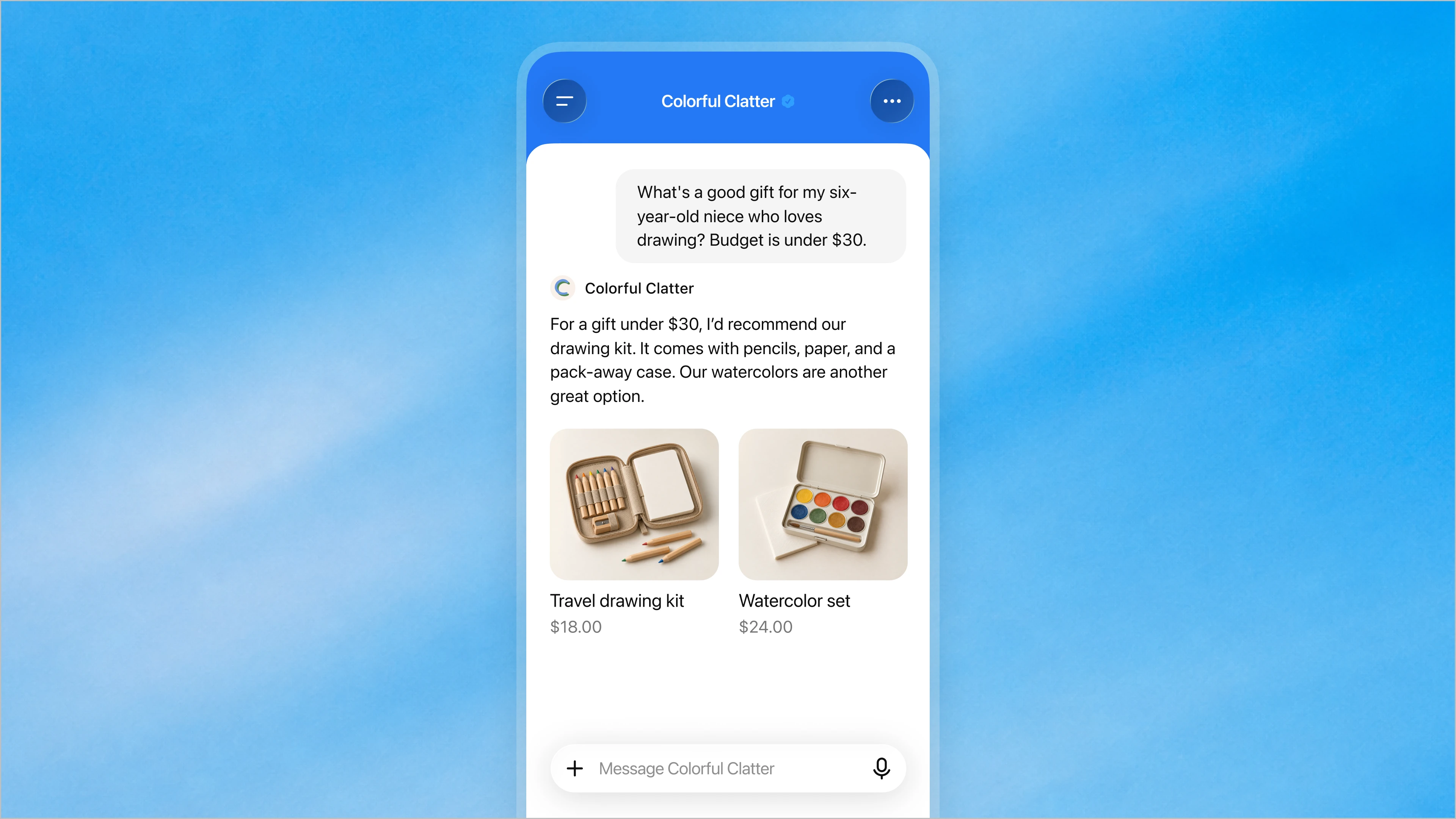
OpenAI’s illustrative Business Agent conversation shows product recommendations from the example business Colorful Clatter. Image: OpenAI. Source: OpenAI.
OpenAI says ChatGPT now reaches 1.2 billion people each week. Its launch announcement describes Business Hub as the interface for claiming a business, updating its details and supplying product feeds with prices and availability. It also provides aggregated insights into mentions, website clicks and the topics in conversations where a business’s website is cited.
Eligible businesses in places where ChatGPT is offered can claim profiles, initially requiring a website. The company’s FAQ says owners or authorized representatives must verify the business; a blue check identifies a claimed profile. Claiming does not guarantee higher placement or sales, and a business may appear in answers without creating an agent.
Shopify, the commerce platform whose merchant catalog already supplies eligible products to ChatGPT, provides one route in: merchants can connect through Business Hub or their Shopify admin. Other businesses can claim directly, while existing OpenAI Enterprise customers and advertisers can work through their OpenAI representative.
The agent rollout is narrower than profile claiming. Initially, eligible ecommerce and online service businesses in the United States can build, test and publish a Business Agent. Users reach it by opening a business’s profile after it appears in a ChatGPT response. The agent can answer follow-up questions using the business’s product information and instructions. OpenAI says that conversation is labeled and separate from the user’s original chat and ChatGPT’s independent answers.
Business Hub and Business Agents are free for now, OpenAI said in a launch briefing report. The same agent can also become the destination for sponsored placements, which the company says are labeled and separate from ChatGPT responses. Publishing an agent does not itself authorize paid advertising: the terms require a separate advertising relationship.
OpenAI had already been testing sponsored agents in September; the beta adds an organic route to that conversational format. The company described early sponsored-agent tests as promising, particularly for conversation depth, without providing conversion figures in the briefing report.
Advertising already sits alongside OpenAI’s consumer subscriptions, enterprise products and usage-based developer APIs. On August 31, the company said ChatGPT Ads had reached $1 billion in annualized revenue run rate. That is a company-reported measure of revenue pace, rather than a full year of realized revenue or evidence that the new Business Agents generate sales.
Brand conversations are also an established competitive direction. In a January 11 announcement, Google, the operator of the competing Search service, introduced its own Business Agent to answer product questions in a brand’s voice. It said the rollout would start the next day, with eligible U.S. retailers able to activate and customize agents through its Merchant Center tools. Branded conversational shopping therefore predates OpenAI’s beta.
Google’s January announcement also described the Universal Commerce Protocol, a common standard co-developed with Shopify and other retailers to connect agents with commerce systems, and plans for checkout on eligible U.S. retailers’ product listings in Search’s AI Mode and its Gemini AI assistant app. Those checkout plans do not establish which capabilities have since been delivered.
For businesses, the practical distinction is between contributing information, having a conversation and purchasing distribution. None guarantees a favorable recommendation. OpenAI says claiming a business should not change how frequently it appears, although better information can help the system identify relevant conversations.
Businesses also cannot bring an independently built agent into this offering, OpenAI said in the briefing. The platform builds the agent from the instructions and product feeds supplied. When shoppers are ready to pay, they are sent to the business’s own site, according to the same report.
The analytics offer OpenAI’s own account of supported activity inside ChatGPT, but their definitions leave out parts of a brand’s visibility.
An OpenAI spokesperson explained in the briefing report that, for an online business, a mention counts when ChatGPT references its website; simply naming the brand does not count. For local businesses, a mention counts when ChatGPT shows a result for that location. Website clicks measure clicks on supported ChatGPT links, rather than completed visits or purchases. Low-volume counts may be withheld for privacy, and the beta does not include share-of-voice comparisons with rivals.
OpenAI says businesses receive neither users’ original conversations nor their Business Agent chat transcripts. Discovery topics are aggregated themes, with insights available only above privacy thresholds. The launch therefore gives businesses a clearer view of some activity without exposing the full conversation or establishing a link to revenue.
Industry executives quoted in the same briefing report questioned whether outside visibility tools’ estimates would stand up against OpenAI’s data, while noting that businesses still need comparisons across AI services. Coverage of ChatGPT alone limits the beta’s usefulness as a replacement for those services.
OpenAI’s separate advertising platform already offers conversion-measurement tools, including Pixel and Conversions API, according to its August announcement. Those capabilities do not make the new profile’s mentions and clicks measures of agent-driven sales.
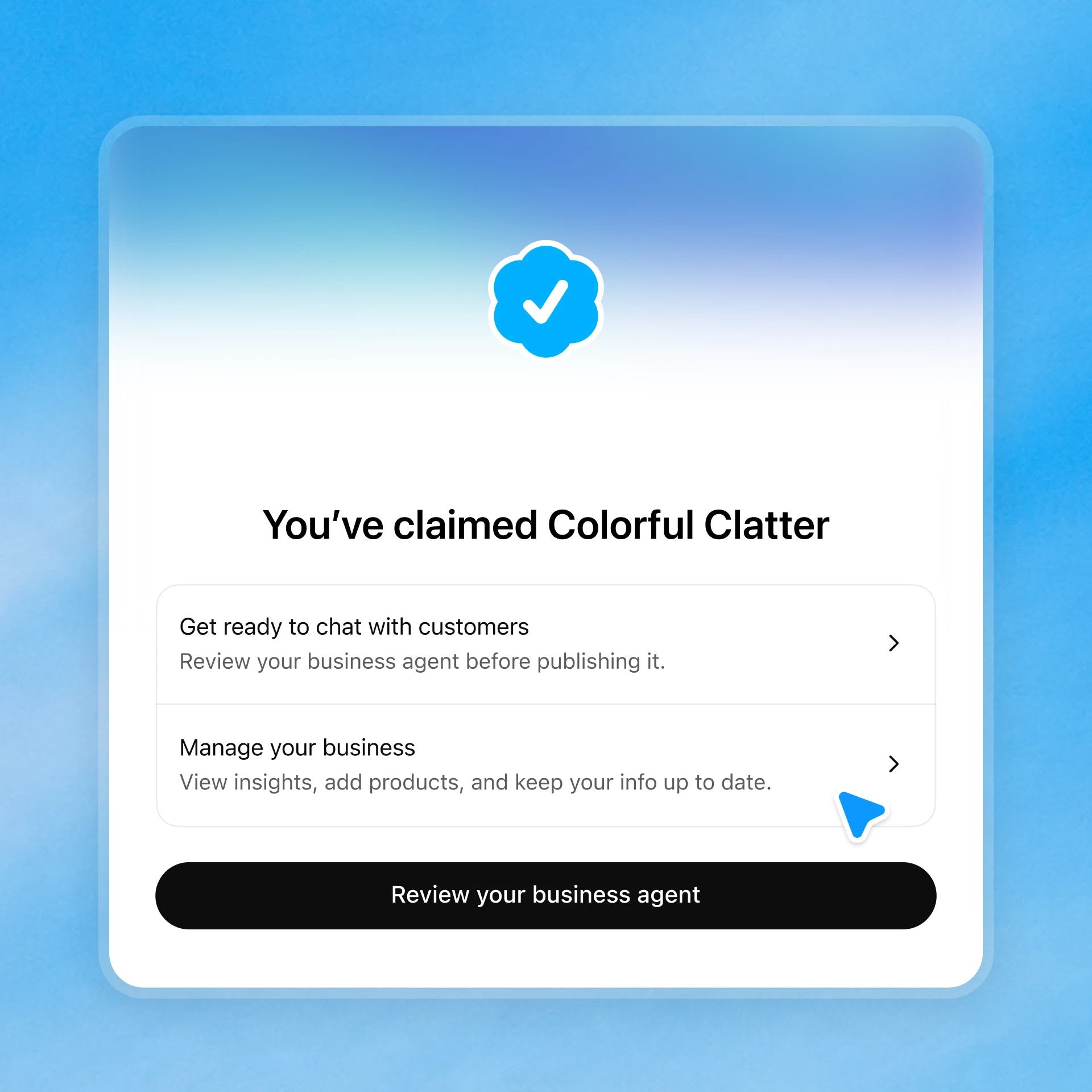
OpenAI’s example claiming screen prompts businesses to review their agent before publishing. Image: OpenAI. Source: OpenAI.
The Businesses in ChatGPT Terms qualify the promise that businesses can shape their presence. Claiming a listing does not confer exclusive control over its contents: OpenAI can supplement, edit or replace information from other sources, or decline submitted material. It may maintain a listing even after a business stops managing it. The display license for basic public business information is perpetual and irrevocable.
Businesses retain their rights in submitted data, but the terms make that data available for OpenAI’s development, provision and improvement of products and services, as well as its defined display uses. For product feeds, businesses must permit crawler and agent access to their websites under OpenAI’s documentation and, on request, help resolve feed discrepancies and integration problems. The terms also state that text and data mining opt-outs or similar reservations concerning businesses’ and their affiliates’ websites or submitted data will have no effect against OpenAI or its affiliates.
The terms also give OpenAI ownership of Insight Data and treat it as confidential. Businesses can use those insights to measure and improve their use of the service, but cannot sell them without OpenAI’s written authorization; access by service providers is limited to work on the business’s behalf under equivalent restrictions.
Businesses that enable or publish an agent are responsible for its content, configurations, testing, actions and outputs, including material they have not reviewed or approved. OpenAI does not warrant that an agent will always follow instructions or respond accurately and reserves the right to modify, suspend or remove it without notice.
The terms also require businesses to indemnify OpenAI for specified third-party claims involving their agents and contain broad waivers concerning supplied data and other online materials. The defined waiver excludes claims that OpenAI breached these terms.
There is an important privacy distinction between chat transcripts and authorized leads. The terms contemplate sharing contact information that users explicitly authorize through an agent. The Business Agents Policy bars sharing user information or submitting a form, booking or purchase without explicit authorization through an approved feature. It also requires agents to identify themselves as AI representing the business, rather than independent advisers or humans, and prohibits pressure tactics, false urgency, unnecessary sensitive-data collection and advice requiring a professional license.
Verification is not a blanket endorsement. The profile policy says OpenAI does not verify every detail or resolve every factual dispute, while the agent policy separately says business verification alone does not guarantee eligibility to publish an agent.
OpenAI plans to expand the tools to more markets and business categories and develop capabilities for organizations with more complex needs. It has not supplied a timetable for the broader agent rollout, and free access today is not a commitment to permanent free pricing.
For a business deciding whether to publish, free access still comes with work: maintaining accurate feeds, testing responses and accepting responsibility for outputs it may not have reviewed. OpenAI’s launch materials provide no figures for adoption, conversion rates or incremental sales from the new organic agents.
The next evidence needed is whether those conversations produce additional sales or useful leads at a cost businesses can justify, including that maintenance burden. OpenAI’s promises of independent recommendations and separation from paid promotion will also need to hold as the same agents gain both organic and sponsored distribution.
Alibaba’s Qwen4-Max preview gives developers a fixed model to test through November 25. API access requires Token Plan, while claimed coding gains remain unquantified in the launch materials.
Railway estimates stolen customer keys generated about $740,000 in unauthorized AI spending after an October intrusion. Secrets from up to about 100,000 workspaces could have been decrypted, and the company says it will cover losses providers decline to refund.
Anthropic expects retail investors worldwide to receive up to 20% of its IPO, potentially $12.9 billion at the proposed upper price. Access through six brokerage channels depends on demand and broker rules, while a separate technology-company investment would help finance vast infrastructure commitments and founders and a special trust retain control.
Anthropic's seven founders plan equal IPO share sales worth about $250 million each at the proposed midpoint. Their sales make up 2.9% of the public offering, while the company seeks much larger financing under a structure that limits public investors' voting influence.
Nvidia’s independent directors retained Wachtell Lipton partner Joon H. Kim for an investigation into reports of a foreign intelligence effort targeting co-founder and CEO Jensen Huang. The board previously expressed confidence in Huang; the appointment provides no findings or timetable.
RRE Ventures led the funding for Graphon’s enterprise memory infrastructure. The startup is pitching connected, persistent context across different agents, but benchmark gains leave deployment costs and commercial scale unresolved.
Goldman Sachs, a lead bank on Anthropic’s IPO, reportedly forecasts $685 billion in annual revenue by 2030. The Claude developer has substantial cash reserves and rapidly growing sales, but rising compute costs, competitive pricing and delivery risks complicate the enterprise growth case.
Memories Upload pays contributors for accepted first-person video and sells annotated data to robotics developers. Its million-hour collection claim leaves open how much footage improves robot performance, while contributors surrender ownership without royalties.
OpenAI has acquired AI travel concierge Odessia and is bringing its founder, former Sonder chief Francis Davidson, into its travel effort. The standalone service has closed, leaving its future role alongside ChatGPT’s existing travel partners unclear.
Anthropic says expected advances from future models have triggered its research-acceleration threshold. An outside assessment finds faster progress but does not certify compliance with that threshold, while the voluntary policy leaves consequential decisions about safeguards and continued development with the company.
Teleport has made Beams generally available with task-specific infrastructure permissions and a kill switch. Its access-security platform supplies an enterprise foothold, but established competitors and custom pricing for key controls complicate the buying decision.
New York will connect more than 80 researchers with Empire AI computing resources to evaluate advanced AI systems and advise state oversight, expanding a center first announced in January.
Anthropic’s amended IPO filing raises its Microsoft spending commitment while disclosing an exit right from a $34.9 billion Lambda agreement. Google’s larger commitment was already disclosed earlier, and expensive short-term computing continues to squeeze margins.
The cash deal would bring Oura’s existing AI and physician care partner under its ownership. The $159 annual integration already connects members to doctors, but geographic limits, extra service costs and unproven clinical benefits qualify the expansion.
Reddit is testing AI-organized review pages for roughly 10,000 products. The pages link back to users’ conversations, but lack purchase verification—a safeguard Amazon says it uses for its own AI review highlights.
The renamed MegaETH Foundation is funding its own products after an earlier shift away from its accelerator. Its December inference market must show how it improves on existing services that already route requests by price and reliability.
Cambridge startup Tendrils Compute has raised a Benchmark-led seed round to build processors based on interaction nets. Its backers see an opening in branching workloads, including AI agents, but theoretical parallelism has yet to establish a commercial hardware advantage.
Google and Artificial Analysis launched a 200-task test of AI agents working with visually dense professional files. Google's study finds close leading scores and sharply different API bills, as its new Carbon model reaches customers alongside the Argon alternative.
Google is widening paid access to Gemini 4 Carbon for complex coding, business and scientific work. Gemini API token rates double after November 30, while benchmark results show that its cost advantage depends on the task and reasoning setting.
MiniMax has released downloadable weights for H3-Image, a model combining image generation and editing at native 16-megapixel resolution. Local deployment offers an alternative to its paid API, but hardware demands and a restrictive community license qualify the promise of open access.