Editorial Team
8 min read
Goldman Sachs, a lead bank on Anthropic’s IPO, reportedly forecasts $685 billion in annual revenue by 2030. The Claude developer has substantial cash reserves and rapidly growing sales, but rising compute costs, competitive pricing and delivery risks complicate the enterprise growth case.
Goldman Sachs analysts reportedly forecast roughly $685 billion in annual revenue by 2030 for Anthropic, the AI developer behind the Claude assistant and Claude Code coding agent. The investment bank is helping lead Anthropic’s initial public offering, putting its growth forecast before investors being asked to fund a costly expansion at a targeted fully diluted valuation of about $1.4 trillion.
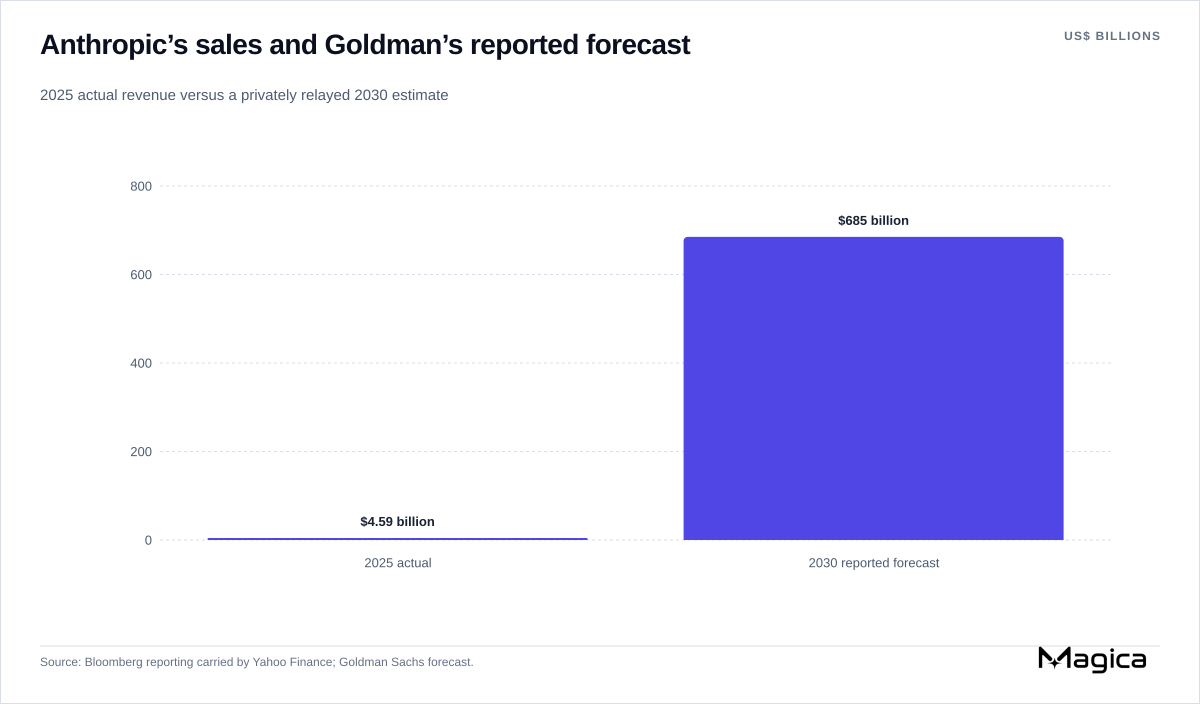
Goldman’s reported 2030 forecast compared with Anthropic’s 2025 revenue. Goldman is a lead IPO underwriter; the forecast is not company guidance. Chart: Magica. Source: Yahoo Finance.
The projection comes from a report citing an unidentified person familiar with the estimates, who described a verbal briefing. Goldman’s analysts expect $586 billion of enterprise revenue and roughly $100 billion from other customers in 2030. Those rounded components do not add exactly to the headline total; the enterprise estimate represents about 86% of $685 billion.
Goldman is a Wall Street investment bank and a lead underwriter alongside Morgan Stanley, according to the reported offering terms. Its role gives the forecast a commercial context: the bank is helping sell the transaction. Goldman and Anthropic declined to comment in the report describing the $685 billion estimate.
A separate account of forecasts discussed with a potential investor put 2030 revenue above $600 billion, following about $52 billion in 2026, $136 billion in 2027 and $442 billion in 2029. These accounts describe privately relayed forecasts, rather than a published model with a full set of assumptions. The $685 billion endpoint would be nearly 150 times Anthropic’s $4.585 billion of actual 2025 revenue.
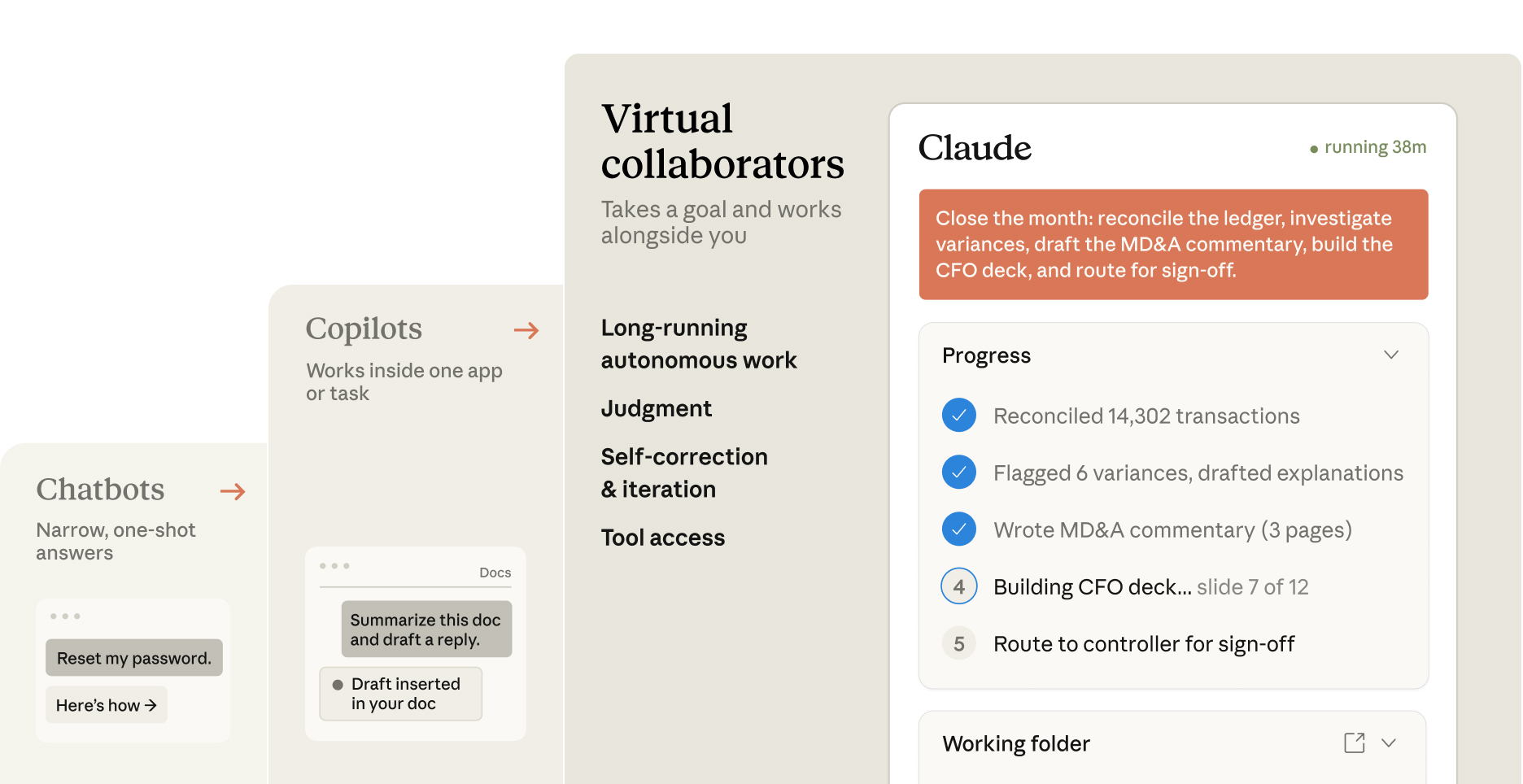
Company-reported product vision: Anthropic’s IPO illustration contrasts chatbots, copilots and virtual collaborators. The financial workflow is illustrative. Source: Anthropic IPO registration statement.
Anthropic was founded in January 2021 by AI researchers, including former staff of rival AI developer OpenAI. Its IPO registration statement dates Claude’s commercial launch to the first quarter of 2023. It now sells access to its AI models through a developer platform and applications, charging through usage fees, subscriptions or both. A growing number of enterprise customers agree to annual or multiyear minimum spending commitments.
Claude Code, introduced as a research preview in February 2025, can plan, write, test and debug software. Anthropic has already extended beyond coding with Claude Cowork, a workplace agent introduced as a research preview in January 2026 that performs multistep desktop tasks. The company’s expansion into broader office work is therefore already under way; the scale of future demand remains uncertain.
As of September 30, more than 1,900 customers had each generated at least $1 million in trailing-12-month revenue, including approximately 250 generating at least $10 million each, Anthropic says in the filing. Its reported financial results also show a business growing faster than its compute expense:
| Reported measure | Nine months ended Sept. 30, 2025 | Nine months ended Sept. 30, 2026 |
|---|---|---|
| Revenue | $2.55 billion | $33.24 billion |
| Compute and infrastructure expense | $4.38 billion | $18.81 billion |
| Operating loss | $5.22 billion | $1.26 billion |
| Operating cash flow | −$2.02 billion | $6.57 billion |
The figures are from the filing and cover matching nine-month periods. Compute and infrastructure expense includes research, model development, customer-serving workloads and internal usage, so it is broader than the cost of serving customers alone.
Accounting losses are a separate measure. Anthropic reported a $104 billion nine-month net loss, dominated by fair-value changes in convertible financing as its valuation increased. That is not $104 billion of cash consumption. Its $1.26 billion operating loss for the same period also differs from the $4.1 billion of adjusted operating income reported after excluding stock compensation and noncash charitable contributions.
Anthropic’s $81 billion October revenue run rate measures something different. The filing defines it as trailing-28-day consumption fees multiplied by 13, plus current monthly subscription fees multiplied by 12. It annualizes recent activity; it is neither revenue already earned over a year nor Goldman’s full-year sales forecast.
The filing identifies AI developers Google and OpenAI as primary rivals for developers and enterprises. It also warns that models with publicly available weights can compete for workloads prioritizing cost, while larger technology companies can bundle AI into existing products or subsidize prices. Enterprise spending on AI does not automatically become Anthropic revenue.
Anthropic says in the filing that price reductions accompanying new model versions and contractual discounts offset approximately $600 million of the revenue increase from higher usage between the second and third quarters of 2026.
There is also a qualification to its current sales base: Anthropic estimates that 5%–7% of revenue in the first nine months came from customers it subsequently determined were violating its usage policy or commercial terms. It expects that proportion to decline following stronger enforcement, although the effect on revenue growth is uncertain.
The cost picture changed within the year. Third-quarter revenue reached $17 billion, while compute and infrastructure expense reached $9.9 billion, or 58% of revenue, up from 48% in the second quarter. Anthropic attributes the higher share to additional compute coming online. The quarter included $5 billion of compute under short-term commitments that it says currently cost significantly more than comparable capacity under multiyear agreements.
The company typically procures compute 12–18 months before availability, making those expenses largely fixed in the near term. It warns that electrical equipment shortages, power availability, permitting and partners’ financing constraints can delay or raise the cost of capacity. Signing a contract does not mean the infrastructure is ready to serve customers.
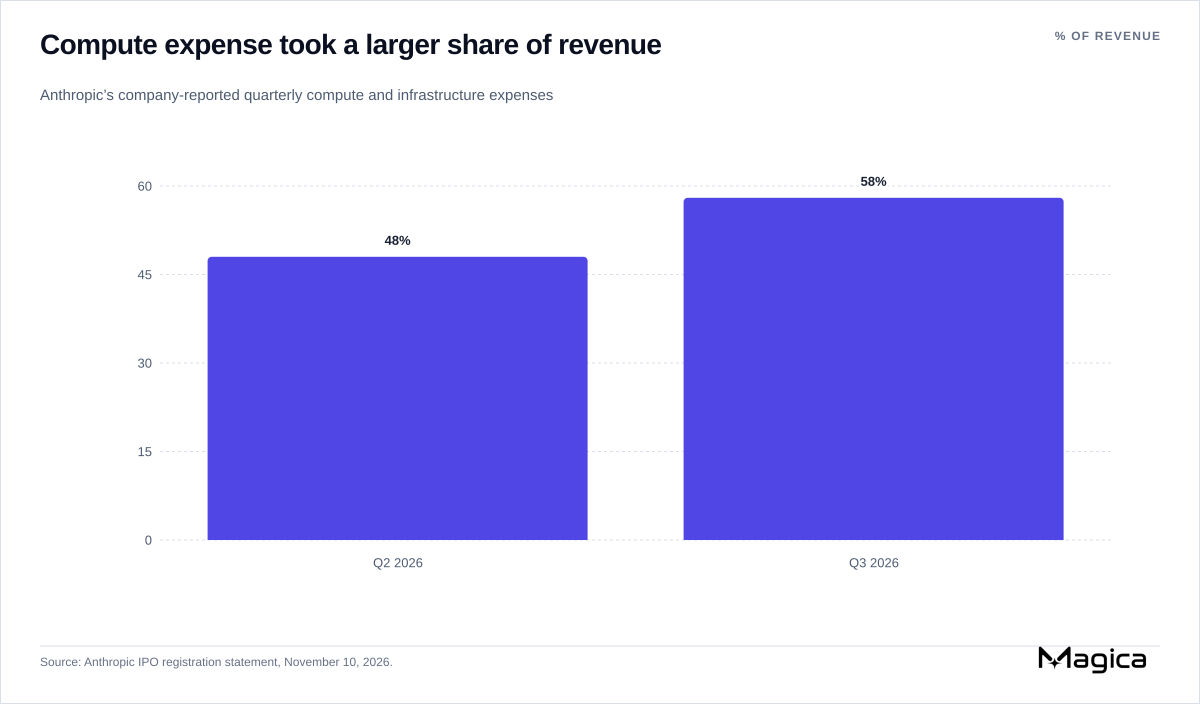
Company-reported compute and infrastructure expenses rose from 48% of revenue in Q2 to 58% in Q3 2026. Expenses include research, model development and internal usage. Chart: Magica. Source: Anthropic IPO registration statement.
Anthropic is approaching the offering with substantial resources. Its filing shows that at September 30 it held $95.6 billion in cash and equivalents and $36.3 billion in short-term investments—a combined $131.9 billion. The filing says its existing liquidity, sales receipts and credit facility should support its requirements for at least 12 months from the prospectus date, while warning that future investment could require additional financing sooner than anticipated.
That cushion belongs alongside its roughly $900.9 billion in aggregate commitments, substantially all for compute and infrastructure. About $451.6 billion is expected before the end of 2030, according to coverage of the filing. These are multiyear obligations, rather than one year’s expense or an immediate cash bill.
The filing adds important qualifications. Approximately $186.2 billion of the aggregate relates to arrangements subject to termination rights or contingent conditions before commencement. Separately, Anthropic estimates $150 billion–$175 billion of payments under other compute arrangements without fixed dollar commitments, excluded from the $900.9 billion total. Their eventual cost depends on capacity, delivery and pricing conditions. About $70.7 billion of aggregate obligations is expected in the 12 months after September 30, including $4.2 billion subject to such conditions or termination rights.
Suppliers can also be investors and competitors. Google has agreed to buy $10 billion of shares within the concurrent $26 billion private placement, the filing says. Anthropic separately committed to spend at least approximately $121.3 billion with Google between April 2026 and July 2033 regardless of actual usage, subject to specified contractual exceptions. Anthropic warns that overlapping funding, supply and competitive relationships can create conflicts over compute access, costs and workload priority.
Goldman reportedly expects compute-infrastructure spending to rise more than tenfold to nearly $400 billion by the decade’s end. The same account forecasts a similar increase in compute profit, a measure the report does not define.
Even so, the bank projects positive annual free cash flow only in 2030, at $33.6 billion. The reported cash-flow path includes a $12.8 billion outflow in the fourth quarter of 2026 and $65.7 billion in 2027, despite positive free cash flow in the first nine months of 2026. It also projects operating losses peaking at $40.4 billion in 2027, operating profitability in 2029 and $65.2 billion of operating profit in 2030.
The proposed offering comprises 825 million shares at $70–$78 each, for a planned Nasdaq listing under the symbol ANT. Anthropic would sell about 801.35 million, with existing stockholders selling the balance. The public offering and private placement could total roughly $90.4 billion at the high end; the filing estimates Anthropic itself would receive $84.6 billion net at the $74 midpoint, before any exercise of the underwriters’ additional-share option. The figures differ because of pricing assumptions, selling shareholders and transaction costs.
Buying shares also brings limited control. Anthropic is a public benefit corporation whose board must balance shareholder interests with its public purpose of responsible AI development and those affected by its conduct. A financially disinterested Long-Term Benefit Trust generally can elect and remove a majority of authorized directors. A founders’ entity will hold 50.1% of voting power on matters submitted to shareholders generally, including elections of directors not chosen by the trust.
The IPO is scheduled to price November 18 and begin trading the following day, according to the reported deal timetable. The price and timetable remain prospective. Investors’ next decision is what to pay for this growth path; subsequent results must show whether usage can absorb newly delivered capacity at sustainable prices and turn the present cash cushion into durable cash generation.
Alibaba’s Qwen4-Max preview gives developers a fixed model to test through November 25. API access requires Token Plan, while claimed coding gains remain unquantified in the launch materials.
Railway estimates stolen customer keys generated about $740,000 in unauthorized AI spending after an October intrusion. Secrets from up to about 100,000 workspaces could have been decrypted, and the company says it will cover losses providers decline to refund.
Anthropic expects retail investors worldwide to receive up to 20% of its IPO, potentially $12.9 billion at the proposed upper price. Access through six brokerage channels depends on demand and broker rules, while a separate technology-company investment would help finance vast infrastructure commitments and founders and a special trust retain control.
Anthropic's seven founders plan equal IPO share sales worth about $250 million each at the proposed midpoint. Their sales make up 2.9% of the public offering, while the company seeks much larger financing under a structure that limits public investors' voting influence.
Nvidia’s independent directors retained Wachtell Lipton partner Joon H. Kim for an investigation into reports of a foreign intelligence effort targeting co-founder and CEO Jensen Huang. The board previously expressed confidence in Huang; the appointment provides no findings or timetable.
RRE Ventures led the funding for Graphon’s enterprise memory infrastructure. The startup is pitching connected, persistent context across different agents, but benchmark gains leave deployment costs and commercial scale unresolved.
Memories Upload pays contributors for accepted first-person video and sells annotated data to robotics developers. Its million-hour collection claim leaves open how much footage improves robot performance, while contributors surrender ownership without royalties.
OpenAI has acquired AI travel concierge Odessia and is bringing its founder, former Sonder chief Francis Davidson, into its travel effort. The standalone service has closed, leaving its future role alongside ChatGPT’s existing travel partners unclear.
Anthropic says expected advances from future models have triggered its research-acceleration threshold. An outside assessment finds faster progress but does not certify compliance with that threshold, while the voluntary policy leaves consequential decisions about safeguards and continued development with the company.
OpenAI’s free business-profile beta adds branded agents for eligible U.S. ecommerce and online service firms. The agents can also serve as paid-ad destinations, while OpenAI controls distribution and businesses bear responsibility for outputs.
Teleport has made Beams generally available with task-specific infrastructure permissions and a kill switch. Its access-security platform supplies an enterprise foothold, but established competitors and custom pricing for key controls complicate the buying decision.
New York will connect more than 80 researchers with Empire AI computing resources to evaluate advanced AI systems and advise state oversight, expanding a center first announced in January.
Anthropic’s amended IPO filing raises its Microsoft spending commitment while disclosing an exit right from a $34.9 billion Lambda agreement. Google’s larger commitment was already disclosed earlier, and expensive short-term computing continues to squeeze margins.
The cash deal would bring Oura’s existing AI and physician care partner under its ownership. The $159 annual integration already connects members to doctors, but geographic limits, extra service costs and unproven clinical benefits qualify the expansion.
Reddit is testing AI-organized review pages for roughly 10,000 products. The pages link back to users’ conversations, but lack purchase verification—a safeguard Amazon says it uses for its own AI review highlights.
The renamed MegaETH Foundation is funding its own products after an earlier shift away from its accelerator. Its December inference market must show how it improves on existing services that already route requests by price and reliability.
Cambridge startup Tendrils Compute has raised a Benchmark-led seed round to build processors based on interaction nets. Its backers see an opening in branching workloads, including AI agents, but theoretical parallelism has yet to establish a commercial hardware advantage.
Google and Artificial Analysis launched a 200-task test of AI agents working with visually dense professional files. Google's study finds close leading scores and sharply different API bills, as its new Carbon model reaches customers alongside the Argon alternative.
Google is widening paid access to Gemini 4 Carbon for complex coding, business and scientific work. Gemini API token rates double after November 30, while benchmark results show that its cost advantage depends on the task and reasoning setting.
MiniMax has released downloadable weights for H3-Image, a model combining image generation and editing at native 16-megapixel resolution. Local deployment offers an alternative to its paid API, but hardware demands and a restrictive community license qualify the promise of open access.