Editorial Team
8 min read
Anthropic expects retail investors worldwide to receive up to 20% of its IPO, potentially $12.9 billion at the proposed upper price. Access through six brokerage channels depends on demand and broker rules, while a separate technology-company investment would help finance vast infrastructure commitments and founders and a special trust retain control.
Anthropic, the artificial intelligence research and product company behind the Claude assistant and models, expects retail investors to receive up to 20% of its initial public offering, according to its November 10 amended prospectus. That could put about $12.9 billion of the base offering into individual investors' hands at the proposed upper price, with access through brokers including Robinhood, Charles Schwab and Fidelity.
Founded in 2021, Anthropic commercially launched Claude in early 2023 and sells access to AI through its models, platform and applications, with an emphasis on business customers. It is led by co-founder and chief executive Dario Amodei, previously vice president of research at rival AI lab OpenAI. The company has applied to list on the Nasdaq exchange under ANT.
The offering would open public ownership of that business at a reported proposed valuation reaching $1.404 trillion on a fully diluted basis. But the retail percentage is an expectation subject to demand, and the shares offer limited influence over a company raising money for infrastructure obligations extending into 2045.
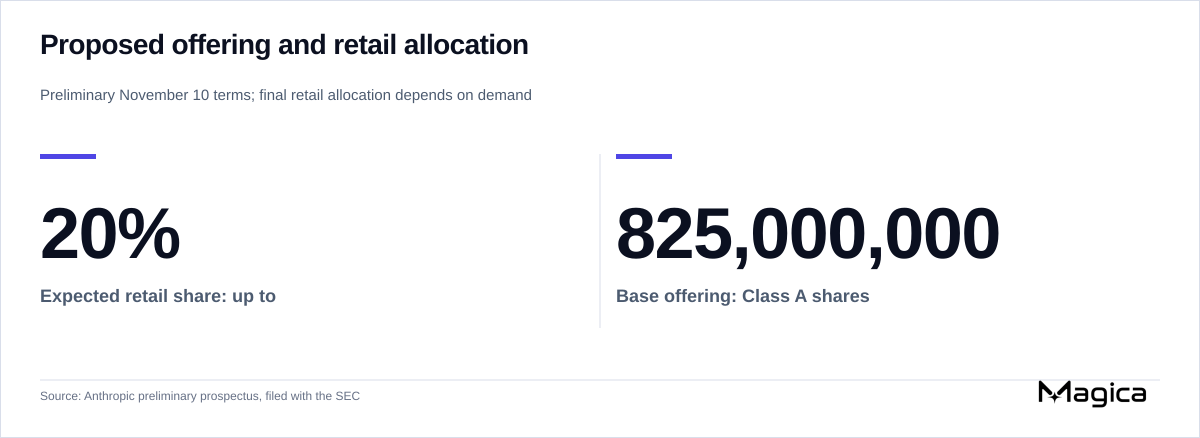
Anthropic's company-reported preliminary terms propose 825 million Class A shares, with up to 20% expected for retail investors worldwide, subject to demand. Source: Anthropic / SEC.
Anthropic plans to offer 825 million Class A shares at an estimated $70 to $78 each, giving the base sale a gross value of $57.75 billion to $64.35 billion. Applying the full 20% retail share produces 165 million shares, worth $11.55 billion at $70 or $12.87 billion at $78. These are conditional calculations, excluding the underwriters' option to buy another 123.75 million shares, rather than a finalized price or guaranteed allocation.
The filing says the retail expectation includes investors in the United States and other countries and that final amounts will depend on actual demand. It encompasses allocations by underwriters as well as purchases through six named brokerage channels: Charles Schwab, Fidelity, Robinhood, Trade-PMR, SoFi and E*TRADE from Morgan Stanley.
Those platforms will act as selling group members, distributing shares at the IPO price under their own terms and requirements. The filing does not disclose how many shares each will receive. E*TRADE is affiliated with Morgan Stanley, one of the lead underwriters; the platforms are not affiliated with Anthropic.
Retail access at the offer price has precedent. Robinhood, the brokerage platform now participating in Anthropic's distribution, said in its July 2021 IPO prospectus that it expected underwriters to reserve approximately 20% to 35% of its own offering for customers through its broker-dealer subsidiary and IPO Access feature. That was an expected reservation through one affiliated channel, whereas Anthropic's figure covers aggregate retail allocations worldwide. The percentages alone do not establish that Anthropic's distribution is unprecedented.
Fidelity's participation guide shows how access can narrow at the broker level. Customers with at least $25,000 in certain Fidelity assets may be eligible. Requests start at 25 shares, rise in 25-share increments and can reach one million shares. Customers may nevertheless receive fewer shares than requested or none, depending on demand and the shares Fidelity receives.
Fidelity says its usual tiering methodology ranks participating customers by the assets and revenue associated with their relationship across accounts under their Social Security or taxpayer identification number. Requesting more shares does not improve that ranking, and the broker will not allocate more than requested. Its rules therefore make the size of the customer relationship relevant to allocation priority.
Customers who receive shares must fund the purchase by settlement, usually the next business day. Fidelity also treats sales within the first 15 calendar days as flipping and says repeated flipping can restrict participation in future IPOs. These are Fidelity's policies, not universal conditions for Anthropic's offering.
At the proposed $78 upper price, the offering implies a $1.404 trillion fully diluted valuation, according to the report on the amended terms. That compares with a reported $965 billion valuation in Anthropic's May private fundraising round, although private-round and public-offering valuations are not necessarily calculated on identical bases. It is also below the $2 trillion valuation the report says Anthropic was previously targeting.
Most of the IPO would raise capital for Anthropic: the company will sell approximately 801.35 million shares, while existing shareholders will sell approximately 23.65 million. The seven co-founders each plan to sell nearly 3.4 million shares, worth about $250 million apiece at the $74 midpoint. Proceeds from those shareholder sales go to the sellers.
Separately, Anthropic has agreements to sell $26 billion of non-voting Class N shares at the IPO price to seven technology companies, subject to closing conditions. Google and Nvidia would invest $10 billion each; both also provide chip technology Anthropic uses to train and serve Claude. At the $74 midpoint, the filing estimates combined net proceeds to Anthropic from the IPO and private placement of $84.6 billion, or $93.7 billion if underwriters exercise their additional-share option in full. Those estimates deduct offering costs and exclude selling shareholders' proceeds; they are not the size of the retail pool.
The company says the money will support general corporate purposes, including compute and infrastructure investment. Investors would finance that expansion within a structure that limits their authority. Anthropic is a Delaware public benefit corporation, required to balance shareholders' financial interests with those of people materially affected by its conduct and its stated purpose of developing advanced AI responsibly for humanity's long-term benefit.
Class A shares carry one vote each. A founders' limited liability company will hold a special Class F share carrying 50.1% of voting power on matters submitted to stockholders generally, including election of directors outside the trust's designated seats. Separately, the Long-Term Benefit Trust, an independent body of financially disinterested trustees, generally has authority to elect and remove a board majority. Founder liquidity and broader public ownership would therefore coexist with retained governance powers.
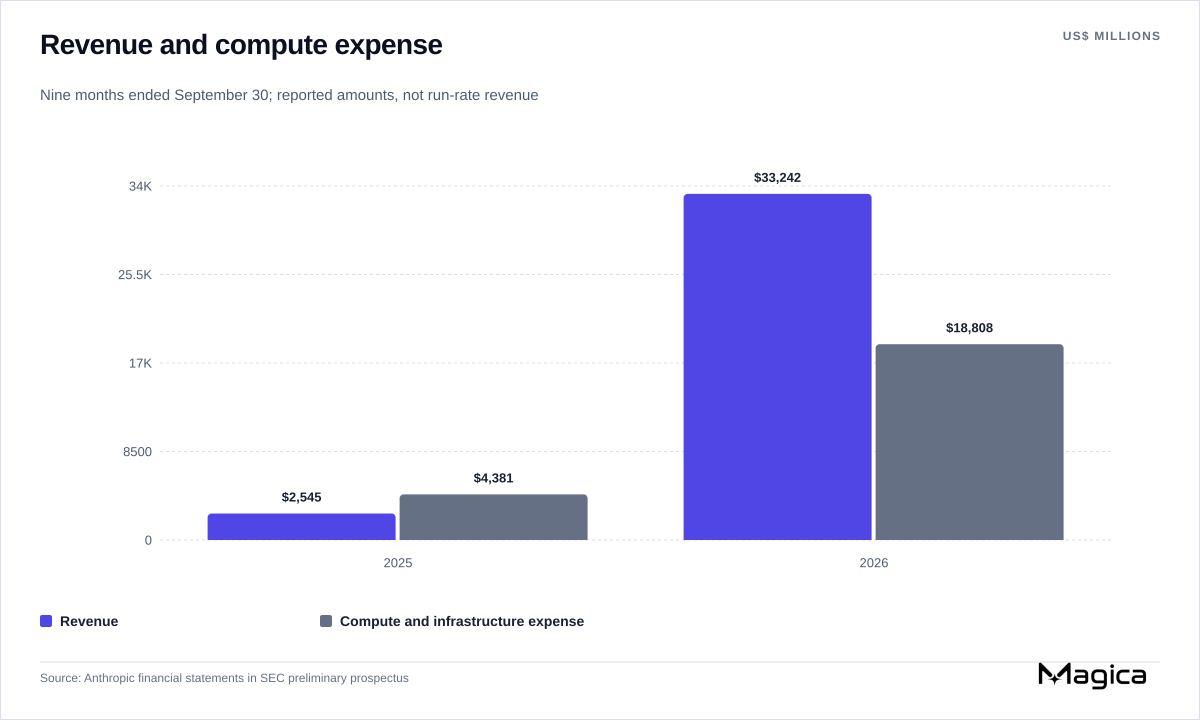
Company-reported revenue and compute and infrastructure expense for comparable nine-month periods. The gap is not operating profit; future infrastructure commitments are excluded. Source: Anthropic. Source: Anthropic / SEC.
The filing's financial statements show rapid growth and a narrowing operating loss. The comparable nine-month periods also show the increase in recognized compute and infrastructure expense.
| Reported result | Nine months ended September 30, 2025 | Nine months ended September 30, 2026 |
|---|---|---|
| Revenue | $2.545 billion | $33.242 billion |
| Compute and infrastructure expense | $4.381 billion | $18.808 billion |
| Operating loss | $5.224 billion | $1.260 billion |
For a more current measure, Anthropic reported approximately $81 billion in run-rate revenue at October 31, up $10 billion from September 30. This company-defined metric annualizes trailing 28-day consumption fees by multiplying them by 13, then adds monthly subscription fees multiplied by 12. It is an estimate of the annualized value of activity at that date, not booked annual revenue or a forecast.
The nine-month net loss was much larger at $104.039 billion, including $94.324 billion of fair-value losses on convertible notes, derivative liabilities and simple agreements for future equity. The filing says those valuation changes were primarily driven by increases in Anthropic's enterprise valuation. They should not be read as cash consumed by operating the business: operating activities generated $6.569 billion in cash during the period, while investing activities used $36.546 billion.
Anthropic had $131.9 billion in cash and short-term investments at September 30. Its roughly $900.9 billion of commitments, substantially all for compute and infrastructure, stretch over many years. Approximately $70.7 billion is due in the following 12 months and $451.6 billion is expected before the end of 2030, with substantially all the remainder expected between 2031 and 2045.
Those obligations have important qualifications. About $186.2 billion involves arrangements subject to termination rights or conditions before commencement. The total also excludes arrangements without fixed dollar commitments, for which Anthropic estimates payments of another $150 billion to $175 billion, dependent on capacity, delivery, pricing and deployment conditions.
Capital alone does not resolve the delivery problem. Anthropic says it has consistently operated with customer demand exceeding available compute, and warns that power availability and suppliers' financing can constrain data-center development. It also identifies Google and OpenAI as primary frontier-model competitors and open-weight or open-source models as alternatives for workloads that prioritize cost efficiency. Google thus appears on both sides of the financing story: a major prospective investor and a direct competitor. The filing warns that rivals can bundle AI into existing products or subsidize prices, putting pressure on the revenue needed to support Anthropic's commitments.
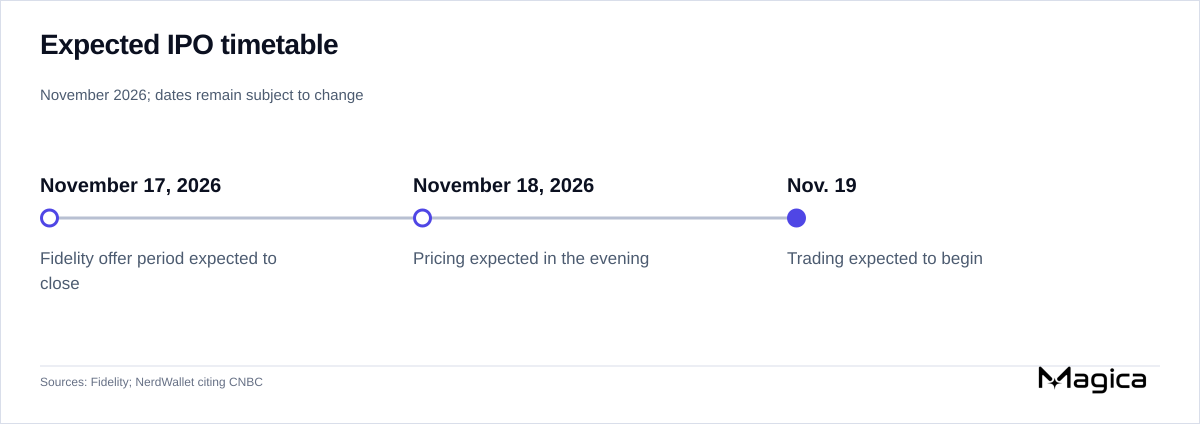
Fidelity's company-reported offer deadline is November 17 at 4 p.m. Eastern, with pricing expected November 18 evening. Trading is expected November 19, according to NerdWallet citing CNBC. Dates may change. Source: Fidelity.
Fidelity expects its offer period to close November 17 at 4 p.m. Eastern, with registration effectiveness and pricing expected on the evening of November 18. Customers must then confirm their indications of interest to remain eligible for allocation; confirmation converts the indication into an order at the offer price but does not guarantee shares. A guide to the offering, citing CNBC reporting based on IPO insiders, puts the expected trading debut on November 19.
The final price, actual retail share and allocation across brokers will determine how much of the proposed access becomes stock ownership. For investors receiving shares, subsequent results will test whether revenue growth and improved compute efficiency can support infrastructure payments while competitors challenge pricing. The IPO would supply capital for that effort; it would leave the underlying execution risk with shareholders.
Alibaba’s Qwen4-Max preview gives developers a fixed model to test through November 25. API access requires Token Plan, while claimed coding gains remain unquantified in the launch materials.
Railway estimates stolen customer keys generated about $740,000 in unauthorized AI spending after an October intrusion. Secrets from up to about 100,000 workspaces could have been decrypted, and the company says it will cover losses providers decline to refund.
Anthropic's seven founders plan equal IPO share sales worth about $250 million each at the proposed midpoint. Their sales make up 2.9% of the public offering, while the company seeks much larger financing under a structure that limits public investors' voting influence.
Nvidia’s independent directors retained Wachtell Lipton partner Joon H. Kim for an investigation into reports of a foreign intelligence effort targeting co-founder and CEO Jensen Huang. The board previously expressed confidence in Huang; the appointment provides no findings or timetable.
RRE Ventures led the funding for Graphon’s enterprise memory infrastructure. The startup is pitching connected, persistent context across different agents, but benchmark gains leave deployment costs and commercial scale unresolved.
Goldman Sachs, a lead bank on Anthropic’s IPO, reportedly forecasts $685 billion in annual revenue by 2030. The Claude developer has substantial cash reserves and rapidly growing sales, but rising compute costs, competitive pricing and delivery risks complicate the enterprise growth case.
Memories Upload pays contributors for accepted first-person video and sells annotated data to robotics developers. Its million-hour collection claim leaves open how much footage improves robot performance, while contributors surrender ownership without royalties.
OpenAI has acquired AI travel concierge Odessia and is bringing its founder, former Sonder chief Francis Davidson, into its travel effort. The standalone service has closed, leaving its future role alongside ChatGPT’s existing travel partners unclear.
Anthropic says expected advances from future models have triggered its research-acceleration threshold. An outside assessment finds faster progress but does not certify compliance with that threshold, while the voluntary policy leaves consequential decisions about safeguards and continued development with the company.
OpenAI’s free business-profile beta adds branded agents for eligible U.S. ecommerce and online service firms. The agents can also serve as paid-ad destinations, while OpenAI controls distribution and businesses bear responsibility for outputs.
Teleport has made Beams generally available with task-specific infrastructure permissions and a kill switch. Its access-security platform supplies an enterprise foothold, but established competitors and custom pricing for key controls complicate the buying decision.
New York will connect more than 80 researchers with Empire AI computing resources to evaluate advanced AI systems and advise state oversight, expanding a center first announced in January.
Anthropic’s amended IPO filing raises its Microsoft spending commitment while disclosing an exit right from a $34.9 billion Lambda agreement. Google’s larger commitment was already disclosed earlier, and expensive short-term computing continues to squeeze margins.
The cash deal would bring Oura’s existing AI and physician care partner under its ownership. The $159 annual integration already connects members to doctors, but geographic limits, extra service costs and unproven clinical benefits qualify the expansion.
Reddit is testing AI-organized review pages for roughly 10,000 products. The pages link back to users’ conversations, but lack purchase verification—a safeguard Amazon says it uses for its own AI review highlights.
The renamed MegaETH Foundation is funding its own products after an earlier shift away from its accelerator. Its December inference market must show how it improves on existing services that already route requests by price and reliability.
Cambridge startup Tendrils Compute has raised a Benchmark-led seed round to build processors based on interaction nets. Its backers see an opening in branching workloads, including AI agents, but theoretical parallelism has yet to establish a commercial hardware advantage.
Google and Artificial Analysis launched a 200-task test of AI agents working with visually dense professional files. Google's study finds close leading scores and sharply different API bills, as its new Carbon model reaches customers alongside the Argon alternative.
Google is widening paid access to Gemini 4 Carbon for complex coding, business and scientific work. Gemini API token rates double after November 30, while benchmark results show that its cost advantage depends on the task and reasoning setting.
MiniMax has released downloadable weights for H3-Image, a model combining image generation and editing at native 16-megapixel resolution. Local deployment offers an alternative to its paid API, but hardware demands and a restrictive community license qualify the promise of open access.