Editorial Team
4 min read
U.S. cyber agencies allege that six China-based AI companies used large-scale querying to extract proprietary capabilities from American frontier models. Beijing calls the accusation groundless, leaving the technical evidence and the companies’ responses as the central unresolved issues.
China has rejected U.S. allegations that China-based AI companies used industrial-scale knowledge distillation to extract proprietary capabilities from American frontier models. The U.S. claims come from a joint advisory by the Cybersecurity and Infrastructure Security Agency, the National Security Agency and the FBI; they are allegations, not a public adjudication.
The dispute is consequential because it is about both a commonplace machine-learning technique and the terms on which model outputs can be used. CISA, the U.S. agency that describes itself as the nation’s cyber-defense agency and coordinator for critical-infrastructure security, says a less capable model can learn from a stronger model’s outputs through distillation. It also says that method can be misused to obtain a competitor’s capabilities more quickly and cheaply than developing them independently.
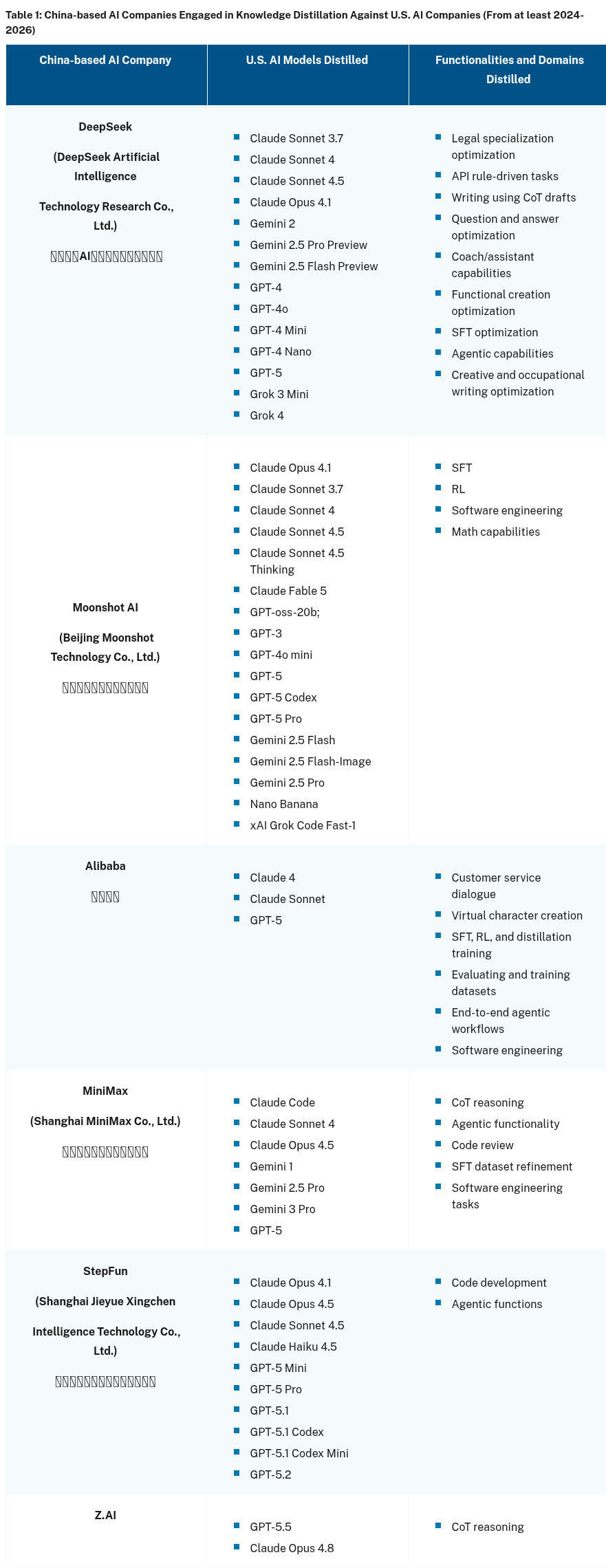
CISA’s advisory lists six China-based AI companies, named U.S. models and alleged functional areas. Source: www.cisa.gov.
In its September 8 release, CISA said the three agencies believe DeepSeek, Moonshot AI, Alibaba, MiniMax, StepFun and Z.AI extracted billions of tokens through millions of exchanges or requests from variants of Anthropic’s Claude, OpenAI’s GPT, Google’s Gemini and xAI’s Grok since at least late 2024. The agencies said this occurred likely with Chinese government awareness.
The release alleges that the companies violated providers’ terms of service, rather than merely using a conventional training method. It says the campaigns shortened research and development and undermined fair competition. That framing matters: the asserted problem is allegedly unauthorized access to model outputs, not distillation in the abstract.
Five technology groups have accumulated an estimated $3.2 trillion in future purchase and lease commitments. Filings show the funding pressure, but broad spending categories, long payment schedules and a methodology change limit what the total says about AI debt and growth.
The public release names the companies and describes the alleged scale, but its claims have not been tested in a public proceeding. The material provided does not include a response from the named companies to the agencies’ account; one report says Moonshot AI declined to comment and that the other companies contacted did not immediately respond.
China’s Commerce Ministry, as described in the report, called the U.S. allegations groundless. It said distillation is used by AI companies worldwide and characterized U.S. action against Chinese companies over the practice as an attempt to monopolize the industry; it warned of countermeasures if Chinese firms were suppressed on that basis.
Mao Ning, a spokesperson for China’s Foreign Ministry, gave the government’s separate response at a regular briefing. In the ministry’s transcript, Mao said China’s AI development reflected technological self-reliance and strength, urged the United States to stop what she called false accusations and smears, and said the two countries should cooperate on AI.
Those responses challenge the accusation’s characterization and policy implications. They do not, in the retained statements, address the agencies’ specific assertions about the number of requests, the alleged access patterns or the named providers’ terms of service.
The advisory does not announce a sanction or a technical remedy that settles the dispute. It recommends that U.S. frontier-model providers take three steps:
These measures would make API access, account-sharing and unusually high-volume querying part of model-security operations. They also place the issue in a competitive setting: if the allegations are substantiated, the claimed shortcut would concern not simply an AI research technique but access to the outputs of the most capable commercial systems.
The next question is whether the allegations can be independently examined. That would require more evidence connecting the claimed volumes and request patterns to the named companies, as well as substantive responses from those companies.
China has made clear that it views the accusation as an industrial-policy dispute as well as a security allegation. The agencies have made clear that they want providers to change their defenses now. Neither position, on the retained record, resolves the central factual issue: whether the alleged campaigns occurred as described.
PwC finds growth in a subset of AI-exposed junior job postings demanding senior skills, alongside pressure on entry-level opportunities. Workplace research suggests AI can support learning, but leaves employers to demonstrate how recruits acquire independent expertise.
CoreWeave bonds fell after the election of candidates favoring data center restrictions. Texas governor-elect Gina Hinojosa wants to extend an existing approvals pause until lawmakers pass protections, adding delivery uncertainty for an industry whose expansion depends on power and financing.

Walmart plans new permissions and a gateway for outside shopping agents, while Amazon blocks unauthorized tools and sells ads through its own assistant. The stakes are product discovery, customer data and whether delegated purchases add sales or displace advertising opportunities.
Apple reportedly cut some engineers’ daily AI allowances from $300 to $200 in October and is weighing deeper restrictions. The limits tighten control over model use, but unused allowances make the savings uncertain.
Factory is acquiring coding-agent collaboration platform HumanLayer after raising $200 million in September. It plans to integrate shared tasks and planning tools, while HumanLayer promises open source, refunds and at least 30 days of continued service.
A minister identifies Google-commissioned research behind the action plan’s £400 billion AI claim. The government’s central estimate is £120 billion, but different methods and adoption assumptions prevent a straightforward forecast-cut comparison.
Research has separated language models’ detection of altered internal activity from their ability to identify its content. Mechanistic studies and skeptical controls leave the interpretation disputed—and one intervention that improved detection made other measures of self-knowledge worse.
The IEA maps 134 policies governing data-center integration, arguing that credible project queues, coordinated tariffs and flexible connections can protect consumers while accommodating AI growth. Many measures remain too new to judge.
Three watchdog groups seek to halt Project Meridian, alleging that its contractor-heavy membership and closed meetings violate federal advisory committee law. MITRE’s invitation for outside ideas complicates the dispute over public participation.
Meta is seeking up to €9 billion in its first euro bond sale, drawing record orders while offering wider spreads than Alphabet. Its advertising business and large liquid reserves cushion an AI investment push that has overtaken quarterly operating cash flow.
Pangram is expanding its text-detection business into images and video. Browser checks and developer access broaden its reach, while company benchmark scores leave real-world error rates and costs unresolved.
About two dozen restrictive data center measures appeared to pass in initial returns. Texas governor-elect Gina Hinojosa’s promised construction pause adds a state-level constraint, though the capacity ultimately delayed remains uncertain.
Riot Platforms says its 15-year Corsicana lease with Anthropic will generate about $28 billion in revenue. The tenant owns and operates the compute, while Riot develops power infrastructure and funds module reimbursements through debt or credits against future rent.
Sonos plans limited U.S. early access for its conversational assistant, with a reported November 6 start. Users can return to older voice controls—a choice that also separates local audio processing from the new assistant’s cloud processing.
Tesla, SpaceX and AI infrastructure shares fell after Democratic election wins, while broader stocks rallied. Texas governor-elect Gina Hinojosa’s proposed data center pause puts a major construction pipeline in focus, but Republicans retain control of the Texas Legislature and federal agencies.
Capital One Ventures leads Sentra’s $150 million Series C and gains a board seat as the company expands AI-agent data controls. Sentra reports roughly 100 major enterprise customers and revenue in the tens of millions, but exact revenue, valuation and comparative costs remain undisclosed.
Google agreed to support Anthropic’s lease obligations at TeraWulf’s Kentucky campus, strengthening its bid for project financing. The support starts after delivery milestones, while debt terms and a guaranteed construction price remain unsettled.
OpenAI plans to acquire Pierre Computer and integrate its Code Storage service into Codex. The purchase would extend an existing supplier relationship into code infrastructure, but its terms, customer economics and relationship to OpenAI’s own Pando system remain unresolved.
OpenAI says India leads ChatGPT’s markets by weekly active users. Earlier free offers, strong app engagement and planned enterprise deployments explain the stakes, but the company has not disclosed comparable paid-user or revenue figures.