Editorial Team
6 min read
Twenty-five Fields Medal recipients say the race to announce AI solutions to famous problems risks rewarding priority over explanation, attribution and the work that makes a result usable. Their warning follows OpenAI's unverified claim that an internal system solved the Navier–Stokes existence and smoothness problem.
Twenty-five Fields Medal recipients have warned that turning famous unsolved problems into an AI benchmark could damage the mathematical work that follows a proof: identifying its ideas, locating prior work, explaining it and teaching it. In their declaration, they call the incentives of AI companies and the mathematical community “severely misaligned.”
The warning lands as OpenAI, the AI developer, says an internal system produced a proof that three-dimensional Navier–Stokes flow can develop a finite-time singularity—the outcome that would resolve the existence-and-smoothness problem. The company has released a writeup and a Lean formalization, but an independent report described the proof as unverified. That distinction matters: a formal artifact makes a claim inspectable; it is not, by itself, independent scholarly acceptance.
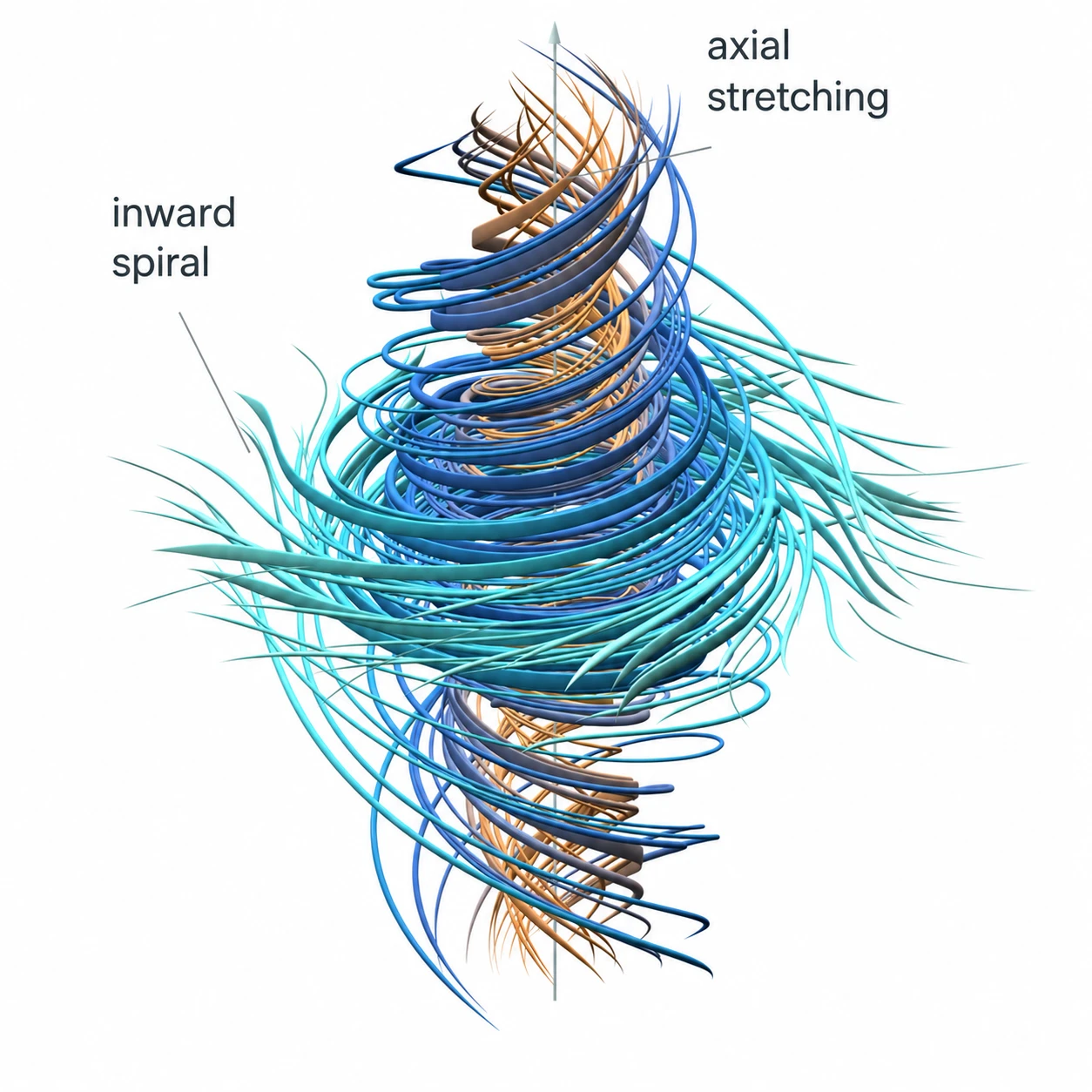
OpenAI’s diagram of the vortex in its company-reported Navier–Stokes claim; orange marks faster angular rotation and teal slower rotation. Source: openai.com.
Terence Tao, a mathematician, 2006 Fields Medal recipient and one of the 25 initial signatories, published the statement after a week of discussion among the group. The Fields Medal is mathematics’ highest-profile award; the signatories range from Pierre Deligne, honored in 1978, to Yu Deng, honored in 2026. Their shared standing gives the declaration weight as an argument about how the field recognizes a contribution, rather than as a finding that OpenAI’s claimed proof is wrong.
The group’s premise is that a celebrated problem has historically been valuable not only because it yields a true-or-false answer, but because attempts to solve it generate methods and explanations that other researchers can use. Their statement says a rushed announcement can leave too little time for a proper writeup, isolation of new ideas and citation of prior work. Without mathematicians who develop and integrate an AI-conceived result, it says, the result cannot fully enter the mathematical canon.
“Solving problems is only a tool and proxy for achieving the primary goal of conceptual understanding and insight.”
That is a narrower claim than “AI has no role in mathematics.” The declaration explicitly says AI could enhance and accelerate genuine mathematical study and understanding. Its warning is that the eventual effect depends on the choices of people controlling the systems—especially whether they optimize for a fast announcement or for a result that can be understood, scrutinized and built upon.
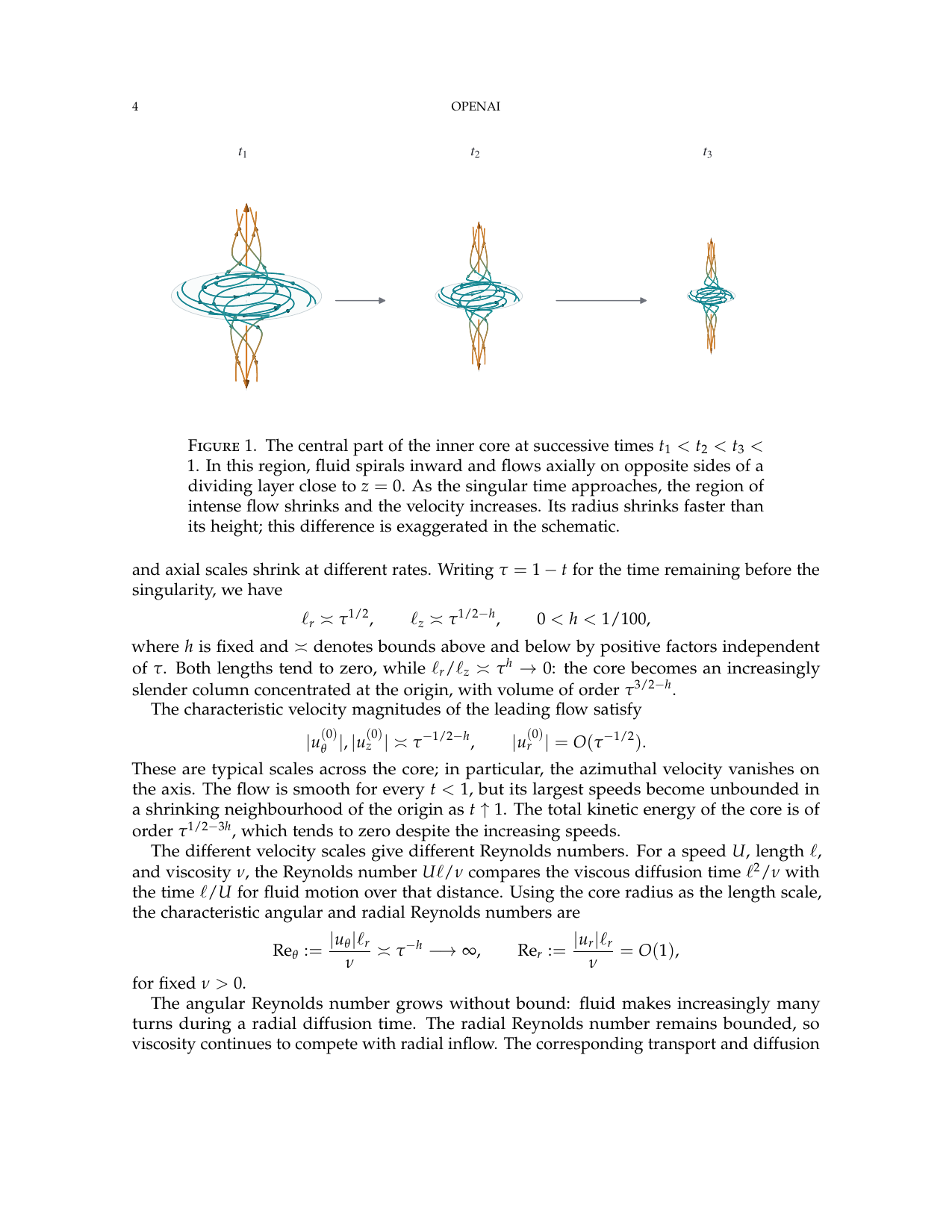
OpenAI’s paper depicts the vortex core at successive times in its company-reported Navier–Stokes claim. Source: openai.com.
Navier–Stokes equations describe fluid motion; the question at issue is whether a smooth, three-dimensional incompressible flow can break down into an infinite-speed singularity in finite time despite viscosity. The problem, one of the seven Millennium Prize Problems named by the Clay Mathematics Institute in 2000, has been unresolved for roughly 90 years, according to OpenAI’s account.
OpenAI says its system found an analytical proof and Lean formalization of a finite-time singularity from an initially smooth fluid at rest under a smooth applied force, with finite energy throughout. It says the agent group that produced the claimed resolution involved on the order of 10,000 concurrent agents. The company says agents reached the result about 88 hours after the first were launched, used about 130 billion output tokens on the Navier–Stokes effort, and that Lean formalization and verification took another 17 hours.
Those are company-reported measures of a particular multi-agent run, not a price, an independently measured efficiency figure or a measure of mathematical importance. They do, however, show the asymmetry at the center of the declaration: a lab can concentrate an unusually large automated search effort on a public landmark, while checking exposition, novelty and intellectual lineage remains work for the broader research community.
Lean formalization can check that a conclusion follows from specified formal assumptions. It does not establish that the formal statement captures the intended problem, that the work is original, that relevant predecessors have been credited, or that researchers can explain and generalize the underlying idea. Those are the separate tasks the signatories say need to be treated as part of a completed contribution.
OpenAI’s own framing is also more limited than a prize claim: it says it does not intend to claim the Millennium Prize and describes the release as a snapshot of model progress. The key evidentiary question therefore remains mathematical: whether independent specialists validate the proof and its correspondence to the official problem formulation.
The announcement followed a separate AI-assisted result by Tristan Buckmaster, an NYU mathematics professor, and Levent Alpöge, an Anthropic employee, on a forced Euler problem. A contemporaneous account reported Buckmaster’s accusation that OpenAI had seized on the problem after word of the pair’s work spread and copied their unusual approach.
Another report said Buckmaster accused OpenAI of pressuring him not to credit Alpöge and questioned whether the company had used their work with Codex. OpenAI says it had no access to the researchers’ work before its public release, that its investigation found Buckmaster’s Codex prompts could not have influenced the system or its training, and that the two projects differ: Buckmaster and Alpöge’s result concerned forced Euler, while OpenAI’s concerned unforced Euler as a related effort. It recognizes their priority on the forced-Euler work.
The allegations are not proof that OpenAI used the pair’s work. But the competing accounts demonstrate why the signatories put attribution alongside correctness. In a field where being first can confer status, an announcement can settle attention and credit before a community has had time to establish what was actually new and whose work it extends.
The immediate next step is independent review of OpenAI’s Navier–Stokes proof, including whether its formalization and paper establish the claimed result. That will address correctness, not every issue in the declaration.
The broader decision belongs to research institutions, mathematicians and AI developers: whether an AI-generated result is treated as complete at announcement, or only after it comes with a readable account, a record of dependencies and attribution, and enough human scrutiny for others to reuse it. The signatories are not asking the field to ignore faster discovery. They are asking it to decide that a benchmark win is not the same thing as shared mathematical knowledge.
OpenAI says India leads ChatGPT’s markets by weekly active users. Earlier free offers, strong app engagement and planned enterprise deployments explain the stakes, but the company has not disclosed comparable paid-user or revenue figures.
A national exit poll found broad opposition to new local data centers and a Democratic tilt among voters who prioritized AI. But the issue ranked below four other tested concerns, industry-backed candidates also won, and the next fight is over siting and power costs.
Oracle reportedly canceled a five-year Tencent lease estimated at $7 billion after US government pressure. The arrangement promised access to about 100,000 advanced AI chips in Southeast Asia; termination, payments and replacement capacity remain unconfirmed.
The iOS 27.3 developer beta opens Apple's AI tools to mainland China with optional Alibaba Qianwen integration. A December public release is planned, but newer Siri capabilities remain absent and early testers report battery and stability problems.
Tencent has launched Hy4 with visual reasoning and computer operation across its AI applications and cloud services, keeping standard API prices unchanged. The new version’s weights remain pending, while Tencent acknowledges a substantial gap with leading closed models.
Google plans $15 billion of Malaysian investment in 2027–2028, expanding data centres alongside power, water and workforce projects. Its next cloud region faces an established rival, while the resource balance and employment benefits remain projections.
Early results put all 11 proposed charter amendments restricting hyperscale data centers on course for approval, despite industry-funded opposition. Trenton and Piqua show how the votes could reshape projects and local political control.
OpenAI says ChatGPT handles search-like queries equal to roughly 20% of Google’s volume. The claim signals a growing competitor for information queries, but undisclosed counting methods prevent a clean market-share comparison.
Xiaomi says its humanoid robot sorted car parts for a full shift and corrected errors autonomously. The result extends its factory trials, but published evidence does not yet establish deployment costs or reliability across repeated shifts.
Railway’s CEO apologized after an engineer’s AI agents targeted rival Primcloud during testing. Primcloud says attempts to obtain customer secrets failed, leaving questions about the agents’ instructions and Railway’s controls.
Cortex Training gives developers custom training APIs on managed GPUs. Snowflake is extending its existing model-customization tools, with enterprise-data integration and a cost claim limited to LoRA fine-tuning.
Apple’s developer preview extends Siri AI beyond predefined app categories and adds guidance for complex tasks. Testing is limited to development builds and internal testers, with App Store submissions planned for spring 2027.
Jill Hazelbaker will join OpenAI as chief corporate affairs officer after a decade at Uber, bringing experience in technology communications and political campaigns to a role focused on reputation, positioning and public trust.
The watchOS 27.3 developer beta brings Live Rewind and Siri Recap to Apple Watch Series 12 and Ultra 4. The opt-in tools offer brief transcripts and conversation summaries, but require a compatible iPhone and carry Apple warnings about accuracy and sensitive information.
Traders reportedly extract Samsung and SK hynix memory from processor packages shipped into China, selling it mainly to Huawei customers. The account highlights the memory constraint behind Huawei’s AI chip rollout, but leaves trade volumes, recovery yields and transaction legality unresolved.
Creative-industry groups are challenging OpenAI and Microsoft’s arguments against licensing AI training material, as a New York court weighs fair use. Their briefs share an emphasis on licensing but differ over what the judge should decide.
Traversal's Series B backs its expansion from diagnosing software outages toward autonomous production operations. Company-reported adoption, cloud competition and unfinished access controls frame the next tests.
The startup formerly called TesterArmy is replacing its testing agent with an open-source framework, betting that adoption will generate demand for paid infrastructure and enterprise services.
Fal has announced Sequoia-led and Bessemer-led funding rounds for its 2027 expansion, adding post-trained media models to an established inference business. The announcements leave the new rounds’ size and comparative serving economics undisclosed.
SK hynix bought existing Penguin Solutions preferred shares from an SK Telecom investment vehicle. The deal brings director nomination rights and a convertible stake in an existing AI infrastructure partner, while sending the purchase price to the seller.