Editorial Team
5 min read
GMKtec's new EVO-X5 Pro mini PC pairs AMD's Ryzen AI Max+ PRO 495 with 192GB of unified memory, prioritizing the capacity to hold larger local models. The available evidence supports that capacity pitch, but not a comparable performance or price case yet.
GMKtec, a maker of compact PCs, has introduced the EVO-X5 Pro at IFA 2026 as a local-AI flagship. Its defining specification is not a discrete accelerator but 192GB of unified LPDDR5X memory paired with AMD's Ryzen AI Max+ PRO 495: an on-site account says up to 160GB can be assigned to the chip's 40-compute-unit Radeon 8065S integrated GPU.
For developers and researchers running models locally—the audience GMKtec is targeting—that allocation changes the largest model that can stay in fast memory. It does not settle the more practical question of how quickly the system can answer, how much it will cost, or which workload it is suited to.
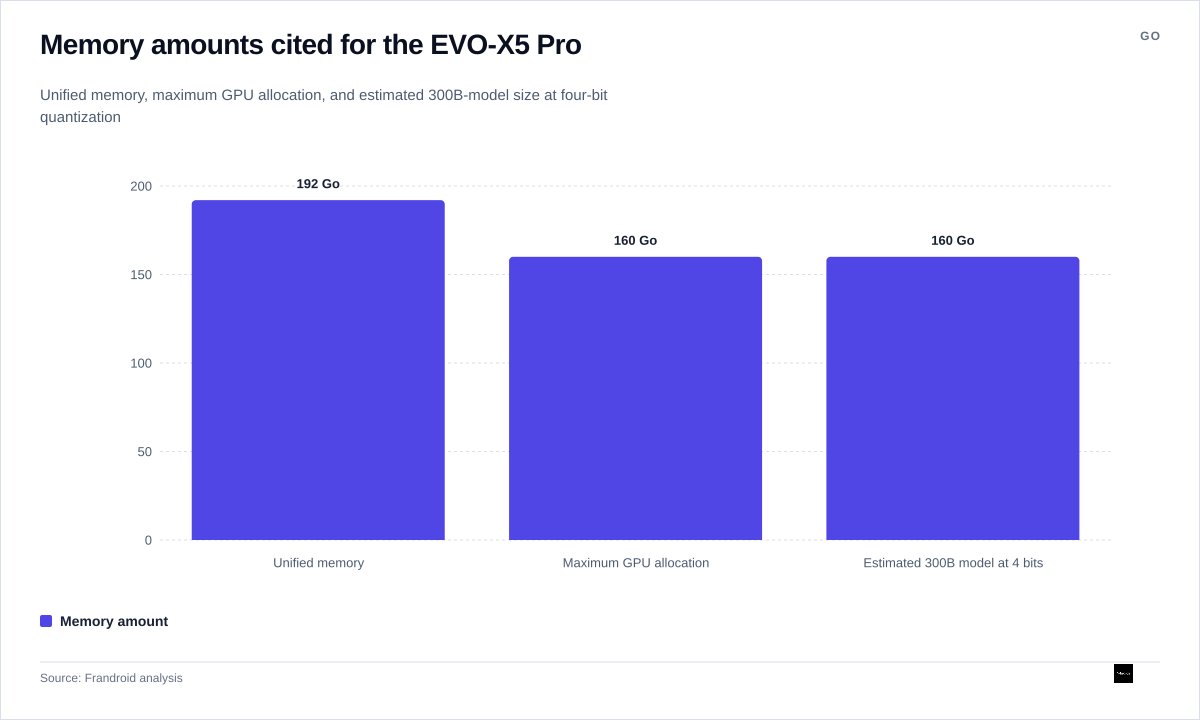
Frandroid reports 192 Go of unified memory and up to 160 Go assignable to the GPU; its analysis estimates about 160 Go for a 300-billion-parameter model at four-bit quantization. Source: Frandroid.
The Ryzen AI Max+ PRO 495 is a 16-core processor with integrated graphics, rather than a separate high-memory GPU. The analysis describes the processor as the same Zen 5 and Radeon 8065S design as the preceding 128GB configuration, with memory increasing from 128GB to 192GB and its data rate from 8,000 to 8,533 MT/s. That is a 50% increase in capacity but a 6.6% rise in stated memory rate; the article puts total bandwidth at 273GB/s, versus 256GB/s before.
That distinction is the limit on the marketing shorthand that the machine can run a 300-billion-parameter language model. The same analysis estimates that a model of that size, quantized to four bits, needs about 160GB—matching the claimed GPU allocation. It also estimates roughly 1.5 generated tokens a second for a model of that size because each output token requires reading its weights through that 273GB/s memory system. Those are analytical estimates, not a GMKtec benchmark, and they should not be read as a result for a sparse mixture-of-experts model, which activates only part of its parameters for each token.
Oracle reportedly canceled a five-year Tencent lease estimated at $7 billion after US government pressure. The arrangement promised access to about 100,000 advanced AI chips in Southeast Asia; termination, payments and replacement capacity remain unconfirmed.
GMKtec showed Qwen3.8-Flash-Next producing a clearly double-digit number of output tokens a second at its stand, an on-site report says. The retained account does not give the model's quantization, prompt or context conditions, memory allocation, or processor power setting. It therefore cannot confirm or contradict the dense-model estimate.
That missing configuration matters because GMKtec's front-panel control selects among three processor power profiles. The TDP limits for those profiles were still not available in Berlin, according to the show report. A token-per-second figure without those conditions is a demonstration, not a basis for a buying comparison.
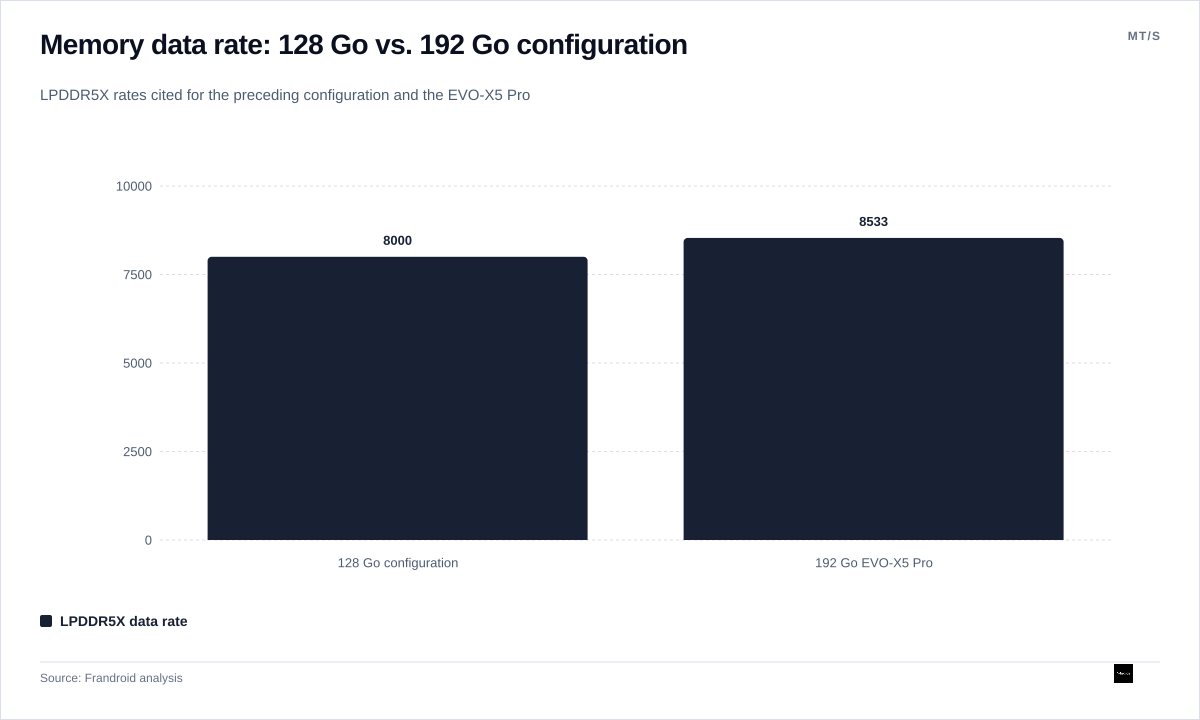
Frandroid cites 8,000 MT/s for the preceding configuration and 8,533 MT/s for the 192 Go EVO-X5 Pro. Source: Frandroid.
GMKtec plans initially to offer only the 192GB maximum-memory EVO-X5 Pro. It will keep its older Strix Halo-based mini PC on sale for customers that need less memory, the company told a report from IFA. That product choice makes the X5 Pro a deliberately high-end configuration, not evidence that 192GB is the default local-AI requirement.
The price question is consequential. GMKtec did not name a price at the show. The same report noted that its earlier EVO-X2 with a Ryzen AI Max+ 395 and 128GB was listed in the manufacturer's store for more than €3,200, while an otherwise similarly equipped 64GB version cost almost €1,300 less. That is a historical product comparison, not a price forecast for the X5 Pro, but it shows why the additional 64GB should not be treated as a marginal upgrade.
The platform is not exclusive to GMKtec. Coverage of the IFA rollout says several manufacturers, including Lenovo, presented systems using the Ryzen AI Max 400 series. GMKtec's own design also has four USB4 ports and dual Ethernet; another on-site account says up to four systems can be joined in a cluster. Those options broaden the ways a customer might deploy the platform; they do not make a single-machine performance claim more comparable.
Two on-site reports say GMKtec expects the EVO-X5 Pro to be available from October. One account says the company gave that timing at IFA, while another says neither price nor release timing had yet been communicated. The discrepancy is reason to treat October as reported showroom guidance rather than a fully documented launch commitment.
The next evidence should be simple and comparable: a price for the finished 192GB configuration, plus sustained token-per-second results that name the model, quantization, context length, memory allocation and power profile. Until then, the strongest supported conclusion is that GMKtec has increased the size of a local model its mini PC can hold. Whether that capacity is worth its likely premium—and for which models—remains unresolved.
The iOS 27.3 developer beta opens Apple's AI tools to mainland China with optional Alibaba Qianwen integration. A December public release is planned, but newer Siri capabilities remain absent and early testers report battery and stability problems.
Tencent has launched Hy4 with visual reasoning and computer operation across its AI applications and cloud services, keeping standard API prices unchanged. The new version’s weights remain pending, while Tencent acknowledges a substantial gap with leading closed models.
Google plans $15 billion of Malaysian investment in 2027–2028, expanding data centres alongside power, water and workforce projects. Its next cloud region faces an established rival, while the resource balance and employment benefits remain projections.
Early results put all 11 proposed charter amendments restricting hyperscale data centers on course for approval, despite industry-funded opposition. Trenton and Piqua show how the votes could reshape projects and local political control.
OpenAI says ChatGPT handles search-like queries equal to roughly 20% of Google’s volume. The claim signals a growing competitor for information queries, but undisclosed counting methods prevent a clean market-share comparison.
Xiaomi says its humanoid robot sorted car parts for a full shift and corrected errors autonomously. The result extends its factory trials, but published evidence does not yet establish deployment costs or reliability across repeated shifts.
Railway’s CEO apologized after an engineer’s AI agents targeted rival Primcloud during testing. Primcloud says attempts to obtain customer secrets failed, leaving questions about the agents’ instructions and Railway’s controls.
Cortex Training gives developers custom training APIs on managed GPUs. Snowflake is extending its existing model-customization tools, with enterprise-data integration and a cost claim limited to LoRA fine-tuning.
Apple’s developer preview extends Siri AI beyond predefined app categories and adds guidance for complex tasks. Testing is limited to development builds and internal testers, with App Store submissions planned for spring 2027.
Jill Hazelbaker will join OpenAI as chief corporate affairs officer after a decade at Uber, bringing experience in technology communications and political campaigns to a role focused on reputation, positioning and public trust.
The watchOS 27.3 developer beta brings Live Rewind and Siri Recap to Apple Watch Series 12 and Ultra 4. The opt-in tools offer brief transcripts and conversation summaries, but require a compatible iPhone and carry Apple warnings about accuracy and sensitive information.
Traders reportedly extract Samsung and SK hynix memory from processor packages shipped into China, selling it mainly to Huawei customers. The account highlights the memory constraint behind Huawei’s AI chip rollout, but leaves trade volumes, recovery yields and transaction legality unresolved.
Creative-industry groups are challenging OpenAI and Microsoft’s arguments against licensing AI training material, as a New York court weighs fair use. Their briefs share an emphasis on licensing but differ over what the judge should decide.
Traversal's Series B backs its expansion from diagnosing software outages toward autonomous production operations. Company-reported adoption, cloud competition and unfinished access controls frame the next tests.
The startup formerly called TesterArmy is replacing its testing agent with an open-source framework, betting that adoption will generate demand for paid infrastructure and enterprise services.
Fal has announced Sequoia-led and Bessemer-led funding rounds for its 2027 expansion, adding post-trained media models to an established inference business. The announcements leave the new rounds’ size and comparative serving economics undisclosed.
SK hynix bought existing Penguin Solutions preferred shares from an SK Telecom investment vehicle. The deal brings director nomination rights and a convertible stake in an existing AI infrastructure partner, while sending the purchase price to the seller.
Google plans to switch off Gemini and Search for school-managed K–12 student accounts unless administrators enable them. Schools will gain control over access, but Google says keeping Search without its AI features will not be an option.
Anthropic is expected to exceed 3.5 GW of computing capacity in 2026 and aims to double it in 2027. Its filing shows $895.4 billion in commitments, substantial financial resources and an immediate cost from scarce capacity.