Editorial Team
8 min read
Zhipu says GLM-5.4 adds vision and stronger coding to its subscription service, with larger usage quotas. Undisclosed credit rates and benchmarks leave its value unresolved as the company expands a cloud business backed by substantial financing.
Zhipu, the Chinese developer of the GLM family of AI models that operates internationally as Z.ai, has launched GLM-5.4 on its Coding Plan service. The company claims better coding and new vision capabilities, linking the release to work on Loop Transformer, an approach that reuses model layers to increase computational depth.
The upgrade matters to a business increasingly dependent on serving models through the cloud rather than installing them at customers’ premises. But larger subscription allowances do not establish cheaper completed work: the launch reporting supplies neither GLM-5.4’s credit deduction rates nor comparable performance results.
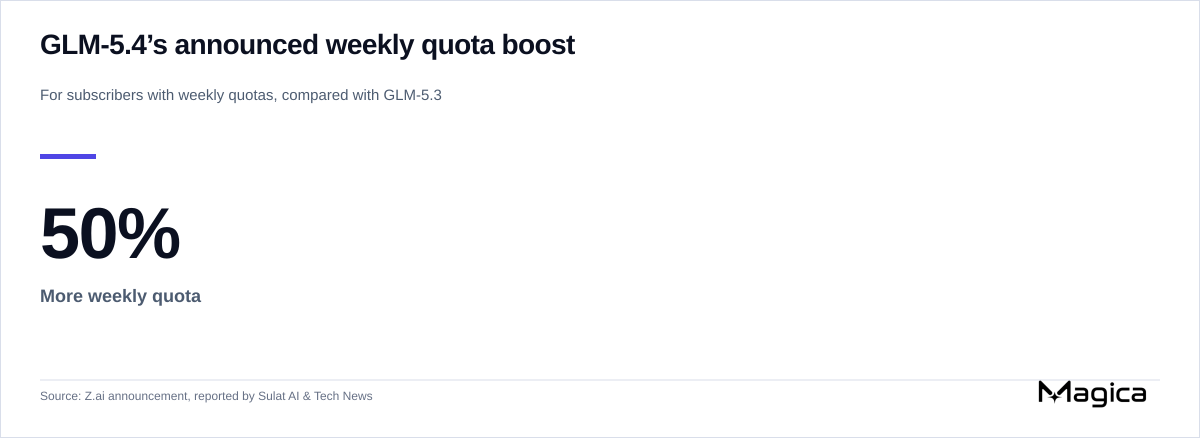
Company-reported weekly quota increase; GLM-5.4’s credit rates remain undisclosed. Source: Sulat AI & Tech News.
Zhipu’s official operations account said on November 23 that subscribers can invoke the model by setting its name to glm-5.4, according to a report of the announcement. The account said the team had spent three months pursuing both loop scaling and larger model size, with Loop Transformer work delivering the first visible results. The vision and coding improvements are the company’s claims.
In a separate announcement described in launch coverage, Zixuan Li, head of Z.ai, said access extends to every Coding Plan tier. Li leads its global product, API platform, partnerships and model releases, according to the profile examined in that report. He had publicly advocated open-weight releases at the AI Engineer conference in September, arguing that they let customers run and adapt models themselves.
Coding Plan is a subscription for using GLM models inside coding tools, including Claude Code, OpenCode and Zhipu’s own ZCode coding agent. It does not pay for direct API calls from a developer’s own application. Zhipu opened the service to all users in August alongside GLM-5.3 and GLM-5.3-Flash, according to its interim results.
Vision needs a precise baseline. The documentation examined in the launch coverage describes GLM-5.3, the preceding flagship, as text-only. But GLM-5.3-Flash already accepts images, video and files. A Vision MCP server also routes Coding Plan users’ visual questions through Flash. GLM-5.4 therefore adds vision relative to the preceding flagship; visual inputs already existed elsewhere in the family. The announcement does not explain whether GLM-5.4’s vision is native or how it compares with Flash.
The Chinese launch report describes GLM-5.4 as roughly 700 billion parameters and says a three-trillion-parameter GLM-5.5 remains planned for December. The separate coverage says Zhipu has not confirmed those size and roadmap claims. They remain reported expectations rather than established launch specifications.
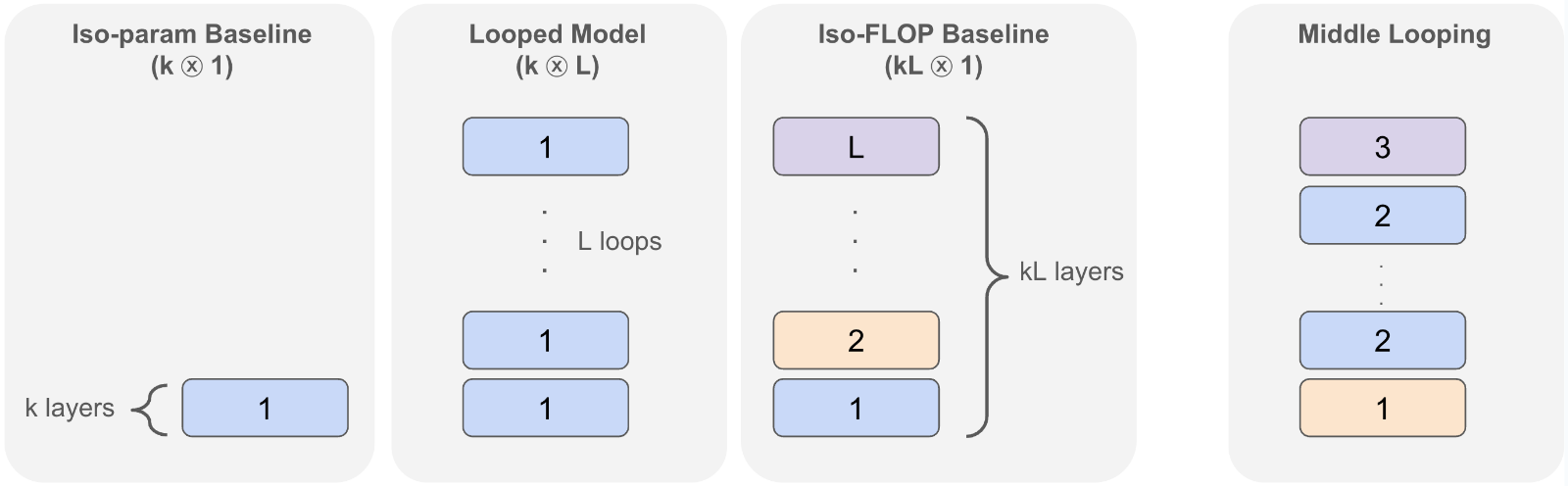
Layer reuse illustrated by Saunshi et al., “Reasoning with Latent Thoughts” (ICLR 2025), Figure 1, CC BY 4.0. This depicts earlier research, not GLM-5.4. Source: Reasoning with Latent Thoughts — ICLR 2025 paper.
Zhipu had already described Loop Transformer in its August interim results: recycling layers could increase effective computational depth without substantially increasing parameter count. At that point, it reported preliminary validation in early experiments.
The broader idea predates this release. The ICLR 2025 paper “Reasoning with Latent Thoughts: On the Power of Looped Transformers,” submitted in February 2025, studied repeatedly applying the same layers. On synthetic reasoning problems, including addition and multi-hop induction, a smaller stack run repeatedly nearly matched a deeper model with separate layers. The abstract also reports competitive results on downstream reasoning tasks.
That establishes research precedent, not GLM-5.4’s design or commercial performance. Repeating layers adds computational steps even when parameters are reused. A smaller parameter count therefore cannot, by itself, establish faster or cheaper inference; evaluation needs quality, latency and resource use on comparable workloads.
Zhipu’s own previous release supplies another caution against assigning every improvement to architecture. Its filing says GLM-5.3 retained GLM-5.2’s architecture and parameter counts while expanding post-training, including reinforcement learning. The company reported an improvement of more than 50% in end-to-end completion on its own coding evaluation. That is a company-tested result for the earlier model, not a GLM-5.4 benchmark, and shows why the new release needs evidence separating the effects of layer reuse from other changes.
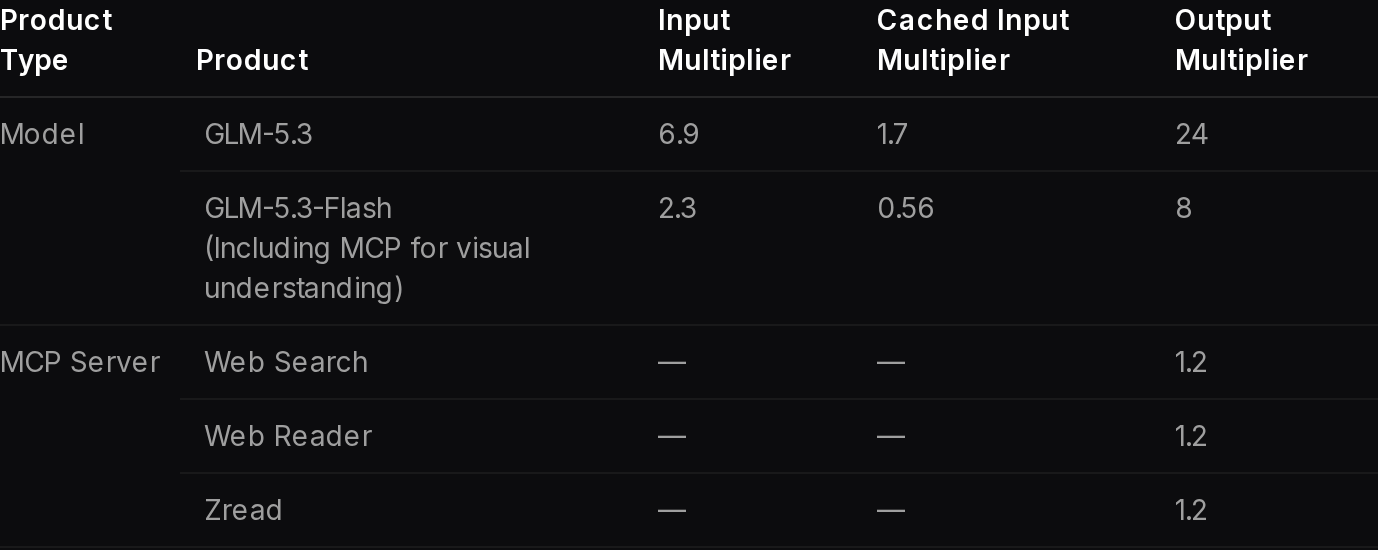
Z.ai’s company-reported credit multipliers differ by model. The inspected table does not list GLM-5.4. Source: Sulat AI & Tech News.
The operations-account announcement says GLM-5.4 allowances rise to 1.5 times their previous level for V2, V3 and team users. Li’s announcement specifies 50% more weekly quota than GLM-5.3 for users with weekly quotas. Neither description establishes an increase in every usage limit.
The service has both rolling five-hour and weekly credit pools; exhausting either requires waiting for its reset. The pricing review accompanying the launch report lists Lite at US$18 a month with 10,000 weekly credits, Pro at US$80 with 60,000, and Max at US$168 with 140,000. Applying the announced 50% increase would give 15,000, 90,000 and 210,000 respectively. Those are calculations from the stated baseline, not separately published GLM-5.4 allocations; the announcement says nothing about raising five-hour limits.
Requests spend credits according to token consumption and model-specific rates. The review also describes half-price credit consumption outside the weekday peak window of 14:00–18:00 Singapore time. Without GLM-5.4’s rates, a larger pool cannot establish how many additional tasks a subscription buys.
Subscribers also have an existing lower-cost visual alternative: the same review says Z.ai gives GLM-5.3-Flash three times the GLM-5.3 quota. It lists direct API rates for GLM-5.3 at US$1.40 per million input tokens and US$4.40 per million output tokens, against US$0.15 and US$0.50 for Flash. These API prices are separate from subscription credits and do not establish equivalent task quality.
Competition extends beyond the company’s own models. The review identifies DeepSeek V4.1 Flash, Kimi K3.1 Pro and Qwen4-Max as coding alternatives, and lower-priced third-party hosting of GLM-5.3 through OpenCode. Those options prevent a larger quota or the Loop Transformer label alone from establishing a competitive advantage. GLM-5.4 still needs a comparable price and quality measure.
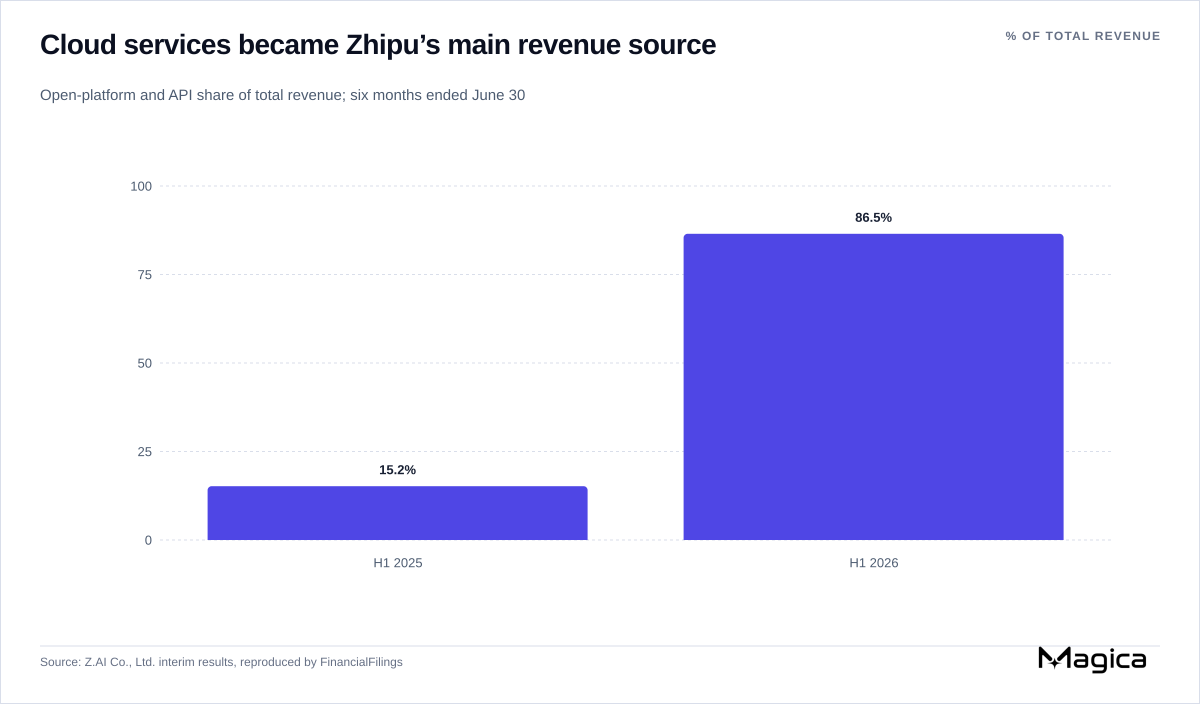
Company-reported open-platform and API revenue shares. These figures do not measure Coding Plan or GLM-5.4 profitability. Source: Zhipu interim results — FinancialFilings reproduction.
Zhipu is listed in Hong Kong as Z.AI Co., Ltd., following its January 2026 listing. Its unaudited interim results for the six months ended June 30 show the scale of its shift toward cloud services:
| Measure | First half of 2025 | First half of 2026 |
|---|---|---|
| Total revenue | RMB190.9 million | RMB953.9 million |
| Open-platform and API revenue | RMB29.1 million | RMB825.2 million |
| Open-platform and API share of revenue | 15.2% | 86.5% |
| Open-platform and API gross margin | −0.4% | 24.6% |
| Group net loss | RMB2.358 billion | RMB2.072 billion |
These are company-wide and business-segment results, not a breakdown of Coding Plan profitability. The filing attributes the cloud margin improvement to scale, higher prices and engineering work that reduced inference costs. It also says Coding Plan subscription prices had increased by the announcement date. The current quota increase follows that history; it is not evidence of a subscription price cut.
The balance is less favorable at group level: total gross margin fell from 50.0% to 26.4% as the lower-margin cloud business grew. Research and development spending reached RMB2.131 billion in the first half of 2026, exceeding revenue. Although the reported net loss narrowed, the company’s adjusted net loss, a non-IFRS measure, widened from RMB1.752 billion to RMB1.964 billion. The reported loss benefited partly from a reduction in charges associated with investor financial instruments after listing.
Losses are only part of the financing picture. The filing records a July 13 placement of 19.78 million new shares at HK$1,588 each, raising approximately HK$31.41 billion gross, or RMB27.23 billion. That funding came after the interim balance-sheet date. It gives Zhipu substantial additional resources alongside its costly model development; it does not demonstrate that serving the new model is profitable.
Infrastructure also limits what can be inferred from the architecture pitch. Zhipu said its unit token inference costs had fallen 80% from the start of 2026 by the June reporting-period end, while using a cluster of more than 100,000 domestic chips. Those are company claims across its infrastructure, not measured savings from GLM-5.4.
For GLM-5.3-Flash specifically, the filing identifies domestic-chip memory capacity and bandwidth as constraints, particularly for long contexts. It describes separating visual encoding, prompt processing and token generation into independently scalable worker pools. Layer reuse addresses one part of a system whose costs also depend on memory, networking and serving software. The filing also warns that Zhipu relies on third parties for computing resources, leaving it exposed to disruption and price changes.
At the launch-stage check described in the reporting, GLM-5.4’s blog and documentation pages returned 404. That account found no published benchmarks, API pricing, context specification or weights. Earlier open-weight releases and Li’s advocacy do not establish that this model can yet be run outside Zhipu’s hosted service.
Subscribers can select glm-5.4, according to the company’s announcement. The next decision is whether to move actual coding work to it rather than use GLM-5.3, Flash or a competing service. Credit rates, documented visual-input support and comparable task-completion results would make that decision assessable. A technical account of the reused layers, loop count, latency and resource cost is also needed to judge what Loop Transformer contributes.
Satya Nadella says Claude Code caught Microsoft off guard by moving AI coding toward the terminal. Microsoft’s response includes managing rival agents in VS Code, while its investment and cloud commitments with Anthropic complicate the competitive picture.
Apple’s reported Siri layoffs targeted older infrastructure, while a beta update points to some migration onto newer systems. The harder test is delivering app control promised in 2024 and subsequently delayed.
The London consumer law business has secured seed funding led by Insight Partners to expand beyond conveyancing. Its bet is on delivering legal work directly, but claimed growth has yet to establish a cost or service advantage over competing practices.
Meta chief AI officer and former Scale AI CEO Alexandr Wang warns that unconstrained AI self-improvement threatens human control. His call for a different industry path follows an AI-assisted mathematical breakthrough, but neither that collaboration nor new research-automation data establishes fully autonomous science.
US President Donald Trump urged Nvidia to bring back its co-founder and former CEO Jensen Huang, despite a reported board statement against reinstatement and unresolved allegations involving Chinese intelligence and chip shipments.
Claude’s estimated October web visits rose 23.8%, but the figures measure neither paying customers nor job losses. A resurfaced account of Dario Amodei discussing immersive games at OpenAI raises a separate question about how AI’s builders approach its social consequences.
OpenAI wants frontier labs to tie development limits to prediction loss and monitoring milestones. Its internal figures offer a starting point, but datasets differ across companies and the metric misses major reasoning gains.
A 2,000-cubic-metre tank and mobile pumping capacity address northern Hong Kong flooding, while AI tools help position crews and detect rising water. Official records distinguish established monitoring from three-site forecasting trials, with costs disclosed but comparative performance results absent.
Reported server price demands reach 45% above earlier agreements. HPE explicitly permits repricing before shipment, while XTX's disputed Dell order raises a sharper question: what happens when a buyer says it paid extra for a fixed price?
OpenRouter disclosed provider removals after investigations into inference data handling. Separate notices describe forwarded requests, a compromised deployment and stolen prompt samples, exposing different weaknesses behind privacy assurances.
Lawyers seeking a quarter of Apple's $250 million settlement fund expect participating buyers to recover at least $61 per eligible iPhone. The estimate depends on claims volume, deductions and final court approval.
Microsoft’s president says AI-assisted vulnerability discovery is forcing faster software repairs and raising disruption risks. But he says Microsoft’s own recent outage was unrelated to AI, leaving incident-by-incident evidence crucial to judging the warning.
Nasdaq-100 futures rose as much as nearly 3% in Sunday evening reports after a punishing selloff. The holiday-shortened week brings earnings and inflation tests for a market still questioning the AI investment boom.
Foreign intelligence officials describe a Chinese state security team helping companies obtain restricted AI chips and collecting semiconductor intelligence. The reported campaign predates the Megaspeed controversy, while new US rules target a separate route: remote access to computing power abroad.
Elon Musk says Tesla cars will retain AI4 while AI5 goes to Optimus. An upgraded AI4 remains in development, hardware costs are rising, and older-car owners still lack a retrofit date.
Visa Crypto Labs is testing an invitation-only wallet for US users to earn and spend OUSD through AI agents. Card verification links agents to owners, but marketplace admission, work acceptance and live identity checks remain separate hurdles.
Treasury Secretary Scott Bessent said responsibility for disputed China chip sales must be established before he backs Jensen Huang’s return to Nvidia, despite President Donald Trump’s support.
Employee equity at Anthropic’s IPO price is reportedly worth $232 billion, while book rightsholders await a first settlement installment estimated at $2,203.56 per work. Vesting, shared copyrights and founder voting rights complicate the comparison.
Moore Threads is preparing a December 29 reveal for Lushan, a desktop GPU pitched at gaming and local AI inference. Its claimed memory record remains unquantified, and capacity alone will not establish performance or value.

Amazon is in advanced talks to buy Decart, whose software helps AI models run efficiently across chips. The reported deal could strengthen AWS’s Trainium business, with conditional payments and five-year founder commitments making execution central to its value.