Editorial Team
6 min read
Choi Kyo-jin resigned after last-minute anti-cheating changes disrupted preparations for South Korea’s college entrance exam. A breakdown of 111 electronic-device cases leaves the extent of AI-assisted cheating unresolved as authorities review penalties and future safeguards.
Choi Kyo-jin, South Korea’s education minister and a former three-term schools superintendent in Sejong, resigned on November 22 after hurried measures against AI-assisted cheating caused confusion before the national college entrance exam. President Lee Jae Myung accepted his resignation, the presidential office said in a press notice.
The College Scholastic Ability Test, or CSAT, is South Korea’s annual national college entrance examination, commonly called Suneung. University admission can heavily influence career prospects, making changes to the exam especially sensitive for candidates and families, as the account of Choi’s departure explains. The November 19 test was for the 2027 academic year.
The ministry now faces decisions on suspected device violations and penalties, while the extent of AI-assisted cheating remains unresolved.
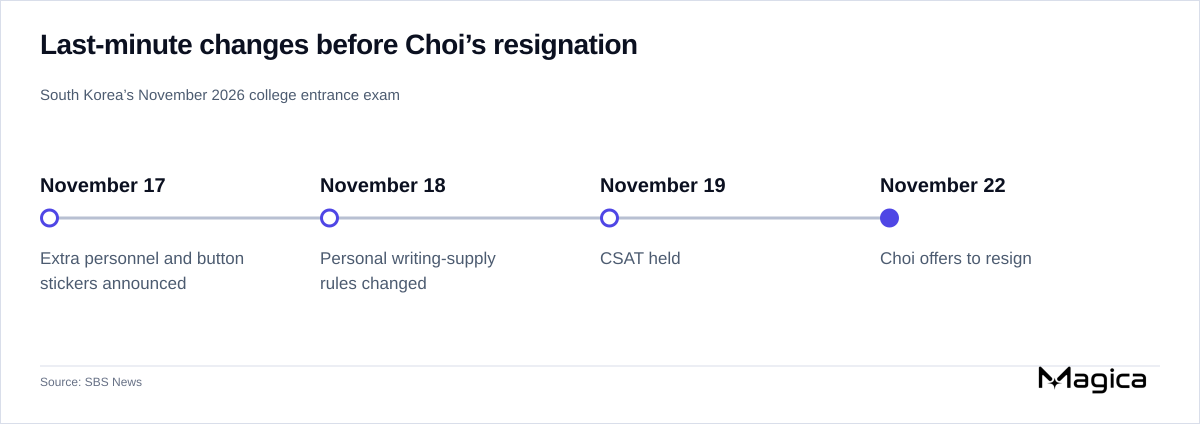
Staffing and exam rules changed shortly before the November 19 CSAT. Choi offered his resignation on November 22. Source: SBS News.
The ministry initially focused on smart glasses. Its response widened after the top scorer in the certified tax accountant examination admitted on November 15 to cheating with a miniature camera and AI—four days before the CSAT, according to the account of the preparations.
On November 17, the government announced an additional 8,400 personnel, including around 1,800 staff dedicated to smart devices and about 6,600 hallway proctors. It also required stickers on clothing buttons to obstruct concealed cameras.
Bipartisan governors propose federal oversight of advanced AI models while preserving state protections for consumers, children and workers. Their framework also asks states to harmonize rules, leaving the boundary between national consistency and local accountability unresolved.
On November 18, authorities changed the rules for personal writing supplies, banning previously permitted items including correction tape, erasers and mechanical pencil lead. Newly mobilized proctors received urgent video training the day before the exam.
Teachers’ organizations argued that the government had shifted the burden of its hurried response onto frontline staff. The Korean Federation of Teachers’ Associations, a teachers’ organization that demanded Choi’s resignation, questioned whether such brief training could equip proctors to detect sophisticated cheating. The opposition People Power Party and a coalition of high school seniors also called for him to step down, the same report said.
During the exam, authorities sent three nationwide emergency phone alerts to expose devices that candidates had failed to surrender. Proctors also inspected glasses and covered clothing buttons, according to the account of the security operation.
When Choi was nominated in August 2025, presidential chief of staff Kang Hoon-sik cited his more than 40 years in education, from middle school teacher to superintendent, and his expected ability to implement Lee’s pledges. He was the first superintendent to serve three terms in Sejong, according to the nomination report.
His subsequent record also included problems with admissions administration. In September, an outage in the Uway Apply application system shortly before the early-admissions deadline prevented some applicants from submitting forms. Choi apologized to students and parents and said he would consider public management of the system. He had taken office on September 12, 2025, according to the review of his tenure.
His parliamentary response to AI cheating became a separate controversy. Asked whether he was completely confident authorities could detect it, the 72-year-old said he did not think he could, citing his age. The reported exchange drew criticism before the CSAT.
In his resignation statement, Choi accepted criticism that the ministry had failed to prepare in advance and acknowledged the inconvenience caused by changes just before the exam. His statement put responsibility on the preparation process. He also said cooperation from candidates, parents, proctors and government agencies had allowed the test to finish without a major incident, according to the account of his remarks.
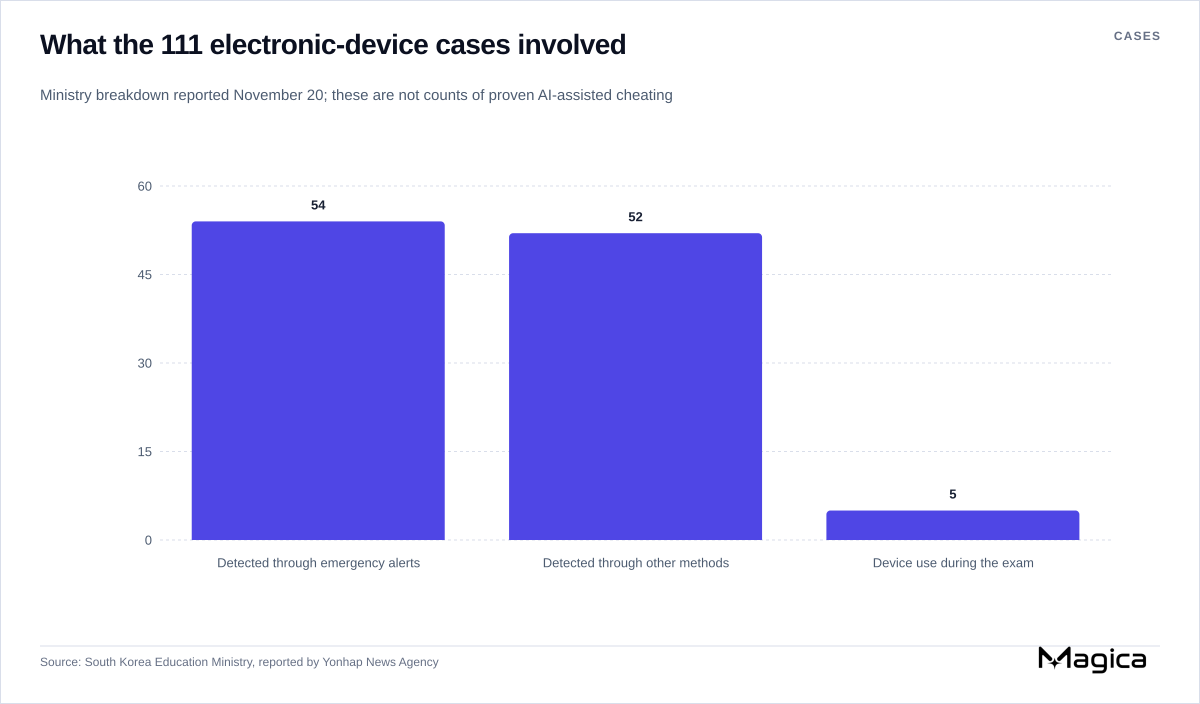
The ministry distinguished device detections from five cases involving use during the exam. These figures do not establish how many cases involved AI. Source: Yonhap News Agency (device-case breakdown).
The Education Ministry reported 111 suspected electronic-device cheating cases nationwide. Its November 20 breakdown distinguished how devices were found from cases involving their use:
| Category reported by the ministry | Cases |
|---|---|
| Devices detected through emergency alerts | 54 |
| Devices detected through other methods, including Wi-Fi signal checks | 52 |
| Device use detected during the exam | 5 |
| Total electronic-device cases | 111 |
The five use cases involved smart glasses; a miniature camera and wireless earphones; a smartphone used to photograph questions; and two instances of smartphone use in toilets. The ministry said it was still checking the detailed items and types of misconduct. The tally excluded infractions unrelated to electronic devices, such as violations of answer-sheet submission times.
These figures establish neither the number of successful AI-assisted cheating attempts nor the share that security checks caught. They do show why the aggregate device count cannot be treated as 111 proven AI-cheating cases.
The ministry’s examination misconduct committee was reviewing cases, with penalties to be decided before scores are released on December 11, according to the account of the pending review. Authorities were also considering reviews of previous entrance exams where credible tips indicated possible AI-assisted cheating. Exam papers must be stored at test locations for at least a year, the report said.
The government and ruling Democratic Party proposed increasing the exam eligibility ban for AI-assisted cheating from the existing one year to ten years. At their November 18 meeting, they said they would seek to amend the Higher Education Act and apply the change to this year’s exam, according to the account of their legislative plan. That was a proposal, separate from the penalties still awaiting case review.
The presidential office said Choi’s successor would be selected through the normal procedure and the prime minister would oversee follow-up measures. Lee also called for a broader inspection of examination management and a review of identification marks on question papers to trace photographed or leaked material, according to the account of his instructions.
The immediate decisions are which suspected cases warrant penalties and what rules apply to them. The broader review must address the preparation failure Choi acknowledged: how to give schools workable security procedures before the next exam approaches.
Sarvam says Token Factory uses private GPUs, separate from subsidised model development. Its own launch data show a competitive hosting business whose value depends on workload, price, control and the location of infrastructure.
The London-based startup is valued at $450 million as two UK government-backed funds invest together for the first time. Its virtual battlefield aims to accelerate autonomous-system testing, but the announcements provide no measured performance or cost results.
Recruitment has begun in Cambridge for a trial expected to involve around 700,000 women, testing whether AI can help detect breast cancer and release specialist time while keeping clinical decisions with NHS staff.
Ant Group led a $100 million round valuing Simplexity Robotics at $1.6 billion. Founded by former Li Auto executives, the startup is putting wheeled robots into factories, but the reported deployments leave customer economics unproven.
Reports describe Alice Huang’s contacts with a Chinese intelligence officer during her relationship with former Nvidia CEO Jensen Huang. Officials have not concluded she spied for China, while a separate chip-export investigation raises questions about enforcement.
Mass General Brigham spinout Aevius launched with $22 million in seed funding for AI models that combine patient data across formats and time. Its founders previously helped build Modella AI, acquired by AstraZeneca, but its launch announcement supplies no performance results or deployment costs.
Compute Desk announced a $45 million Lightspeed-led seed round for GPU pricing, contracting and physical settlement. Its investors see a route to financeable compute, but planned futures markets and unreported adoption leave that ambition unproven.
Jay Clayton confirmed an investigation into former Megaspeed executive Alice Huang and her firm, without resolving espionage or military-use allegations. Official records trace the chip-diversion inquiry to 2024, while separate reporting alleges Li Ming helped direct the business.
Satya Nadella says Claude Code caught Microsoft off guard by moving AI coding toward the terminal. Microsoft’s response includes managing rival agents in VS Code, while its investment and cloud commitments with Anthropic complicate the competitive picture.
Apple’s reported Siri layoffs targeted older infrastructure, while a beta update points to some migration onto newer systems. The harder test is delivering app control promised in 2024 and subsequently delayed.
Zhipu says GLM-5.4 adds vision and stronger coding to its subscription service, with larger usage quotas. Undisclosed credit rates and benchmarks leave its value unresolved as the company expands a cloud business backed by substantial financing.
The London consumer law business has secured seed funding led by Insight Partners to expand beyond conveyancing. Its bet is on delivering legal work directly, but claimed growth has yet to establish a cost or service advantage over competing practices.
Meta chief AI officer and former Scale AI CEO Alexandr Wang warns that unconstrained AI self-improvement threatens human control. His call for a different industry path follows an AI-assisted mathematical breakthrough, but neither that collaboration nor new research-automation data establishes fully autonomous science.
US President Donald Trump urged Nvidia to bring back its co-founder and former CEO Jensen Huang, despite a reported board statement against reinstatement and unresolved allegations involving Chinese intelligence and chip shipments.
Claude’s estimated October web visits rose 23.8%, but the figures measure neither paying customers nor job losses. A resurfaced account of Dario Amodei discussing immersive games at OpenAI raises a separate question about how AI’s builders approach its social consequences.
OpenAI wants frontier labs to tie development limits to prediction loss and monitoring milestones. Its internal figures offer a starting point, but datasets differ across companies and the metric misses major reasoning gains.
A 2,000-cubic-metre tank and mobile pumping capacity address northern Hong Kong flooding, while AI tools help position crews and detect rising water. Official records distinguish established monitoring from three-site forecasting trials, with costs disclosed but comparative performance results absent.
Reported server price demands reach 45% above earlier agreements. HPE explicitly permits repricing before shipment, while XTX's disputed Dell order raises a sharper question: what happens when a buyer says it paid extra for a fixed price?
OpenRouter disclosed provider removals after investigations into inference data handling. Separate notices describe forwarded requests, a compromised deployment and stolen prompt samples, exposing different weaknesses behind privacy assurances.