Editorial Team
6 min read
A 2,000-cubic-metre tank and mobile pumping capacity address northern Hong Kong flooding, while AI tools help position crews and detect rising water. Official records distinguish established monitoring from three-site forecasting trials, with costs disclosed but comparative performance results absent.
Hong Kong has added a stormwater storage tank in flood-prone Ping Che while expanding digital tools intended to give drainage crews earlier warning and a clearer view of rising water. The combination addresses two different constraints: how quickly authorities can identify trouble, and how much water the physical drainage network can handle.
The government's Drainage Services Department, which carries out flood-prevention works and deploys emergency drainage teams, detailed the measures in a Development Bureau account published on November 22. The department already had AI monitoring work under way before this year's storms: it presented its camera-based system at an October 2025 technical lecture.
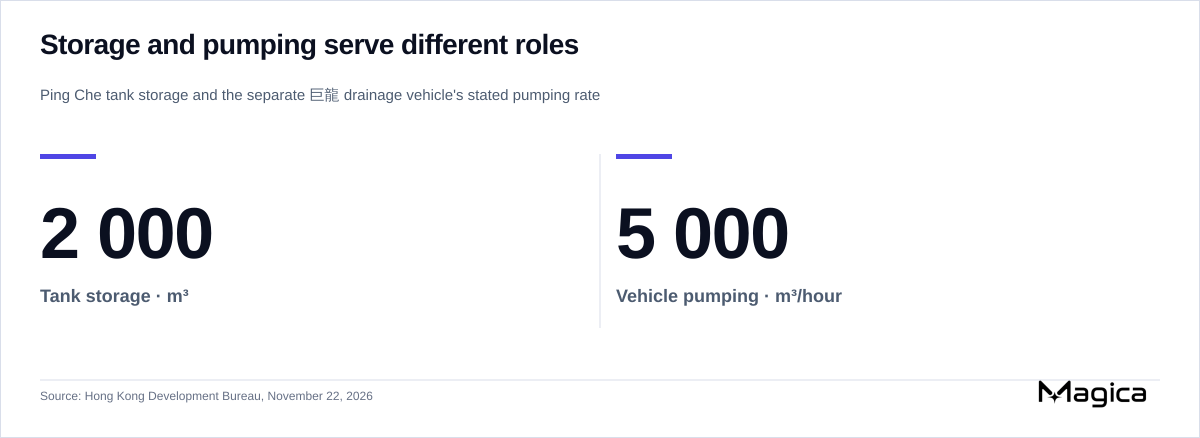
The Development Bureau reports 2,000 cubic metres of tank storage and a separate 巨龍 vehicle pumping rate of 5,000 cubic metres per hour. Source: Development Bureau.
The immediate problem is in the low-lying Ping Che area of Ta Kwu Ling in the northern New Territories. According to the bureau's account, concentrated rain in May and June pushed flows in the upper Ping Yuen River and its tributaries beyond the natural channels' capacity, flooding nearby roads and villages.
The department cleared, dredged and widened waterways and reinforced riverbanks. It also positioned a heavy-duty drainage vehicle called 巨龍, equipped with a telescopic arm that lowers a pump directly into the river. Officials put its pumping capacity at 5,000 cubic metres an hour, moving water to a wider downstream section. That is the vehicle's stated pumping rate, rather than the capacity of the tank's four pumps.
The Ping Che tank opened in late October as an intermediate measure. Its intercepting channel diverts excess river water into 2,000 cubic metres of temporary storage, while four pumps discharge water into a wider downstream reach. Storage buys space for excess water; pumping depends on a route through which that water can be moved.
Reported server price demands reach 45% above earlier agreements. HPE explicitly permits repricing before shipment, while XTX's disputed Dell order raises a sharper question: what happens when a buyer says it paid extra for a fixed price?
Land availability shaped the project. The department reused a Civil Engineering and Development Department site office location, adopted a simple design and assembled pipe sections before the site was ready. It said construction took four months. The bureau says the combined measures substantially reduce local flood risk. Its account gives no project cost, design rainfall threshold or quantified reduction in flooding attributable to the completed tank.
The department's digital programme spans forecasting, detection and equipment reliability. The systems have different coverage and functions.
The department says conventional hydraulic models involve lengthy manual calculations, making continuous, rapid assessment across Hong Kong difficult. Its internally developed 淼立識 system, called Mosaic Model Map in English, was developed in 2024 and used for risk assessments from 2025, according to the department's 2026-27 budget reply. It uses rainfall forecasts from the Hong Kong Observatory to identify areas at higher flood risk one to two hours ahead, displaying maximum predicted extent and depth on a two-dimensional map.
The bureau says it identified vulnerable northern areas, including Shek Wu Wai and Ping Che, allowing officials to position drainage robots nearby before a storm in late July. This is an official account of a deployment, rather than a published measure of forecasting accuracy or time saved.
A more detailed system, 淼弈析, developed with South China University of Technology, combines explainable AI with a digital twin—a digital representation of the physical environment. The department says it displays predicted changes in three-dimensional space over the next two hours, including how quickly water might rise and recede and how long locations could be affected. Officials say that detail helps determine how many teams and what equipment to send. It is being trialled at the Lam Tsuen River in Tai Po, Wan Chai and the Tsui Ping River in Kwun Tong. Those three sites are a narrower deployment than the territory-wide risk-mapping tool.
For detection, the department and the Hong Kong University of Science and Technology developed an AI Flood Monitoring System that analyses images from more than 300 cameras in the police's SmartView network. Officials say it assesses flood severity and alerts the emergency control centre, reducing reliance on staff checking feeds individually or waiting for reports from the scene. The camera network supplies observations; drainage staff still dispatch the response.
The budget reply dates the camera system's development to 2024 and identifies its underlying technology as a large vision-language model, which analyses images using AI. It lists earlier pilots at Chatham Road South in Tsim Sha Tsui, Tai Kiu Tsuen and Tung Tau Wai Village in Yuen Long, followed by expansion through the police camera network.
A fourth system collects pump vibration data and flags anomalies. The department describes this as a move toward maintenance prompted by equipment condition, intended to reduce the risk of pump failures during high flows.
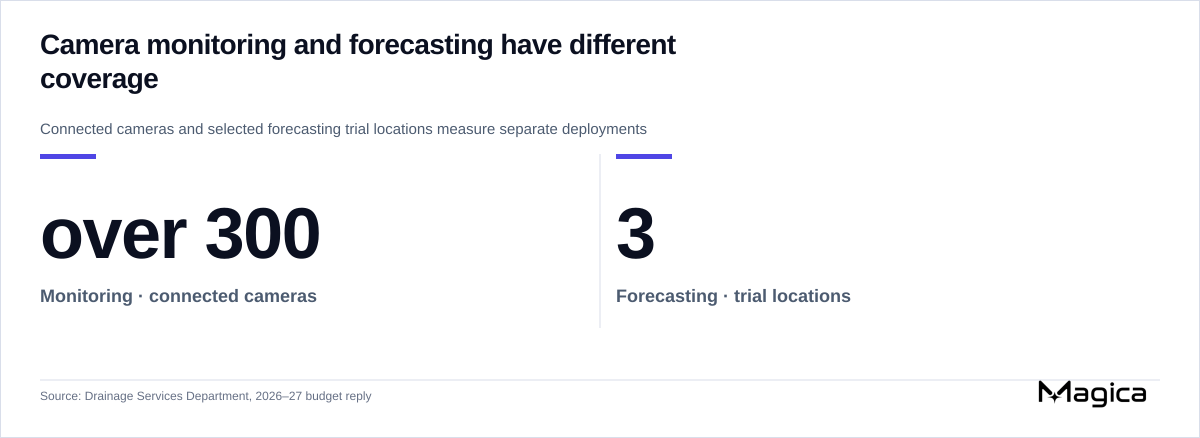
DSD reports over 300 connected SmartView cameras for monitoring and three forecasting trial locations. These figures describe deployment scope, not effectiveness. Source: Drainage Services Department — 2026-27 budget reply.
The budget reply puts camera-system development at approximately HK$6 million, with annual operating expenditure of about HK$1.4 million. The separate forecasting and alert project has an estimated development cost of HK$1.3 million, including operation at its three trial locations in 2026-27. These figures cover different functions, deployment scopes and periods, so they cannot establish which system offers better value.
The department says Mosaic Model Map was developed and operated by staff within its existing establishment, with no additional costs. That describes how the work was resourced, rather than showing that it consumed no staff time. The reply also says departmental funding covers the two university-backed systems; their development and operating expenditure does not come from the separate HK$100 million budget provision for government digital intelligence transformation.
The bureau says it is expanding camera coverage. The next substantive test is whether that expansion and the forecasting trials improve outcomes: reliable warning lead times, missed events and false alarms, deployment speed, and the duration or severity of flooding. The published accounts explain the mechanisms and describe useful deployments, but do not provide those comparative results. The unresolved question is how much earlier intelligence improves protection when local drainage capacity is exceeded—and how much further physical capacity the affected areas need.
OpenRouter disclosed provider removals after investigations into inference data handling. Separate notices describe forwarded requests, a compromised deployment and stolen prompt samples, exposing different weaknesses behind privacy assurances.
Employee equity at Anthropic’s IPO price is reportedly worth $232 billion, while book rightsholders await a first settlement installment estimated at $2,203.56 per work. Vesting, shared copyrights and founder voting rights complicate the comparison.
Moore Threads is preparing a December 29 reveal for Lushan, a desktop GPU pitched at gaming and local AI inference. Its claimed memory record remains unquantified, and capacity alone will not establish performance or value.

Amazon is in advanced talks to buy Decart, whose software helps AI models run efficiently across chips. The reported deal could strengthen AWS’s Trainium business, with conditional payments and five-year founder commitments making execution central to its value.
The University of California is expanding ChatGPT and Codex access across 10 campuses, with extra charges for advanced models and an unresolved dispute over faculty authority.
Ray-Ban’s US store cuts the Gen 2 Wayfarer by 25% to $284.25. Buyers still face separate prescription-lens prices, a cheaper Gen 1 option and newer glasses outside Meta’s frame sale.
Ubisoft has made the team behind its Teammates experiment a dedicated subsidiary targeting AI characters with memory and outside game creators. Earlier playtests show both progress and limitations, while commercial plans remain undisclosed amid group cost cuts and refinancing.
Neuralink has shown a trial participant controlling GTA VI through intended movements. Earlier gaming use and company-reported trial results put the demonstration in context, while its reliability across users remains unmeasured in the reports.
SoftBank founder Masayoshi Son reportedly explored financing a $1 trillion acquisition of memory-chip maker SK hynix, but the company says the deal is no longer under active consideration. The target brings surging earnings, existing shareholders and customer commitments that complicate any simple equation between ownership and access to AI-memory supply.
Nvidia reported $115.8 billion in quarterly revenue, but its shares fell 14% Friday amid a wider technology selloff, a leadership transition and a reported accounting investigation. Strong cash generation offers a counterweight to concerns about the durability of AI spending.
The Nasdaq 100 fell 5.6% on November 20 and closed 19.8% below its record after an intraday bear-market breach. Nvidia’s revenue surge and Anthropic’s huge IPO did not halt the rout; infrastructure bills and resilience elsewhere in the market complicate the picture.
Reporting traces how Megaspeed gained access to Nvidia chips through an unlisted Inspur subsidiary and alleges links to a Cambodian smuggling intermediary. Company denials, differing customs totals and an unresolved criminal investigation complicate the account.
Together AI says an intruder downloaded stored samples of June and July API prompts and searched them for credentials. Zero data retention is now the default for new accounts, but the number of affected customers remains undisclosed.
Users describe grief and physical distress when AI relationships end, whether they choose to leave or the service changes. Research on attachment and farewell tactics raises questions about how providers measure engagement, manage updates and protect intimate data.
UN-backed talks agreed on two more years of work toward an autonomous-weapons instrument, without committing to a treaty. Consensus kept major military powers involved while allowing opponents to weaken the mandate.
Tesla is sending FSD v15 to its first customers, adding a visualization of planned driving and changes to navigation and hazard detection. The software remains supervised, and its claimed 25-fold intervention improvement lacks a disclosed baseline.
OpenAI reports sharply lower reasoning-extraction rates in internal GPT-6.2 tests and backs sanctions against illicit foreign distillation. Its own research and rival Anthropic’s experience show why protecting hidden reasoning leaves capability transfer and customer costs unresolved.
Alberta proposes 600-metre setbacks for large data centres and expanded utility oversight, but exemptions and rules still to be written will determine how much protection communities receive.
President Donald Trump backed Commerce Secretary Howard Lutnick as lawmakers scrutinize alleged delays in restricting a suspected route for AI chips to China. A new congressional inquiry also questions Nvidia’s influence on an existing investigation.