Editorial Team
7 min read
Claude’s estimated October web visits rose 23.8%, but the figures measure neither paying customers nor job losses. A resurfaced account of Dario Amodei discussing immersive games at OpenAI raises a separate question about how AI’s builders approach its social consequences.
Anthropic’s AI assistant Claude recorded its strongest month of estimated web traffic in October, ahead of its developer’s stock-market debut. A November 22 account has also revived a suggestion attributed to Dario Amodei, Anthropic’s chief executive and co-founder, who helped build GPT-2 and GPT-3 as OpenAI’s vice president of research: immersive games might ease political strife from AI-induced joblessness.
Those developments raise distinct questions about commercial success and responsibility toward workers. Traffic measures neither profitability nor job losses; the company’s finances and occupational research provide firmer tests of those consequences.
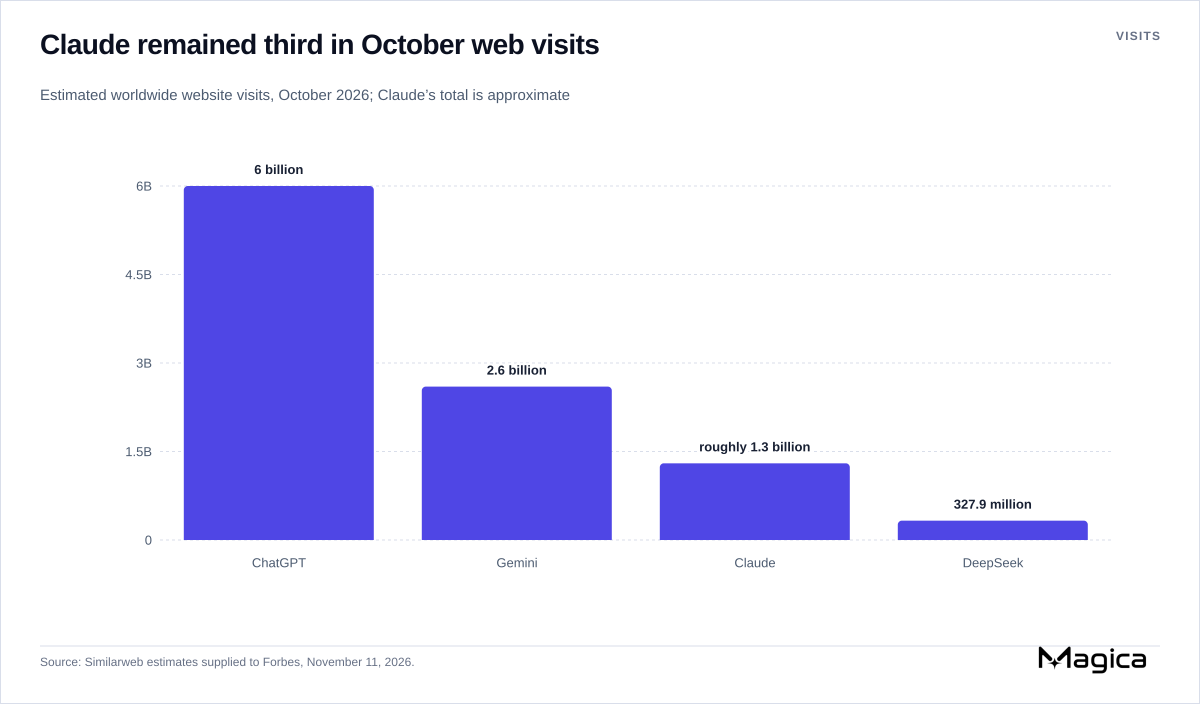
Similarweb’s October 2026 estimates place Claude third among these services. Visits measure activity, not unique users, paying customers or revenue. Source: Forbes.
Anthropic, founded in 2021, describes responsible AI development as its mission in its initial public offering (IPO) prospectus. Claude’s original broader-access announcement described an assistant for writing, summarization, coding and other text tasks, delivered through chat and a developer API. Early distribution included partner products such as Quora’s Poe and Notion, so visits to Claude’s website cannot capture every way people use its technology.
Estimates from digital intelligence platform Similarweb, supplied to a November 11 analysis, put Claude’s worldwide October web visits at roughly 1.3 billion, a 23.8% monthly increase and 536.3% increase from a year earlier. The acceleration followed monthly totals of roughly 950 million to 1 billion between May and September.
The same estimates provide a comparison of October worldwide web visits:
| AI chatbot | Estimated visits | Change from September |
|---|---|---|
| OpenAI’s ChatGPT | 6 billion | +2.2% |
| Google’s Gemini | 2.6 billion | −0.1% |
| Anthropic’s Claude | Roughly 1.3 billion | +23.8% |
| DeepSeek | 327.9 million | +4.7% |
Claude grew fastest among these four services, but remained third in traffic. ChatGPT was also recovering: October was its fourth consecutive month of growth. Visits count activity rather than unique people, paying subscriptions or revenue.
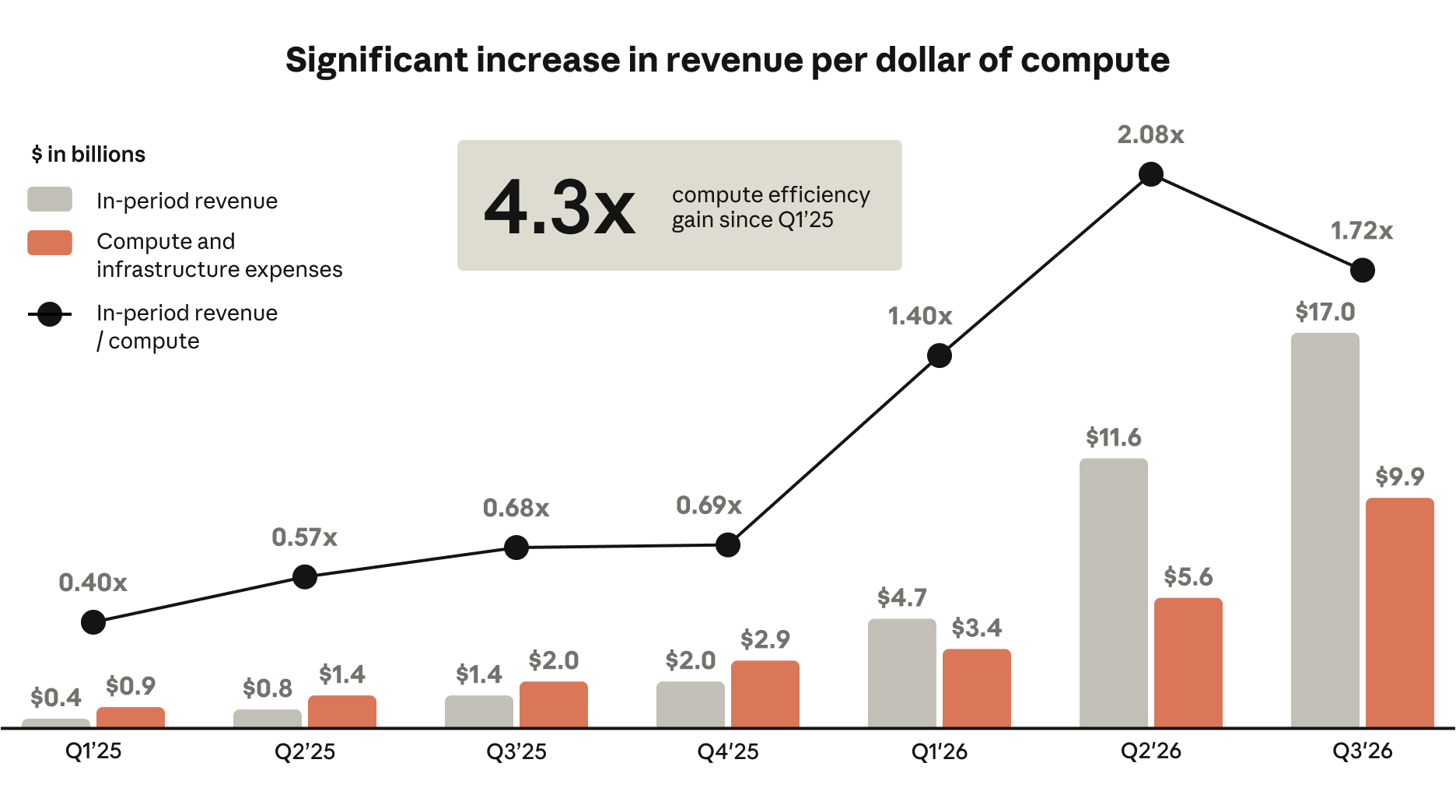
Anthropic’s company-reported revenue and compute expenses through Q3 2026. The comparison excludes other expenses and does not establish profitability. Source: Anthropic IPO prospectus.
The November 11 analysis reported that Anthropic said in a securities filing it sought a $1.4 trillion valuation and planned to offer 825 million shares at $70–$78 each. Those were proposed terms. The November 18 prospectus specifies 980 million shares at $83, including shares sold by existing holders whose proceeds would not go to Anthropic. A November 19 trading account confirms shares began trading on Nasdaq that day under ANT.
The prospectus reports $17 billion in revenue for July–September 2026 and a $104 billion net loss for January–September, including $94.3 billion in fair-value changes to convertible notes, derivative liabilities and future-equity agreements. That accounting loss is not cash consumed.
As of and subsequent to September 30, Anthropic disclosed approximately $900.9 billion in purchase and lease commitments, substantially all for compute and infrastructure, with $451.6 billion expected before December 31, 2030. These multiyear obligations make sustained revenue and financing more consequential than a single month’s traffic growth.
Kalshi is an event-contract exchange that matches participants taking opposing positions. Its Claude market concerns November app downloads, rather than October website visits.
The market page displays a reading from data provider Carbon Arc of 2,033.83 for 20 of November’s 30 days. Its explanation says 100 represents downloads matching the same month a year earlier, with higher readings indicating growth. The displayed figure is consequently an index reading, not 2,033.83 downloads or millions of downloads.
The page’s digest said traders heavily favored the index failing to exceed 2,110.5. However, different parts of the captured page displayed inconsistent probabilities for that threshold. A precise consensus probability would overstate what the snapshot reliably establishes. The available Carbon Arc reference page provides no usable methodological detail, leaving the underlying measurement unverified here.
Neither the partial-month index nor market prices can be combined with Similarweb’s monthly web estimates into a single measure of Claude adoption. They concern different channels, periods and measurement systems.
OpenAI, the AI developer now competing with Anthropic through ChatGPT, credited Amodei with helping build its GPT-2 and GPT-3 language models and co-leading research direction in its December 2020 departure announcement. That technical record helps explain why his discussion of the technology’s consequences matters.
A November 22 account, citing a Wall Street Journal profile, says Amodei suggested during his OpenAI tenure that immersive video games might ease political strife caused by AI-induced joblessness. The account refers to widely circulated Slack messages, but does not describe an official proposal or explain how the idea would work. A report similarly describes debates with fellow employees.
The available accounts do not provide the original Slack exchange, its exact date or a current response from Amodei. They describe a historical discussion about political strife, with no specified mechanism to replace lost income or create work.
There is also a distinction between voluntary commitments and enforceable obligations. The November 22 account, citing the Journal profile and Anthropic’s prospectus, describes pledges by Amodei, company president and co-founder Daniela Amodei, and five other co-founders to dedicate 80% of their personal company equity to philanthropy. It says those pledges are voluntary, revocable and not legally binding. They do not establish a funded response to worker displacement.
Separately, Anthropic’s prospectus describes its public-benefit corporate obligation to balance shareholder interests, affected parties and responsible AI development. That obligation does not make the personal pledges binding.
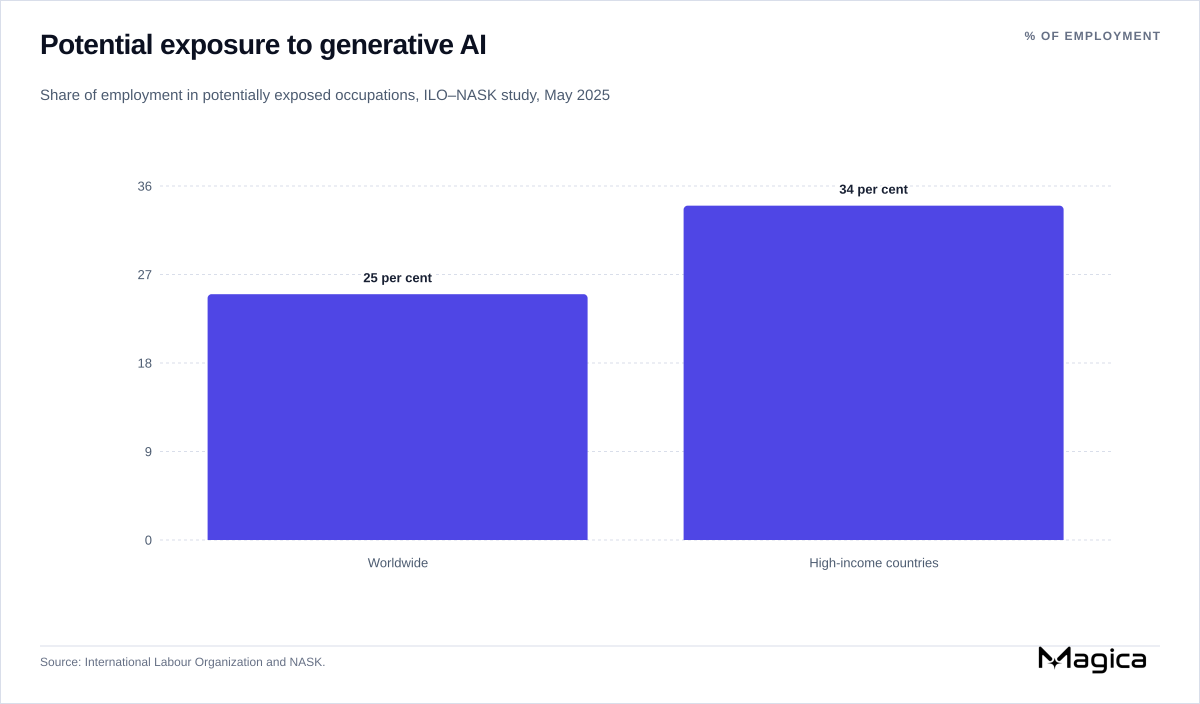
ILO–NASK estimates describe potential occupational exposure, not observed job losses. High-income countries are included in the worldwide estimate. Source: International Labour Organization.
The employment premise needs evidence of its own. A May 2025 study by the International Labour Organization and Poland’s National Research Institute, NASK, estimated that 25% of global employment was in occupations potentially exposed to generative AI, rising to 34% in high-income countries. Its assessment combined nearly 30,000 occupational tasks with expert validation, AI-assisted scoring and employment microdata.
Clerical jobs had the highest exposure. In high-income countries, occupations at the highest risk of automation represented 9.6% of female employment and 3.5% of male employment. Those figures describe potential exposure, not observed job losses. The researchers considered transformation more likely than replacement and identified infrastructure gaps, skills shortages and technological constraints as limits on implementation.
The November 22 account also cites a June 2026 ILO review finding that large-scale displacement remained limited so far, while flagging inequality, fewer opportunities for younger workers and job-quality risks. That is a more qualified picture than a future in which all work disappears.
For Claude’s business, the next test is sustained commercial returns against infrastructure commitments. For workers, it is changes in employment, earnings and job quality. The ILO–NASK study calls for governments, employers and worker organizations to shape the transition. The reported Slack discussion leaves unresolved what concrete measures Amodei and Anthropic would support if displacement becomes widespread.
OpenAI wants frontier labs to tie development limits to prediction loss and monitoring milestones. Its internal figures offer a starting point, but datasets differ across companies and the metric misses major reasoning gains.
A 2,000-cubic-metre tank and mobile pumping capacity address northern Hong Kong flooding, while AI tools help position crews and detect rising water. Official records distinguish established monitoring from three-site forecasting trials, with costs disclosed but comparative performance results absent.
Reported server price demands reach 45% above earlier agreements. HPE explicitly permits repricing before shipment, while XTX's disputed Dell order raises a sharper question: what happens when a buyer says it paid extra for a fixed price?
OpenRouter disclosed provider removals after investigations into inference data handling. Separate notices describe forwarded requests, a compromised deployment and stolen prompt samples, exposing different weaknesses behind privacy assurances.
Foreign intelligence officials describe a Chinese state security team helping companies obtain restricted AI chips and collecting semiconductor intelligence. The reported campaign predates the Megaspeed controversy, while new US rules target a separate route: remote access to computing power abroad.
Elon Musk says Tesla cars will retain AI4 while AI5 goes to Optimus. An upgraded AI4 remains in development, hardware costs are rising, and older-car owners still lack a retrofit date.
Visa Crypto Labs is testing an invitation-only wallet for US users to earn and spend OUSD through AI agents. Card verification links agents to owners, but marketplace admission, work acceptance and live identity checks remain separate hurdles.
Treasury Secretary Scott Bessent said responsibility for disputed China chip sales must be established before he backs Jensen Huang’s return to Nvidia, despite President Donald Trump’s support.
Employee equity at Anthropic’s IPO price is reportedly worth $232 billion, while book rightsholders await a first settlement installment estimated at $2,203.56 per work. Vesting, shared copyrights and founder voting rights complicate the comparison.
Moore Threads is preparing a December 29 reveal for Lushan, a desktop GPU pitched at gaming and local AI inference. Its claimed memory record remains unquantified, and capacity alone will not establish performance or value.

Amazon is in advanced talks to buy Decart, whose software helps AI models run efficiently across chips. The reported deal could strengthen AWS’s Trainium business, with conditional payments and five-year founder commitments making execution central to its value.
The University of California is expanding ChatGPT and Codex access across 10 campuses, with extra charges for advanced models and an unresolved dispute over faculty authority.
Ray-Ban’s US store cuts the Gen 2 Wayfarer by 25% to $284.25. Buyers still face separate prescription-lens prices, a cheaper Gen 1 option and newer glasses outside Meta’s frame sale.
Ubisoft has made the team behind its Teammates experiment a dedicated subsidiary targeting AI characters with memory and outside game creators. Earlier playtests show both progress and limitations, while commercial plans remain undisclosed amid group cost cuts and refinancing.
Neuralink has shown a trial participant controlling GTA VI through intended movements. Earlier gaming use and company-reported trial results put the demonstration in context, while its reliability across users remains unmeasured in the reports.
SoftBank founder Masayoshi Son reportedly explored financing a $1 trillion acquisition of memory-chip maker SK hynix, but the company says the deal is no longer under active consideration. The target brings surging earnings, existing shareholders and customer commitments that complicate any simple equation between ownership and access to AI-memory supply.
Nvidia reported $115.8 billion in quarterly revenue, but its shares fell 14% Friday amid a wider technology selloff, a leadership transition and a reported accounting investigation. Strong cash generation offers a counterweight to concerns about the durability of AI spending.
The Nasdaq 100 fell 5.6% on November 20 and closed 19.8% below its record after an intraday bear-market breach. Nvidia’s revenue surge and Anthropic’s huge IPO did not halt the rout; infrastructure bills and resilience elsewhere in the market complicate the picture.
Reporting traces how Megaspeed gained access to Nvidia chips through an unlisted Inspur subsidiary and alleges links to a Cambodian smuggling intermediary. Company denials, differing customs totals and an unresolved criminal investigation complicate the account.
Together AI says an intruder downloaded stored samples of June and July API prompts and searched them for credentials. Zero data retention is now the default for new accounts, but the number of affected customers remains undisclosed.