This blog post breaks down essential information about camera lenses for beginners, covering types, focal lengths, apertures, and recommendations for first lenses. It explains how lenses work, the differences between prime and zoom lenses, and key features like autofocus and stabilization, helping readers make informed choices for photography and videography.
Camera lenses can be confusing for beginners, with various numbers and specifications that may seem overwhelming. This guide aims to clarify the essential aspects of camera lenses, helping you choose the right one for your photography or videography needs.
A camera lens allows light to pass through different pieces of glass, known as lens elements. These elements bend light to focus it on the camera sensor, creating an image. Without a lens, a DSLR or mirrorless camera is practically useless.
Each camera brand has its own lens mounting system. For example, Sony uses the E-mount system, meaning only E-mount lenses can be attached to Sony cameras. Canon, on the other hand, has different mounts for its older DSLRs (EF Mount) and newer mirrorless cameras (RF Mount). It is crucial to purchase the correct lens for your camera type, as using lens mount converters can lead to trade-offs.
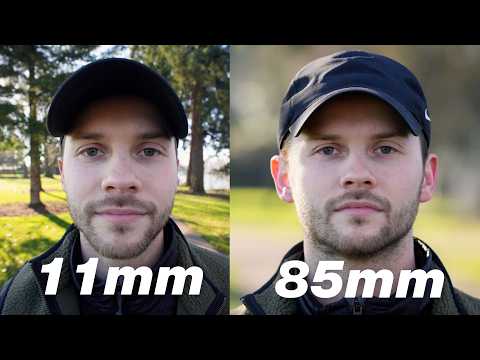
Focal length, expressed in millimeters (mm), is one of the most important factors in a lens. It determines the field of view (FOV) and affects how much of the scene is captured.
Lenses fall into two categories: prime and zoom.
Aperture controls how much light enters the camera and affects depth of field, measured in f-stops (e.g., f/1.8, f/16).
Lenses are designed for either full-frame or APS-C (crop sensor) cameras. The crop factor affects the effective field of view:
Most modern lenses feature autofocus, but manual focus can provide more control, especially in specific situations.
Each lens has a minimum focusing distance, the closest distance at which it can focus on a subject. For example, a lens with a minimum focus distance of 0.38m (1.25ft) must be at least that far from the subject to achieve focus.
Focus breathing refers to a slight change in the lens's field of view when adjusting focus, which can be distracting in video. Some cameras have settings to compensate for this.
Some lenses feature stabilization to reduce vibrations and jitters, especially useful for handheld shooting. This is different from in-body image stabilization (IBIS) found in some cameras.
Most lenses come with a lens hood to block unwanted light and reduce flare. Additionally, lenses have threads for attaching filters, with sizes indicated on the lens. Step-up or step-down rings can adapt filters to different lens sizes.
For beginners, a kit lens is often the easiest starting point, typically costing around $100-$150. Here are some recommendations:
Understanding camera lenses is crucial for any photographer or videographer. By grasping the basics of focal lengths, apertures, and lens types, you can make informed decisions that enhance your shooting experience. Whether you choose a prime or zoom lens, the right choice will depend on your specific needs and shooting style. Happy shooting!