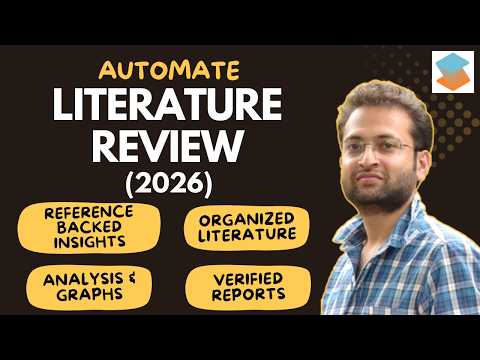
Conducting literature reviews can be overwhelming due to the vast number of research papers and scattered notes. AI tools like SciSpace streamline this process by enabling efficient search across multiple databases, organizing papers, extracting key insights, and generating comparison tables. While AI accelerates discovery and summarization, verifying details from original papers remains essential for ethical research.
One of the most challenging parts of research is finding relevant papers, organizing them, extracting key insights, and turning all that information into a literature review, thesis, or research paper. Researchers often face the daunting task of staring at dozens or even hundreds of PDFs and scattered notes, which can be overwhelming and lead to delays and procrastination before the real work even begins.
In this article, we explore how AI-powered tools like SciSpace can help address these challenges and make the literature review process faster and more efficient.
Before diving into the features of SciSpace, it is important to clarify how AI tools should be used in research. AI should not replace reading research papers entirely. Instead, it should be used to speed up discovering relevant studies, getting quick summaries, and identifying which papers are worth deep reading. For important details such as methods, key findings, citations, or anything to be included in your own work, always refer back to the original paper and verify the information. This approach ensures ethical and judicious use of AI.
Most researchers rely on search engines like Google Scholar or PubMed, experimenting with different keyword combinations until they find useful studies. This process can be time-consuming and inefficient.
SciSpace allows you to search across various databases from a single platform, including Google Scholar, PubMed, and SciSpace’s own database. Additionally, if you have papers saved in reference managers like Zotero or Mendeley, linking these accounts with SciSpace enables the tool to extract information from your existing libraries.
This unified search approach eliminates the need to search individually across different databases or tools.
Unlike generic search tools that rely heavily on exact keywords, SciSpace understands the context behind your query. This reduces the time spent refining search terms and helps you find relevant papers more quickly.
You can also upload PDFs directly to your SciSpace library, bringing all important papers for your project into one organized workspace. This prevents endless searching and keeps your research materials consolidated.
SciSpace has been benchmarked against other AI literature search tools like Consensus and Elicit across hundreds of research queries. The results show that SciSpace’s deep review consistently returns more highly relevant papers, reducing the time spent screening them.
Research papers often end up scattered across download folders, cloud drives, and different devices. SciSpace allows you to create folders within your library for different projects or manuscripts, keeping all your papers organized and easily accessible.
This organization is especially useful when working on multiple projects or long-term reviews.
Not every paper deserves the same amount of attention. You might need background information from one paper, methodology from another, and key findings from a third.
SciSpace offers a chat feature that lets you ask questions about specific papers, such as:
This feature helps you quickly extract insights without manually searching through long PDFs.
SciSpace agents can perform various types of data analysis by combining evidence from research papers with datasets from organizations like WHO and CDC. By describing your objective in plain language, the agent can retrieve relevant information, perform analysis, and generate visualizations.
For times when you cannot read every paper immediately, SciSpace can generate audio summaries that you can listen to like a podcast. This feature is useful during commuting, exercising, or breaks, providing a quick overview of a paper’s content.
Reading a single paper is manageable, but comparing multiple papers to identify trends, differences, and useful insights is challenging. It is easy to forget which study used a particular method or reported a specific result.
SciSpace allows you to add multiple papers to your workspace and generate comparison tables that display key information side by side, such as study design, sample size, methods, key findings, and limitations.
You can ask questions across multiple papers to uncover patterns, contradictions, and emerging themes. Answers are linked back to the original papers, making it easy to verify information and trace it to the source.
This feature helps you spend less time searching through PDFs and more time generating meaningful insights.
Many researchers prefer taking their own notes after verifying information to ensure accuracy and originality. However, notes often become scattered across different apps, documents, or notebooks.
SciSpace enables you to highlight important information, add your own notes, and mark citations within the same workspace. This keeps everything organized and accessible.
SciSpace can automate many time-consuming steps such as finding relevant papers, organizing them, summarizing key information, generating comparison tables, and extracting important findings. This can save significant time, especially during the early stages of a literature review.
You can even provide a single prompt to perform a sequence of tasks including finding literature, suggesting inclusion and exclusion criteria, comparing studies, extracting insights, identifying patterns, and generating a synthesized literature review.
One major concern with AI-generated outputs is the reliability of claims and citations. SciSpace addresses this by offering verified reports under its deep review feature. Before generating the final report, it validates claims against original sources, removes duplicate references, and reduces hallucinated citations.
This increases confidence in the accuracy, transparency, and verifiability of the generated reports.
Despite these advances, it is still recommended to evaluate the quality of studies, verify extracted information, interpret findings, and decide on conclusions yourself.
Once you have gathered all the information, SciSpace allows you to export comparison tables, notes, and bibliographies. This saves time and reduces the need to manually copy information between different tools.
Many researchers and students use ChatGPT for research tasks. However, generic AI tools may not always provide reliable citation-backed outputs.
SciSpace’s ChatGPT app integration enables you to discover papers, conduct literature reviews, and generate research-backed insights directly within ChatGPT while maintaining access to citations and source papers.
This integration supports identifying research gaps, generating presentations, grant writing, and academic writing. Dedicated AI agents assist with systematic literature reviews and manuscript preparation.
AI tools like SciSpace significantly streamline the literature review process by enabling efficient search, organization, summarization, comparison, and note-taking. While AI accelerates many steps, ethical research requires verifying key details from original papers and interpreting findings personally.
By combining AI capabilities with careful human evaluation, researchers can save time and produce high-quality, reliable literature reviews and research papers.
If you are interested in automating your literature review process, exploring SciSpace and its features can be a valuable step forward.