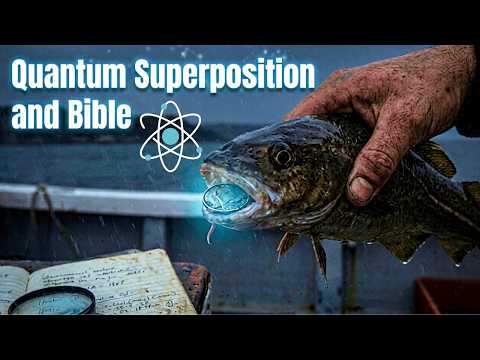
Matthew 17:27 describes Jesus instructing Peter to find a coin in a fish's mouth to pay a tax, illustrating a deeper principle of provision beyond conventional means. This blog explores how this biblical event parallels concepts in quantum physics, emphasizing faith, obedience, and alignment with divine instruction as keys to accessing hidden resources and experiencing timely provision.
The story of Jesus instructing Peter to find a coin inside the mouth of a fish to pay the temple tax is more than a simple miracle. It challenges our conventional understanding of how provision and money appear in our lives. This event unsettles the logic of survival based on predictable income and reveals a deeper pattern of access to resources that are hidden until the moment of obedience.
Many of us have experienced moments when, despite prayer, hard work, and responsibility, the numbers don’t add up. The future feels uncertain, and we quietly wonder where God’s provision really is. If provision only comes through predictable channels like jobs or investments, what happens when those channels dry up or become unstable?
Peter faced a similar tension. A tax was due, a real obligation with a deadline. Jesus did not dismiss the importance of money or taxes. Instead, He gave Peter a specific and unusual instruction: to go to the lake, cast a line, catch the first fish, and find a coin in its mouth. This coin was enough to cover the tax.
This was not about fishing skills or luck. It was about access to hidden resources. The coin was always there but concealed until Peter obeyed Jesus’ instruction. This moment reveals a kingdom pattern that transcends economics and effort. It points to a system where provision exists but is not immediately visible or accessible.
Modern science, particularly quantum physics, offers a concept that resonates with this biblical event. In quantum physics, particles can exist in multiple states simultaneously—possibilities not yet decided until observed or interacted with. This is known as superposition.
Similarly, the coin in the fish was present but not accessible until Peter acted in faith. His obedience collapsed the field of possibility into a tangible reality. What was hidden became visible instantly and unexpectedly.
Many people chase money, trying to control outcomes through effort and strategy. However, the story of Peter suggests a radically different approach: provision is not always about pursuit but about alignment. It involves tuning into a frequency, a word, or an instruction that reveals where provision already exists.
People often look for provision in predictable places—jobs, markets, investments. While these are valid, they are not ultimate. The kingdom operates under authority, not limitation. Authority speaks, responds, and positions provision rather than chasing it.
Jesus did not hand Peter a coin directly. Instead, He involved Peter in the process to shift his understanding of the source of provision. Provision can appear from places no system could predict or strategy could design—often in ways that seem improbable but perfectly timed.
Many people exhaust themselves trying to force provision through closed doors, leading to fatigue and spiritual weariness. The invitation here is not to push harder but to listen differently. Peter did not argue or analyze; he moved in obedience, and the unseen became visible.
This kind of faith, sometimes called quantum faith, is practical and expects God’s word to materialize precisely at the right moment, in the right form, and often through unexpected channels.
As people embrace this perspective, they stop asking, "Where can I get money?" and start asking, "What is God revealing that I haven’t seen yet?" This shift moves one from chasing to perceiving, from striving to discerning.
Expectation shapes perception. Two people in the same situation can see either opportunity or limitation based on their awareness. The shift begins internally, with how one interprets and responds to what is in front of them.
For those interested in deepening this alignment, a practical tool called the Quantum Wealth Scripture Journal offers 30 days of aligning biblical truth with intentional awareness. This daily practice helps structure the shift from theory to application, fostering sensitivity and willingness to move when prompted.
Provision is often concealed before it is revealed. What feels like lack may be a pause before manifestation—a space where possibilities exist unseen and unformed, waiting for alignment to occur.
This understanding brings peace—not from having everything figured out but from trusting that what is needed already exists and will appear at the appointed moment.
This perspective does not remove responsibility but refines it. Responsibility becomes about awareness, sensitivity, and readiness to move even when instructions seem unusual or illogical.
What part of your life feels like lack but could actually be concealment? What would change if you approached your situation with expectation instead of fear? Many miss provision because it does not match their expectations.
The real question is not just where your money is coming from but what God is asking you to do that you haven’t done yet. On the other side of obedience, something prepared and hidden in plain sight may be waiting.
The story of the coin in the fish is not just a theological lesson but a practical invitation to shift from striving to alignment, from chasing to perceiving. It reveals that provision is positioned by divine authority and can appear in unexpected ways at the right moment.
When this truth becomes a lived awareness, anxiety softens, urgency fades, and pressure lifts. You stop reacting and start responding. You stop chasing and start aligning. And in that alignment, provision appears quietly, precisely, and just when it is needed.
This message is a reminder that sometimes one perspective shift is all it takes to see what was there all along.