In the AI era, distinguishing truth from sophisticated fakes requires mastering critical thinking. This article explores five key distortions that hijack judgment—authority bias, marketing deception, groupthink, AI overreliance, and self-deception—and offers practical tools to sharpen your critical thinking skills, helping you navigate a world where lies can look exactly like truth.
People often claim that AI is making us the "stupidest generation in history." However, the real danger lies not in AI itself but in a crisis of critical thinking. In an age where AI can fabricate videos, voices, and information that look indistinguishably real, the ability to think critically and judge information accurately is more important than ever.
When machines can outsmart humans in many domains, the one ability that remains uniquely valuable is human judgment. This article explores five common distortions that hijack our judgment daily and provides simple tools to improve how we think more clearly.
In January 2024, a finance employee at the Hong Kong company Arup received a message from his CFO to transfer $25 million. Sensing something was off, the employee requested a video call to confirm the instructions. The CFO and team appeared on the call, guiding the employee step-by-step.
Feeling reassured, the employee transferred the money. Days later, it was revealed that the entire video call was a deepfake — AI-generated faces and voices mimicking the real CFO and team members. The $25 million was lost forever.
This story highlights the challenge of finding the "real needle" in a haystack of fake needles, underscoring the critical need for sharp critical thinking skills.
Three of these distortions come from external sources, which the author calls the "asks" (spelled ASC, sounding like "ask"). They are:
Authority can fool even the smartest people. Consider the case of Theranos, a company that promised revolutionary blood testing technology using just a single drop of blood. It raised $700 million and was valued at $9 billion, led by Elizabeth Holmes, a charismatic founder who emulated Steve Jobs.
Despite impressive board members and investors, no one asked the critical question: Did the technology actually work? The company kept its technology secret for 12 years, and when investigative journalism exposed the truth, it was revealed that the technology was a sham. Holmes was sentenced to 11 years in prison.
Why did smart investors fail?
Actionable Tool: Always ask, "What needs to be true for this to be real?" Use AI to gather evidence supporting and challenging claims.
Big companies no longer need to lie outright; they craft "true lies" — statements that are technically true but misleading.
Examples include:
Actionable Tool: Use the "question mark move." When you hear marketing phrases, mentally add a question mark and critically analyze the claim. For example, "Up to 8 times faster? Faster than what?"
Groupthink can stop you from thinking independently. A famous experiment showed that when seven actors gave wrong answers confidently, the eighth real participant often conformed, even when the correct answer was obvious.
Mass belief does not guarantee truth, as seen in historical events like the Salem witch trials and financial bubbles.
Actionable Tool: When everyone agrees, seek out dissenting opinions. Use AI as a devil's advocate to challenge consensus views.
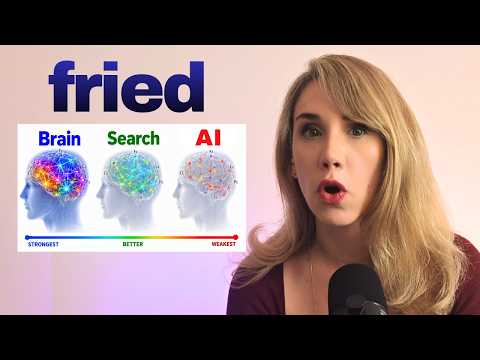
MIT research found that people who used AI tools to write essays showed less brain activity and could not recall their own writing well. Outsourcing thinking to AI can dull creativity and critical analysis.
Actionable Tool: When using AI, include prompts like "Be precise" and "Please verify." Cross-check AI outputs by having one AI review another's work.
The hardest distortion to overcome is our own bias. We tend to believe what we want to be true and avoid facts that contradict our desires.
A personal story illustrates this: A man deeply in love with a woman believed they were meant for each other, but she wisely pointed out that his love alone was not enough to make her fall in love.
Actionable Tool: Ask yourself, "What am I refusing to see because I need this story to be true?" Stay vigilant against self-deception.
In today's world, reality and falsehoods are so intertwined that distinguishing them is challenging. Your judgment and critical thinking skills are your best tools to navigate this fog.
The road to clear thinking may be long and winding, but it leads home. By slowing down, questioning assumptions, and sharpening your critical faculties, you can avoid costly mistakes and see what others miss.
Critical thinking is the most valuable skill in the AI era. It helps you discern truth from sophisticated fakes, resist manipulation by authority and marketing, avoid groupthink, use AI wisely, and confront your own biases.
Invest in your judgment. Ask the right questions. Challenge consensus. Verify information. And remember, the ability to think clearly and critically will make you truly dangerous — in the best way — in the age of AI.
Thank you for reading. Stay curious and keep questioning.