This article explores the methods of utilizing material information in finite element software, particularly focusing on Abaqus. It covers the definition of materials, their behavior under stress and temperature, and practical applications in engineering.
In this article, we will discuss the methods of using material information in finite element software, with a primary focus on Abaqus. We will start with a general overview of materials, followed by how materials are defined in finite element analysis. Finally, we will explore practical applications and methods for processing the obtained material data.
Materials in engineering are categorized based on their properties. It is essential to understand that no material possesses uniform characteristics. For instance, when examining a vehicle, the stress and strain observed can vary significantly due to manufacturing processes. Materials can be classified into different categories based on their properties, such as elastic and plastic materials.
Materials can be divided into:
Understanding these classifications is crucial for accurate modeling in finite element analysis.
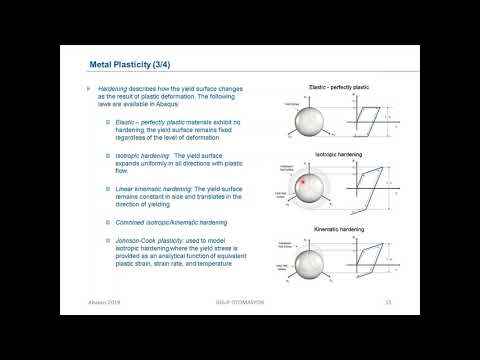
In Abaqus, defining materials involves specifying their properties accurately. The behavior of materials under different conditions, such as stress and temperature, must be modeled correctly to predict their performance in real-world applications.
Once materials are defined, various applications can be explored using finite element analysis. Here are some key considerations:
The behavior of materials can change significantly with temperature. For instance, the Young's modulus may vary, and it is crucial to input temperature-dependent properties into the software.
When analyzing materials under load, it is essential to understand how they will behave under different stress conditions. This includes:
Composite materials require special attention due to their unique properties. The orientation of fibers and the interaction between different materials must be accurately modeled to predict performance.
In conclusion, the accurate definition and understanding of materials in finite element software like Abaqus are crucial for successful engineering applications. By considering factors such as stress, temperature, and material behavior, engineers can create reliable models that reflect real-world conditions. This knowledge is essential for optimizing designs and ensuring the integrity of engineering projects.