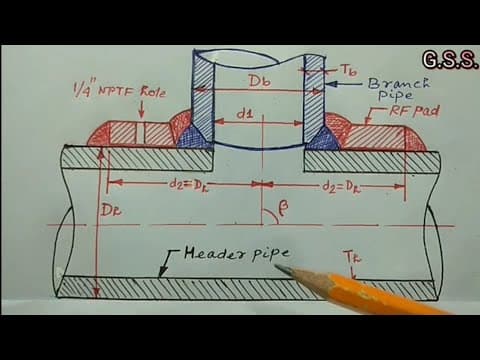
This blog post explores the process of branch calculations in piping engineering as per ASME B31.3, detailing examples of reinforced and unreinforced branch connections, including material specifications, design pressures, and thickness calculations.
Piping engineering is a critical aspect of various industries, particularly in the design and maintenance of piping systems. One of the essential components of piping design is the calculation of branch connections. This blog post delves into the process of branch calculations as per ASME B31.3, providing detailed examples to illustrate the concepts.
In piping systems, branch connections are used to connect a branch pipe to a header pipe. These connections can be reinforced or unreinforced, depending on the design requirements and the stresses involved. The reinforcement is crucial for ensuring the integrity and safety of the piping system under various operating conditions.
Let’s consider a scenario where we need to check the suitability of a 12-inch by 12-inch direct branching for a cooling water line. The design pressure is 7 kg/cm² gauge, and the design temperature is 60 degrees Celsius. The material used is API 5L Grade VAR W Schedule 20, which has a nominal thickness of 6.35 mm.
Header Thickness (T_H):
T_H = Nominal thickness of header × 0.875
T_H = 6.35 mm × 0.875 = 5.55 mm
Branch Thickness (T_B):
T_B = Nominal thickness of branch × 0.875
T_B = 6.35 mm × 0.875 = 5.55 mm
Minimum Pressure Design Thickness of Header (t_H):
t_H = PD₀ / (2AC + 2Py)
t_H = 0.95 mm
Allowable Stress (S):
S = Allowable stress of API 5L Grade V at 60 degrees Celsius = 20 ksi
S = 20 × 6.89476 = 140.6 kg/cm²
Joint Efficiency:
Joint efficiency = 0.854
Minimum Pressure Design Thickness of Branch (t_B):
t_B = 0.95 mm
Khorasan Allowance (C):
C = 1.5 mm
Height of Reinforcement Zone (L₄):
L₄ = 2.5 × (T_H - C) = 10 mm
Effective Length Removed from Header at Branch (d₁):
d₁ = Branch OD - 2 × Run thickness = 3.11 mm
Half Width of Reinforcement Zone (d₂):
d₂ = max(d₁, T_B - C + T_H - C + d₁/2) = 3.11 mm
Required Reinforcement Area (A₁):
A₁ = t_H × d₁ × 2 - sin(β) = 591.5 mm²
Area from Excess Thickness in Header (A₂):
A₂ = 2 × (d₂ - d₁) × (T_H - t_H - C) = 965 mm²
Area from Excess Thickness in Branch (A₃):
A₃ = 2 × L₄ × (T_B - t_B - C) / sin(β) = 62.7 mm²
Since A₁ is less than A₂ + A₃, no branch reinforcement is required. Thus, the 12-inch by 12-inch direct branching is suitable without reinforcement.
In another example, we consider a branch size of 16 inches with a nominal thickness of 9.5 mm and an 8-inch branch with a nominal thickness of 6.35 mm. The service is compressed air at a design pressure of 30 kg/cm² gauge and a design temperature of 60 degrees Celsius. The material remains API 5L Grade VAR.
Header Thickness (T_H):
T_H = 9.5 mm × 0.875 = 8.31 mm
Branch Thickness (T_B):
T_B = 6.35 mm × 0.875 = 5.55 mm
Minimum Pressure Design Thickness of Header (t_H):
t_H = 5.05 mm
Minimum Pressure Design Thickness of Branch (t_B):
t_B = 2.73 mm
Khorasan Allowance (C):
C = 1.5 mm
Height of Reinforcement Zone (L₄):
L₄ = 2.5 × (T_H - C) = 17.02 mm
Effective Length Removed from Header at Branch (d₁):
d₁ = 207.3 mm
Half Width of Reinforcement Zone (d₂):
d₂ = max(d₁, T_B - C + T_H - C + d₁/2) = 207.3 mm
Required Reinforcement Area (A₁):
A₁ = t_H × d₁ × 2 - sin(β) = 2093.7 mm²
Area from Excess Thickness in Header (A₂):
A₂ = 2 × (d₂ - d₁) × (T_H - t_H - C) = 365 mm²
Area from Excess Thickness in Branch (A₃):
A₃ = 2 × L₄ × (T_B - t_B - C) / sin(β) = 45 mm²
In this case, since A₁ is greater than A₂ + A₃, branch reinforcement is required. The required reinforcement thickness can be calculated as follows:
Since A₂ + A₃ + F₄ is greater than A₁, the reinforcement is adequate.
Branch calculations are essential in ensuring the safety and reliability of piping systems. By following the guidelines set forth in ASME B31.3, engineers can determine whether a branch connection requires reinforcement or if it can be safely implemented without additional support. Understanding these calculations is crucial for maintaining the integrity of piping systems across various applications.