This article explores the concept of design resistance in limit state design, emphasizing the importance of ensuring that the resistance of structural members exceeds the applied loads. It discusses the Eurocode 3 guidelines for calculating design resistance, including the use of partial safety factors and the significance of conservativeness in structural design.
In the realm of structural engineering, ensuring the stability and safety of structures is paramount. One critical aspect of this is the concept of design resistance, particularly in limit state design. This article delves into the principles of design resistance, focusing on how it is determined and its significance in maintaining structural integrity.
Design resistance refers to the ability of a structural member to withstand applied loads without failure. For a structure to be deemed fit for use, the resistance of its members must always exceed the loads acting upon them. This fundamental principle ensures that structures remain stable and safe under various conditions.
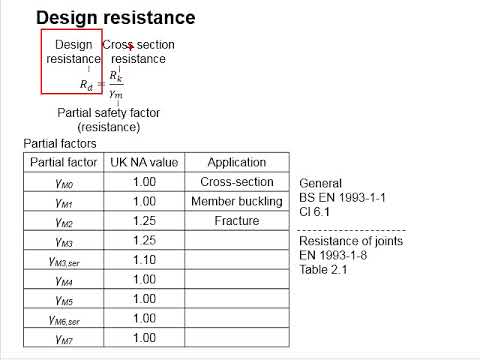
According to the Eurocode 3 guidelines, the design resistance of a member is calculated by dividing the actual resistance of the cross-section by specific partial factors of safety. These factors are crucial as they account for uncertainties in material properties, loading conditions, and potential failure modes.
The Eurocode 3 provides a table detailing the partial factors of safety, commonly referred to as gamma factors. The relevant factors include:
Typically, the values for these factors are as follows:
These factors are essential in ensuring that the design resistance is conservative, meaning it provides a safety margin against potential failures.
To calculate the design resistance of a member, one must first determine the actual resistance of the cross-section. This value is then divided by the appropriate partial factor of safety. The resulting design resistance must be checked against the design loads acting on the member. It is crucial that the design loads do not exceed the design resistance to ensure the safety of the structure.
The concept of conservativeness is integral to structural design. Several layers of conservativeness are considered:
These multiple layers of conservativeness work together to mitigate uncertainties in various aspects of design, ultimately leading to a safe and reliable steel structure.
In conclusion, understanding design resistance is crucial for engineers involved in limit state design. By adhering to the Eurocode 3 guidelines and incorporating partial factors of safety, engineers can ensure that the resistance of structural members exceeds the applied loads. This comprehensive approach to design not only enhances safety but also instills confidence in the structural integrity of buildings and other constructions.