This article explains the row column transposition cipher, a classical encryption technique that rearranges the positions of letters in plaintext without substitution. It covers the creation of a rectangle grid, filling plaintext row-wise, reading ciphertext column-wise based on a key, and demonstrates the process with an example. It also explores enhancing complexity by applying multiple stages of transposition.
In classical cryptography, two primary techniques are substitution and transposition. While substitution replaces letters with other letters, transposition rearranges the positions of the letters without changing the letters themselves. This article focuses on a more complex transposition technique known as the row column transposition cipher.
This technique is more intricate than the Rail Fence cipher and involves creating a rectangular grid to rearrange the plaintext letters systematically. By the end of this article, you will understand how the row column transposition works, how to generate ciphertext using this method, and how to increase the complexity of the cipher to make it harder to break.
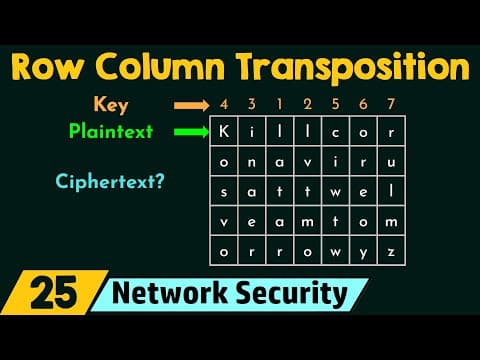
Row column transposition is a method where the plaintext letters are written into a rectangle grid row by row, and then the ciphertext is generated by reading the letters column by column in a specific order determined by a key.
This method does not substitute letters but permutes their positions, making it a transposition cipher.
The sender and receiver decide on the dimensions of the rectangle. For example, it could be 5 rows by 7 columns, or any other combination that suits the message length and agreement.
The plaintext message is written into the rectangle row by row. If the message does not fill the entire grid, the remaining empty spaces are filled with random letters (such as 'x', 'y', 'z') to complete the grid.
The key is a sequence that determines the order in which columns are read to generate the ciphertext. For example, a key of 4 3 1 2 5 6 7 means the columns will be read in the order: 4th column first, 3rd column second, 1st column third, and so on.
The ciphertext is created by reading the letters column by column according to the key order.
Let's walk through an example to illustrate the process.
We choose 5 rows and 7 columns for the grid.
The plaintext is:
Kill Corona Virus at 12 a.m. tomorrow
Filling the grid row by row:
| K | I | L | L | C | O | R |
|---|---|---|---|---|---|---|
| O | N | A | V | I | R | U |
| S | A | T | 1 | 2 | A | M |
| . | T | O | M | O | R | R |
| O | W | Y | Z |
Note: The last two empty cells are filled with 'y' and 'z' to complete the grid.
The key is:
4 3 1 2 5 6 7
This means the columns will be read in the order: 4th, 3rd, 1st, 2nd, 5th, 6th, 7th.
Concatenating these columns gives the ciphertext.
To make the cipher more secure, the ciphertext generated from the first stage can be used as the plaintext input for another round of row column transposition. This process can be repeated multiple times, each time using a key and rectangle agreed upon by the sender and receiver.
This multi-stage transposition increases the permutation complexity, making it significantly harder for unauthorized parties to reconstruct the original message.
The row column transposition cipher is a classical encryption technique that rearranges the positions of letters in a plaintext message using a rectangular grid and a key that determines the order of reading columns. It is more complex than simpler transposition methods like the Rail Fence cipher.
By agreeing on the grid size and key, the sender and receiver can securely encrypt and decrypt messages. The technique can be further enhanced by applying multiple rounds of transposition, increasing the difficulty of cryptanalysis.
Understanding and implementing this cipher provides valuable insight into classical encryption methods and the principles of permutation-based security.
Row column transposition is a powerful and educational example of classical cryptography. It demonstrates how simple rearrangement of letters can secure communication. By mastering this technique, learners gain foundational knowledge applicable to more advanced cryptographic systems.
We hope this detailed explanation and example have helped you understand the working of the row column transposition cipher and how to generate and enhance ciphertext using this method.