Editorial Team
7 min read
MiniMax has released downloadable weights for H3-Image, a model combining image generation and editing at native 16-megapixel resolution. Local deployment offers an alternative to its paid API, but hardware demands and a restrictive community license qualify the promise of open access.
MiniMax released H3-Image on November 10, making its image-generation and editing model available as downloadable weights as well as through a paid API. It generates images directly at around 16 megapixels without an upscaler, but independent deployment remains conditional on the company’s license and the operator’s hardware.
MiniMax, the AI model developer behind the Hailuo AI Video-01 series, already had an image-generation business. It launched Image-01, its first text-to-image model, on its API platform on February 28, 2025. H3-Image adds a downloadable model for both generation and editing, derived from its H3 multimodal family.
For creators and application developers, the release expands the choice of where to run image generation. It does not by itself establish that operating the model is cheaper than buying API access, or that every developer has permission to deploy it.

MiniMax’s H3-Image release artwork. Downloadable weights are subject to its community license. Source: MiniMax. Source: MiniMax GitHub.
The community license dated November 10 grants limited, royalty-free rights within an applicable territory that excludes the European Union, United Kingdom, Republic of Korea and United States. It prohibits using, distributing or displaying the model works or their outputs outside that territory under this agreement.
That is a restriction on the community grant, with a separate licensing route: MiniMax invites people in excluded territories to contact it about permission subject to compliance controls and guardrails.
Separate prior written authorization is also required if the user or its affiliates exceed $1 million in annualized revenue, or if the user provides hosted services to third parties. The hosting trigger is independent of the revenue threshold. Commercial product interfaces must prominently display the model’s name.
The agreement bars using the model or its outputs to improve other AI models, except H3-Image and its derivatives. MiniMax claims no rights over generated outputs, but that does not cancel the agreement’s restrictions on their use. Operators offering output generation to third parties must also maintain safeguards and a mechanism for reporting suspected violations.
“Open weights” therefore describes the release more precisely than unrestricted open-source availability: developers can obtain the checkpoint, while MiniMax retains contractual control over important deployment choices.
According to MiniMax’s repository, generation and reference-image editing share one checkpoint distilled to six sampling steps. It supports up to 16 reference images. Its effective working range is about 4–20 megapixels, with the best results generally around 16 megapixels, including 4096×4096 square images and wider or taller canvases.
The model uses a 33.1-billion-parameter diffusion transformer based on H3’s architecture with the audio branch removed. It reuses H3’s Qwen3-VL text encoder. MiniMax lists the image-model package at 68.65 GB and the separately loaded text encoder at 66.7 GB; an existing H3 installation can reuse the encoder. Download sizes are not GPU memory requirements.
In the launch report relaying MiniMax’s claims, the company says it built on H3’s pre-training with improvements across post-training data, reinforcement learning, sampling-step reduction, prompt enhancement and deployment optimization. It claims generation of a 4096×4096 image in under ten seconds and speeds up to five times mainstream alternatives. The report does not supply a defined hardware and workload baseline for that competitive speed claim.
Distribution extends beyond the checkpoint. ComfyUI, a visual workflow application for generative models, supports native execution and API-based Partner Nodes. Its native text-to-image node defaults to 2048×2048 when dimensions are left automatic; users must select dimensions to get the larger canvas.
MiniMax’s Code product page presents the model as a way to develop game art, product concepts and spatial studies for projects. MiniMax Design offers an online generation-and-editing interface. These are routes into creative workflows, rather than evidence of independently measured quality gains.

MiniMax’s AI-generated editing example combines ten references—an empty room and nine furniture images—into one furnished room. Source: MiniMax. Source: MiniMax GitHub.
A deployment recipe maintained by the vLLM-Omni MiniMax-H3 maintainers provides more specific evidence than the headline speed claim. It tests online serving on NVIDIA H200 141 GB GPUs and reports these configurations:
| Configuration on H200 | Reported peak memory per GPU | Text-to-image time, 4736×3552 |
|---|---|---|
| Four GPUs, sequence parallelism, resident weights | 81.3 GiB | 3.84 seconds |
| Four GPUs, diffusion-transformer tensor parallelism, resident weights | 36.2 GiB | 4.01 seconds |
| One GPU, layer offloading of transformer and text encoder | 14.7 GiB | 12.85 seconds |
Sequence parallelism divides the image-token sequence across GPUs; tensor parallelism divides the transformer itself. Layer offloading keeps weights in host memory and transfers blocks to the GPU as needed. The single-GPU offload configuration allows execution without fitting all the weights in GPU memory. It still needs substantial host memory, including roughly 62 GiB each for offloaded text-encoder and transformer weights.
The latency figures are medians of three client end-to-end requests after one warm-up, at concurrency one, using the release’s example prompt and six sampling steps. Peak memory was sampled every half-second, with the memory of an idle, unrelated H3 server subtracted. These are reported deployment measurements, not an independent quality benchmark or sustained multi-user throughput test.
They demonstrate a useful memory–latency tradeoff on the tested server hardware. They do not establish that a desktop GPU with similar memory capacity will deliver the same speed.
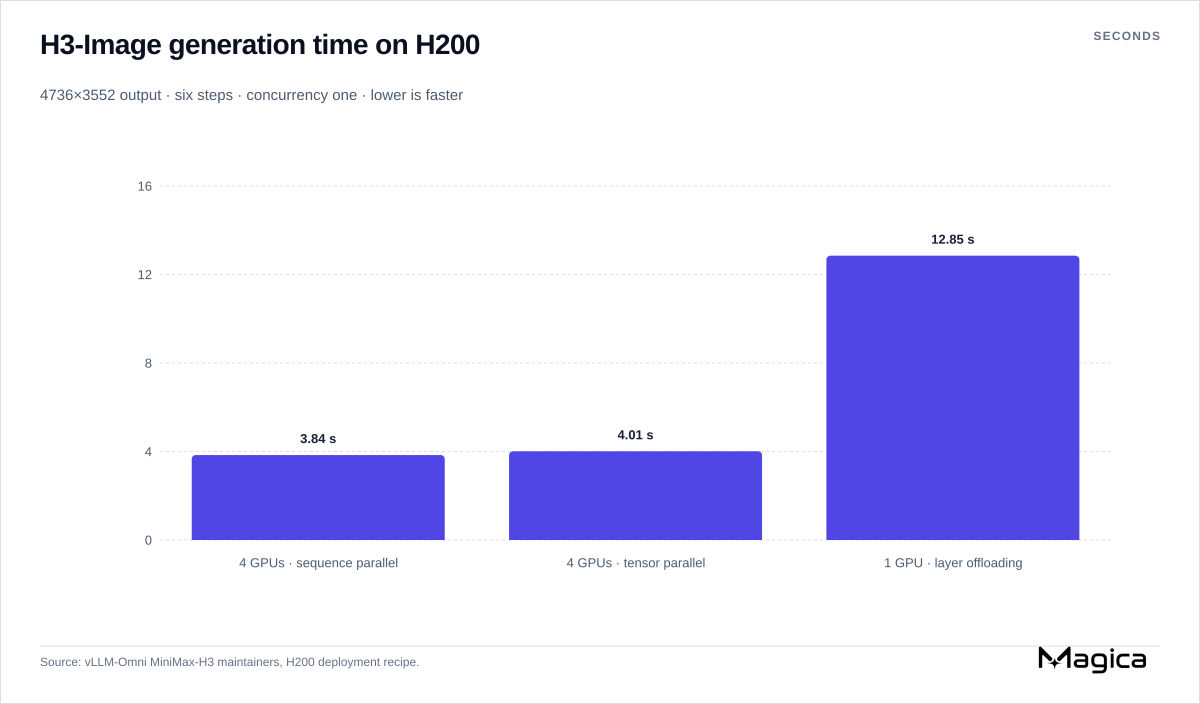
Company-reported H200 deployment measurements published by the vLLM-Omni MiniMax-H3 maintainers: median times for 4736×3552 output over three requests after warm-up, at concurrency one. Source: vLLM-Omni H200 Deployment Recipe.
MiniMax’s published API rates charge separately for text and image tokens. All prices below are in US dollars per million tokens, before the temporary promotion:
| API model | Input text | Input images | Output images |
|---|---|---|---|
| H3-Image | $2.30 | $1.50 | $3.80 |
| H3-Image-Highspeed | $2.30 | $3.00 | $7.60 |
The page illustrates a standard 4096×4096 text-to-image request at $0.06879 before a promotion and $0.03439 during it. The promotion halves total request costs for final images of at least 16,600,000 pixels and ends November 17, 2026, at 16:00 UTC, exclusive.
MiniMax cautions that some 1K and 2K example amounts were adjusted for presentation and do not represent original measured costs for those specifications. The examples are neither fixed per-image prices nor average costs; billing depends on actual token usage. They cannot establish a general cost per image or a break-even point for local deployment.
MiniMax also lists legacy Image-01 and Image-01-live at $0.0035 per image. That is an earlier service with a different billing basis, not a like-for-like price for H3-Image’s resolution and editing capabilities.
The API guide warns that a timed-out or disconnected request can still complete and incur charges for successful images; retrying generates and charges again. It recommends disabling automatic retries. The service supports outputs up to 20 million pixels but does not support masked edits or transparent backgrounds, limitations that affect whether it can replace an existing production workflow.
Downloadable image models have precedents. Generative-media developer Black Forest Labs released its FLUX.1 family in August 2024, including the locally oriented schnell variant under Apache 2.0, with ComfyUI integration at launch. That establishes an earlier, more permissively licensed distribution option, not equivalent image quality or resolution.
MiniMax itself describes Seedream 5.0 Pro, another image-creation model, as an alternative for multi-reference composition on its Code comparison page. Neither that marketing comparison nor MiniMax’s claim of the strongest instruction following among open-source models supplies a reproducible head-to-head quality ranking.
A fair evaluation must also include prompt preparation. MiniMax says H3-Image expects detailed English descriptions. Its API enhances text-to-image prompts by default and always enhances image-editing prompts; an optional local text-to-image prompt expander is available. Comparing a short raw local prompt with an enhanced API request would compare different pipelines.
The next deployment decision therefore needs three pieces of evidence: results on representative prompts and edits, total operating costs at the required concurrency, and the necessary license authorization. The published measurements show that native high-resolution generation is practical on specified hardware. Whether independent operation is preferable to API access remains a workload-specific decision.
Alibaba’s Qwen4-Max preview gives developers a fixed model to test through November 25. API access requires Token Plan, while claimed coding gains remain unquantified in the launch materials.
Railway estimates stolen customer keys generated about $740,000 in unauthorized AI spending after an October intrusion. Secrets from up to about 100,000 workspaces could have been decrypted, and the company says it will cover losses providers decline to refund.
Anthropic expects retail investors worldwide to receive up to 20% of its IPO, potentially $12.9 billion at the proposed upper price. Access through six brokerage channels depends on demand and broker rules, while a separate technology-company investment would help finance vast infrastructure commitments and founders and a special trust retain control.
Anthropic's seven founders plan equal IPO share sales worth about $250 million each at the proposed midpoint. Their sales make up 2.9% of the public offering, while the company seeks much larger financing under a structure that limits public investors' voting influence.
Nvidia’s independent directors retained Wachtell Lipton partner Joon H. Kim for an investigation into reports of a foreign intelligence effort targeting co-founder and CEO Jensen Huang. The board previously expressed confidence in Huang; the appointment provides no findings or timetable.
RRE Ventures led the funding for Graphon’s enterprise memory infrastructure. The startup is pitching connected, persistent context across different agents, but benchmark gains leave deployment costs and commercial scale unresolved.
Goldman Sachs, a lead bank on Anthropic’s IPO, reportedly forecasts $685 billion in annual revenue by 2030. The Claude developer has substantial cash reserves and rapidly growing sales, but rising compute costs, competitive pricing and delivery risks complicate the enterprise growth case.
Memories Upload pays contributors for accepted first-person video and sells annotated data to robotics developers. Its million-hour collection claim leaves open how much footage improves robot performance, while contributors surrender ownership without royalties.
OpenAI has acquired AI travel concierge Odessia and is bringing its founder, former Sonder chief Francis Davidson, into its travel effort. The standalone service has closed, leaving its future role alongside ChatGPT’s existing travel partners unclear.
Anthropic says expected advances from future models have triggered its research-acceleration threshold. An outside assessment finds faster progress but does not certify compliance with that threshold, while the voluntary policy leaves consequential decisions about safeguards and continued development with the company.
OpenAI’s free business-profile beta adds branded agents for eligible U.S. ecommerce and online service firms. The agents can also serve as paid-ad destinations, while OpenAI controls distribution and businesses bear responsibility for outputs.
Teleport has made Beams generally available with task-specific infrastructure permissions and a kill switch. Its access-security platform supplies an enterprise foothold, but established competitors and custom pricing for key controls complicate the buying decision.
New York will connect more than 80 researchers with Empire AI computing resources to evaluate advanced AI systems and advise state oversight, expanding a center first announced in January.
Anthropic’s amended IPO filing raises its Microsoft spending commitment while disclosing an exit right from a $34.9 billion Lambda agreement. Google’s larger commitment was already disclosed earlier, and expensive short-term computing continues to squeeze margins.
The cash deal would bring Oura’s existing AI and physician care partner under its ownership. The $159 annual integration already connects members to doctors, but geographic limits, extra service costs and unproven clinical benefits qualify the expansion.
Reddit is testing AI-organized review pages for roughly 10,000 products. The pages link back to users’ conversations, but lack purchase verification—a safeguard Amazon says it uses for its own AI review highlights.
The renamed MegaETH Foundation is funding its own products after an earlier shift away from its accelerator. Its December inference market must show how it improves on existing services that already route requests by price and reliability.
Cambridge startup Tendrils Compute has raised a Benchmark-led seed round to build processors based on interaction nets. Its backers see an opening in branching workloads, including AI agents, but theoretical parallelism has yet to establish a commercial hardware advantage.
Google and Artificial Analysis launched a 200-task test of AI agents working with visually dense professional files. Google's study finds close leading scores and sharply different API bills, as its new Carbon model reaches customers alongside the Argon alternative.
Google is widening paid access to Gemini 4 Carbon for complex coding, business and scientific work. Gemini API token rates double after November 30, while benchmark results show that its cost advantage depends on the task and reasoning setting.