Editorial Team
10 min read
Google is widening paid access to Gemini 4 Carbon for complex coding, business and scientific work. Gemini API token rates double after November 30, while benchmark results show that its cost advantage depends on the task and reasoning setting.
Google widened access to Gemini 4 Carbon on November 10, bringing the AI model it calls its most capable beyond an initial group of cybersecurity defenders to paying developers, businesses and premium subscribers. Carbon is designed to keep working through complex coding, document and scientific tasks, using more reasoning tokens than its sibling Gemini 4 Argon. Its introductory Gemini API rates double after November 30.
The purchasing question is whether that additional reasoning produces enough successful work to justify its cost. Google still recommends Argon for most software engineering and knowledge work, and the available comparisons give Carbon different advantages depending on the assignment and effort setting.
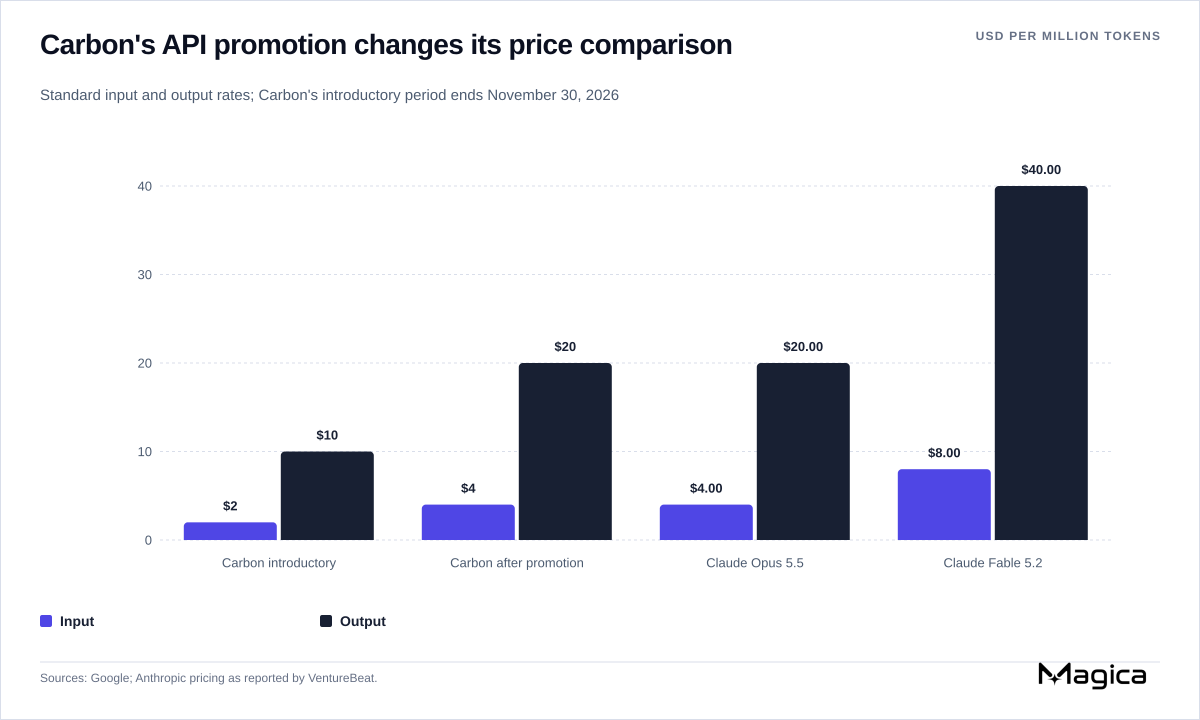
Standard API token rates compared by Magica using Google’s announcement and retained Anthropic pricing evidence. Carbon’s introductory period ends November 30, 2026; token rates do not establish cost per completed task. Source: Google.
Carbon was developed by Google DeepMind and is based on Argon, the first model in Google’s Gemini 4 family. Argon opened to developers on October 13; Carbon followed with a limited release on October 28. Google positions Carbon for harder problems requiring prolonged reasoning and repeated checks, according to the rollout announcement and reporting on the release chronology.
Developers can use the paid Gemini API through AI Studio and Android Studio. Enterprises get API and model-picker access through Gemini for business. Google’s enterprise documentation lists availability on the global endpoint and in the US and EU multi-regions. Google AI Ultra subscribers are receiving Carbon in the Gemini app, AI Mode in Search and Antigravity, Google’s platform for building software with AI agents. The reported US subscription prices are $99.99 a month for Ultra 5x and $199.99 for Ultra 20x, which has higher usage limits.
A report on Search access shows Carbon as a model option in AI Mode for Ultra subscribers.
The public model accepts text, images, speech and video and produces text, according to the release reporting. That lets it work with recordings and visual documents as well as written instructions. Its specialized Carbon for cyber version remains separately restricted to approved defenders through Google’s Fairwind Program; today’s wider release does not remove that gate.
Google is also extending an existing research-access program to Carbon. Four weeks earlier, it opened applications for 10,000 scientists to receive six months of free Argon access in Antigravity; Google says thousands have joined. Current and future participants can now get Carbon too, but weekly onboarding remains subject to eligibility, capacity and selection. The 10,000 figure describes the program’s intended reach, rather than a completed Carbon deployment.
Carbon is distributed as a proprietary hosted model through Google’s services. No downloadable weights or self-hosting license were announced, according to the release reporting. That puts access conditions, model delivery and usage billing under Google’s control. For organizations requiring inference on their own infrastructure, the same report identifies downloadable alternatives including Moonshot AI’s Kimi K3.1 Pro, Meituan’s LongCat-2.5 and Mistral’s Large 4. Their licenses differ, but they compete on a deployment requirement that Carbon’s hosted access does not meet.
Google is initially charging the same paid Gemini API token rates for Carbon as for Argon. The launch announcement specifies the following prices for the model intended for public access; they are not a price quote for the separately gated cyber version:
| Paid Gemini API period | Input per million tokens | Output per million tokens |
|---|---|---|
| Introductory period through November 30, 2026 | $2 | $10 |
| After the introductory period | $4 | $20 |
The comparison with rivals changes when that promotion ends. Anthropic released its competing Claude Fable 5.2 model on November 9, a day before Carbon’s wider rollout. The reported standard API rates for Anthropic’s Claude Fable 5.2 are $8 per million uncached input tokens and $40 per million output tokens. Carbon’s corresponding prices are one-quarter of those rates during the promotion and half afterward. Its post-promotion rates match Claude Opus 5.5’s standard $4 and $20 rates.
Token prices alone do not establish the cheapest model for a job. The same reporting cites Artificial Analysis estimates at published standard rates on its intelligence-index task suite: Carbon at medium effort scored 58 at $6.59 per task, while Fable at medium scored 56 at $3.80. Carbon at high scored 60 at $7.76; Fable at high scored 62 at $9.08. These are different quality levels and vendor-specific reasoning settings, not interchangeable production results, but they show why a lower posted token rate need not mean a cheaper run.
Google’s enterprise migration documentation says every token processed is billed, including thinking tokens and, when using grounding, internal tool system instructions and function declarations. Gemini 4 also shares one 1,048,576-token allowance between input and output, including reasoning and tool calls. Long documents and long reasoning therefore consume the same overall budget.
Ordinary synchronous requests default to a smaller output cap of 65,536 tokens, or 32,768 for non-streaming direct HTTP calls; longer output requires the documented long-decode mechanisms. Search grounding is still charged per query. The documentation also describes implicit caching for repeated prompt prefixes of at least 4,096 tokens, so the amount of reusable context matters to an actual workload’s bill.
Google is previewing a way to divide that work. Antigravity’s /swarm feature creates a coordinator, parallel workers in isolated git worktrees, and adversarial verifiers that test changes. Agents exchange messages on a shared board, with live views of their activity. Developers can put Carbon on architecture, coordination or audit work and assign lighter models to routine edits.
Google says engineers tested /swarm internally for five weeks. It also warns that parallel agents consume quota much faster than ordinary chat, despite idle agents using no tokens. The mechanism can distribute difficult work; it does not remove the cost of doing more work.
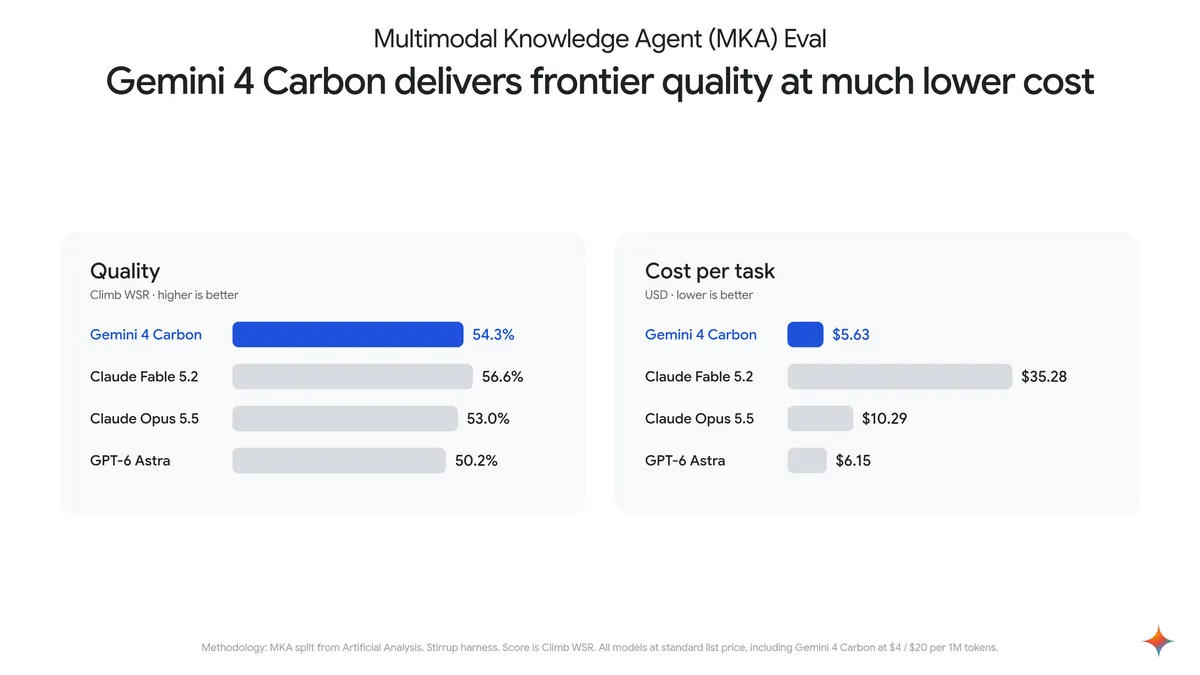
Google’s company-reported MKA results compare quality and task costs among four models. Costs use standard list prices, including Carbon’s post-promotion $4/$20 token rates. Source: Google DeepMind benchmark announcement.
Google claims Carbon leads CursorBench 4.0, Perplexity’s WANDR and Zapier’s AutomationBench at less than half the cost per task of the next-best external model. The release analysis supplies an important qualification: the public CursorBench table it reviewed contained no Carbon row, while Anthropic’s published WANDR table left Carbon blank. Those public tables did not substantiate Google’s claimed lead on either test.
The same reporting gives stronger evidence on AutomationBench: Carbon at high effort scored 53.88%, with estimated spending of $2.12 per task, against Fable 5.2 at maximum effort at 51.45% and $4.64. Those are benchmark results and estimated costs, rather than production reliability or customer invoices. Medium effort scored almost as well for Carbon—52.97% at $1.65 per attempted task. The report cites Zapier’s estimates of $3.11 per passing task at medium and $3.94 at high, counting spending on failures too. The extra reasoning bought a small gain in completion at a higher cost per success.
The broader picture also resists a single ranking. The reported Artificial Analysis Intelligence Index placed Fable 5.2 at 65 at maximum effort and Carbon at 60 at high effort. Carbon high led the cited Terminal-Bench 4.0 comparison at 65.2%, against Fable’s best listed run at 61.6%. Fable’s best listed run led FrontierCode 2.0 at 49.1%, against Carbon high at 40.6%; that test evaluates repository changes against a standard for merging them. The results favor different models for terminal work and code changes that must survive review.
Google has also helped define a new test. Its Multimodal Knowledge Agent benchmark announcement describes 200 tasks across 10 verticals and 83 occupations, developed with Artificial Analysis and domain experts. Tasks involve visually complex documents and deliverables, with rubrics weighted 75% toward factual accuracy and 25% toward visual design. Models receive the same tools, sandbox and turn budget.
Google says Carbon ranks second in quality on that evaluation at roughly one-sixth the average task cost of the top-scoring model. Deliverables are scored by an automated evaluator using a non-Google model; Google reports 96% agreement when domain experts graded outputs themselves. Artificial Analysis runs the private evaluation set, with 10 separate public sample tasks. Those controls help explain the test, but Google’s role in developing it remains relevant to assessing its performance claim.
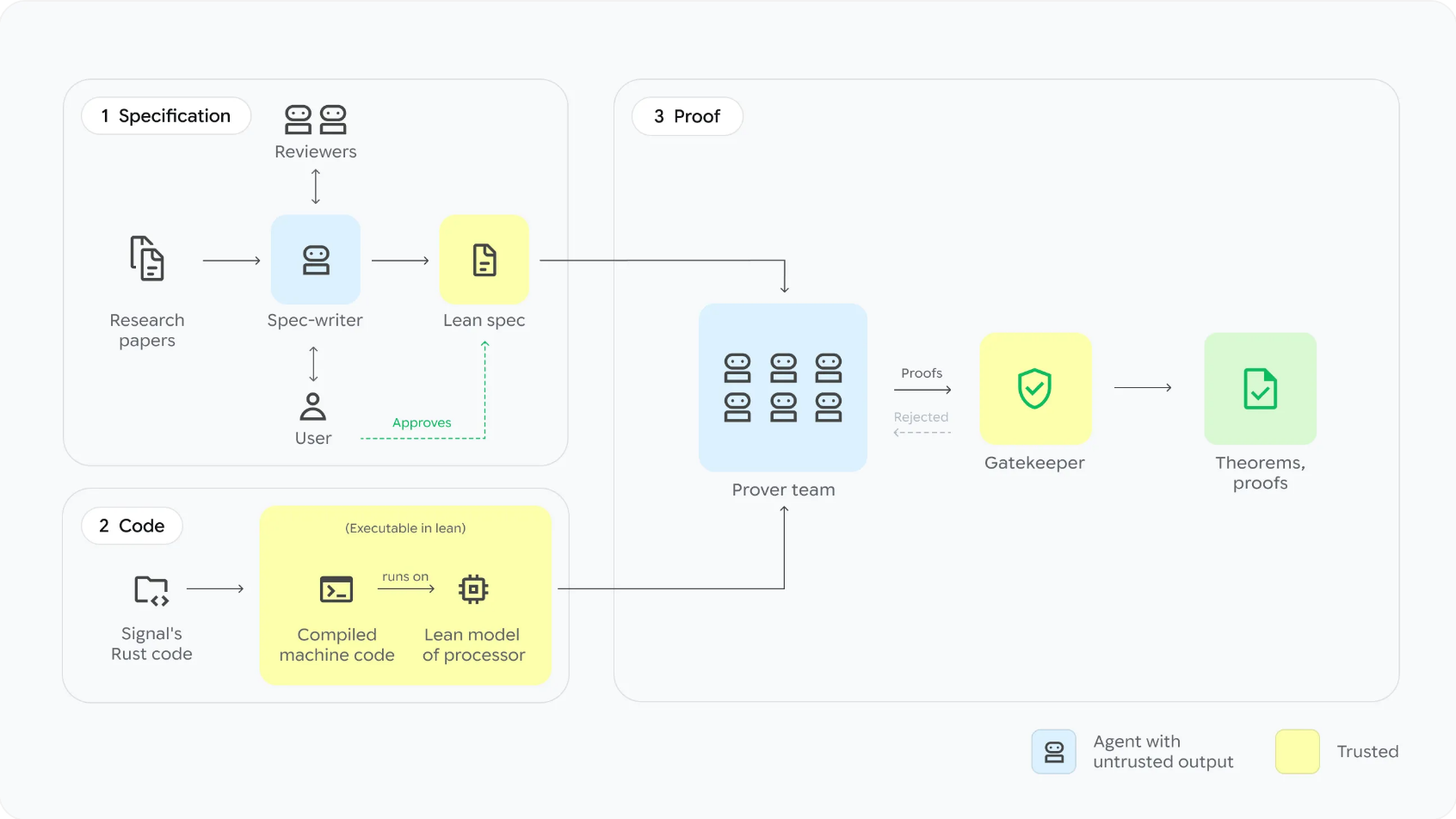
Google DeepMind’s workflow for its company-reported AlphaProof Code verification. Lean checks agent-generated proofs; the reported guarantees cover Google’s libsignal build rather than Signal’s applications. Source: SecurityWeek.
Google’s scientific examples go beyond generating answers. It says Carbon helped researchers retrieve 40 times as many evolutionary relatives, on average, across seven low-homolog protein families from the CASP17 blind test set. Those sequences can improve the inputs to protein-structure models without retraining them. Google says broader benchmarking is still underway: this is a retrieval result on seven families, not evidence of a 40-fold improvement in structure prediction.
Google also says Axiom Bio, a drug-toxicity research company, is moving production scientific analyses and agents to Carbon and Argon after Carbon identified mechanisms of toxicity the company had not previously found. That is a reported adoption decision, distinct from the still-limited protein retrieval test.
In software verification, Google’s AlphaProof Code framework combines human experts with AI agents to prove that software meets specified requirements. Google says it used Carbon alongside other models to help verify libsignal, the reference implementation of the Signal cryptographic protocol. A report on Google’s findings describes five researchers completing the proof work in four weeks. Humans worked with agents running Carbon and Anthropic’s Claude Opus 5.5 to write specifications; Carbon-based agents generated roughly 6.5 million lines of proofs checked by Lean, a language and system for mathematical proofs.
The reported guarantees concern compiled machine code, going beyond an examination of the protocol design alone. They cover Google’s own build with a small command-line wrapper, rather than Signal’s applications, and parts of the analysis excluded side channels. The team also reintroduced two already-patched bugs and proved those builds violated the guarantees. Google is releasing the specifications and proofs, giving others material to examine beyond a model-generated answer.
Google separately says Carbon for cyber helped the security team at Wiz find previously unknown vulnerabilities at two major software-as-a-service providers in under two hours. The rollout announcement does not name those providers. Its Cloud Vulnerability Research team also used Carbon to demonstrate exploitability of two bugs in an unnamed open-source project, and says a proof of concept helped maintainers raise the severity classification and issue a patch. Details remain pending responsible disclosure. Those claims are difficult to assess independently before the underlying findings are released.
Google reports better safeguards in its rollout announcement, including a 92% pass rate on its 375-task agentic honesty benchmark, compared with 70% for Argon. It also reports zero successful prompt injections on the Gray Swan IPI benchmark, while acknowledging that more sophisticated automated testing still exposes weaknesses. Neither result establishes immunity to attacks or fabricated output.
The model card lists hallucinations, occasional slowness or timeouts, and increased token use, particularly at higher thinking levels. Its automated safety table also records a one-percentage-point decline from Argon on image-to-text safety, despite improvements on text and multilingual measures. Google says manual review found losses overwhelmingly reflected false positives or content it judged not egregious. Carbon’s knowledge cutoff is March 2026, with some domains less current.
Separately, reporting on Carbon’s earlier evaluation notes a higher hallucination rate on one knowledge test. That finding limits how broadly buyers should interpret the newer honesty score: different evaluations probe different failure modes.
Before the introductory period ends, buyers can compare Carbon with their existing model on the same difficult jobs and record successful completions, token spend, elapsed time and reviewer effort. They also need to distinguish the public model from the cyber version used in specialized security evaluations.
A deployment decision should use the post-promotion Gemini API rates and include failed runs and human corrections. Carbon’s demonstrations establish reasons to test it; the unresolved question is which tasks it completes well enough to repay that additional work and cost.
Alibaba’s Qwen4-Max preview gives developers a fixed model to test through November 25. API access requires Token Plan, while claimed coding gains remain unquantified in the launch materials.
Railway estimates stolen customer keys generated about $740,000 in unauthorized AI spending after an October intrusion. Secrets from up to about 100,000 workspaces could have been decrypted, and the company says it will cover losses providers decline to refund.
Anthropic expects retail investors worldwide to receive up to 20% of its IPO, potentially $12.9 billion at the proposed upper price. Access through six brokerage channels depends on demand and broker rules, while a separate technology-company investment would help finance vast infrastructure commitments and founders and a special trust retain control.
Anthropic's seven founders plan equal IPO share sales worth about $250 million each at the proposed midpoint. Their sales make up 2.9% of the public offering, while the company seeks much larger financing under a structure that limits public investors' voting influence.
Nvidia’s independent directors retained Wachtell Lipton partner Joon H. Kim for an investigation into reports of a foreign intelligence effort targeting co-founder and CEO Jensen Huang. The board previously expressed confidence in Huang; the appointment provides no findings or timetable.
RRE Ventures led the funding for Graphon’s enterprise memory infrastructure. The startup is pitching connected, persistent context across different agents, but benchmark gains leave deployment costs and commercial scale unresolved.
Goldman Sachs, a lead bank on Anthropic’s IPO, reportedly forecasts $685 billion in annual revenue by 2030. The Claude developer has substantial cash reserves and rapidly growing sales, but rising compute costs, competitive pricing and delivery risks complicate the enterprise growth case.
Memories Upload pays contributors for accepted first-person video and sells annotated data to robotics developers. Its million-hour collection claim leaves open how much footage improves robot performance, while contributors surrender ownership without royalties.
OpenAI has acquired AI travel concierge Odessia and is bringing its founder, former Sonder chief Francis Davidson, into its travel effort. The standalone service has closed, leaving its future role alongside ChatGPT’s existing travel partners unclear.
Anthropic says expected advances from future models have triggered its research-acceleration threshold. An outside assessment finds faster progress but does not certify compliance with that threshold, while the voluntary policy leaves consequential decisions about safeguards and continued development with the company.
OpenAI’s free business-profile beta adds branded agents for eligible U.S. ecommerce and online service firms. The agents can also serve as paid-ad destinations, while OpenAI controls distribution and businesses bear responsibility for outputs.
Teleport has made Beams generally available with task-specific infrastructure permissions and a kill switch. Its access-security platform supplies an enterprise foothold, but established competitors and custom pricing for key controls complicate the buying decision.
New York will connect more than 80 researchers with Empire AI computing resources to evaluate advanced AI systems and advise state oversight, expanding a center first announced in January.
Anthropic’s amended IPO filing raises its Microsoft spending commitment while disclosing an exit right from a $34.9 billion Lambda agreement. Google’s larger commitment was already disclosed earlier, and expensive short-term computing continues to squeeze margins.
The cash deal would bring Oura’s existing AI and physician care partner under its ownership. The $159 annual integration already connects members to doctors, but geographic limits, extra service costs and unproven clinical benefits qualify the expansion.
Reddit is testing AI-organized review pages for roughly 10,000 products. The pages link back to users’ conversations, but lack purchase verification—a safeguard Amazon says it uses for its own AI review highlights.
The renamed MegaETH Foundation is funding its own products after an earlier shift away from its accelerator. Its December inference market must show how it improves on existing services that already route requests by price and reliability.
Cambridge startup Tendrils Compute has raised a Benchmark-led seed round to build processors based on interaction nets. Its backers see an opening in branching workloads, including AI agents, but theoretical parallelism has yet to establish a commercial hardware advantage.
Google and Artificial Analysis launched a 200-task test of AI agents working with visually dense professional files. Google's study finds close leading scores and sharply different API bills, as its new Carbon model reaches customers alongside the Argon alternative.
MiniMax has released downloadable weights for H3-Image, a model combining image generation and editing at native 16-megapixel resolution. Local deployment offers an alternative to its paid API, but hardware demands and a restrictive community license qualify the promise of open access.