Editorial Team
6 min read
Teleport has made Beams generally available with task-specific infrastructure permissions and a kill switch. Its access-security platform supplies an enterprise foothold, but established competitors and custom pricing for key controls complicate the buying decision.
Teleport, a provider of identity and access security for infrastructure, announced Beams’ general availability on November 10. The runtime is designed to let AI agents work on production systems with temporary permissions, execution-plan reviews and a kill switch. Teleport’s announcement says availability began November 9, following a public beta that started in March 2026.
Beams extends Teleport’s existing business of controlling infrastructure access into the environment where agents execute work. For enterprises deciding whether to give software agents authority over live systems, the consequential question is whether those controls contain mistakes without making deployment too costly or cumbersome. General availability opens that assessment; it does not establish the answer.
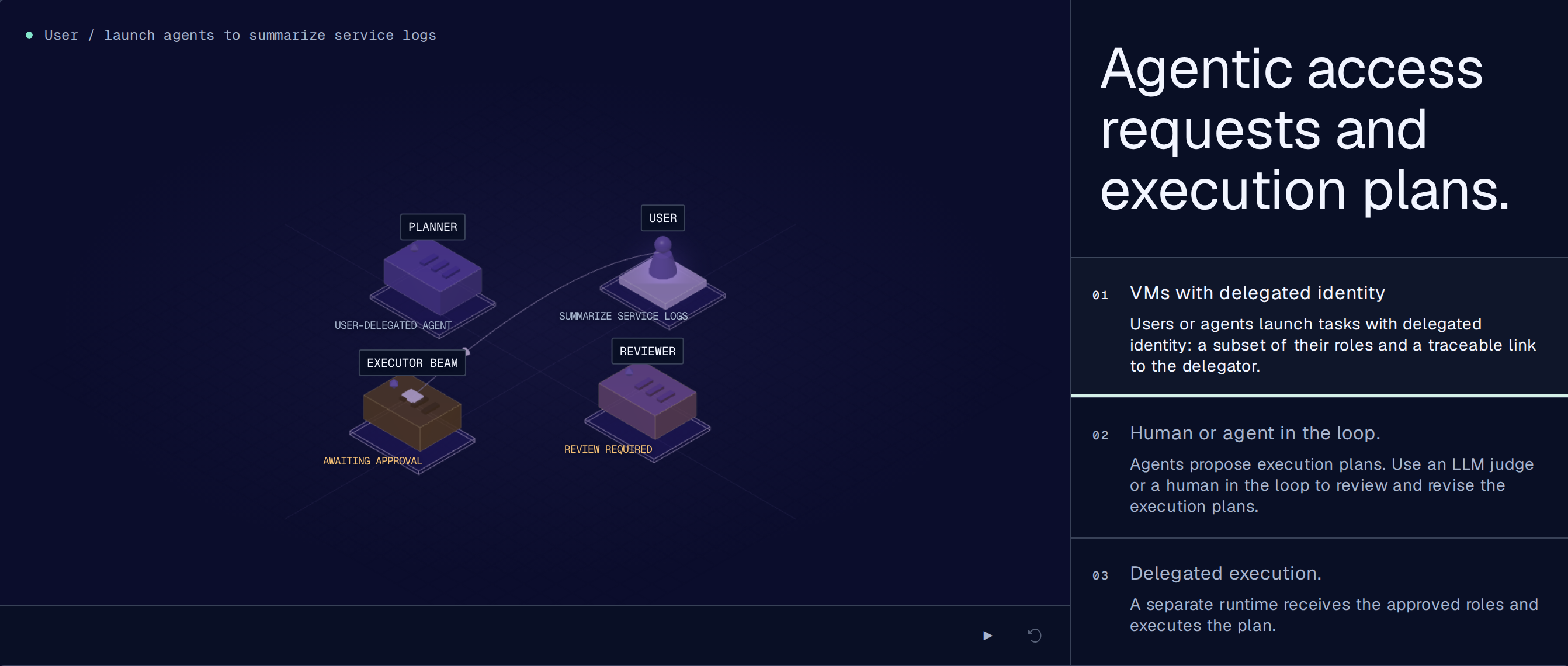
Teleport’s company-reported workflow demonstration illustrates delegated identity, plan review and execution with approved roles. Source: Teleport.
Teleport says each Beams runtime receives an identity delegated by a user or another agent. Agents begin with no standing privileges and propose execution plans with associated access requests. A human or a large language model acting as a judge reviews and revises the plan; a separate runtime executes it using only approved roles.
An agent must generate new action requests for steps outside the approved plan. Review therefore centers on the proposed scope of work rather than a mandatory human check on every step. Because an LLM can serve as the judge, an approved plan does not necessarily imply human approval.
The company says Beams automatically discovers resources and connects to cloud accounts, Kubernetes clusters, PostgreSQL databases and Model Context Protocol servers—interfaces through which agents use tools—without putting passwords or other secrets in the agent’s environment. Authentication uses identity-based methods including IAM, Kerberos and X.509. Its LLM gateway manages model selection and captures model and protocol traces.
Teleport describes privileges as ending when a task finishes. In launch reporting, the company’s account is that revocation prevents an agent from reusing those permissions to reach other systems, agents or applications. That describes the intended security boundary, rather than an independently measured result.
According to Teleport, agents run in short-lived micro virtual machines, with virtualized networking controlling inbound and outbound connections and DNS. Protocol traffic enters the audit record, and base images are rebuilt regularly to reduce vulnerabilities.
Isolation limits the execution environment; behavioral monitoring examines what happens inside it. Teleport says its classifiers flag departures from an agent’s objective, including goal hijacking and harmful coordination among agents. Seven built-in rules cover behaviors such as exposed secrets, destructive actions and privilege escalation, and customers can add rules. Sessions are scored against the MITRE ATT&CK framework to generate risk summaries.
The kill switch is intended to stop agent activity, actions and all connections to production infrastructure at once. A separate feature, Phases, snapshots artifacts and memory so work can resume in another runtime, restart from checkpoints or branch into parallel workflows under the same isolation.
Teleport explicitly says Beams does not guarantee what a model decides. Its proposition is to constrain what an agent can reach, record its actions and withdraw its authority. The launch announcement supplies no measured classifier accuracy or comparative security results to establish how reliably those controls work.
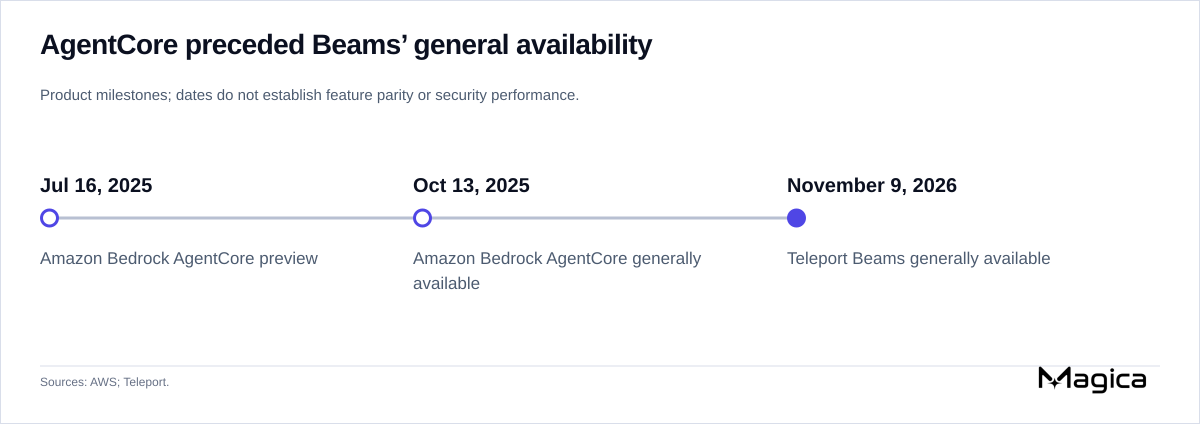
AWS and Teleport’s announced availability dates place AgentCore’s production release before Beams’. Source: AWS.
Beams builds on the Teleport Infrastructure Identity Platform, which the company says is in production at more than 700 enterprises, including Nasdaq, DoorDash and Elastic. Teleport describes that platform as a unified identity layer for humans, machines, workloads and agents that replaces static credentials and standing privileges. This is relevant operating experience and a potential route into enterprise accounts; the customer figure measures the underlying platform’s footprint, not Beams adoption.
Teleport also announced an August 25 partnership with Cisco, involving technology integration, licensing and investment. Teleport described Cisco as its largest strategic investor. That provides context for Teleport’s commercial backing, but the announcement does not disclose an investment amount or establish demand for Beams.
Securing agent execution is already a competitive business. Amazon Web Services, Amazon’s cloud infrastructure business, introduced Bedrock AgentCore as modular infrastructure for deploying and operating agents in a July 16, 2025 preview. It described session isolation, execution observability, memory and identity integration for access to AWS resources and third-party services, with support for models both inside and outside Amazon Bedrock.
AgentCore then became generally available on October 13, 2025. AWS said that release added private-network support and identity-aware authorization, and described consumption-based pricing without upfront costs. Beams therefore faces an existing production offering, not merely a historical preview. These descriptions do not establish feature parity or a security ranking: buyers must compare the particular access, approval, monitoring and revocation mechanisms they need.
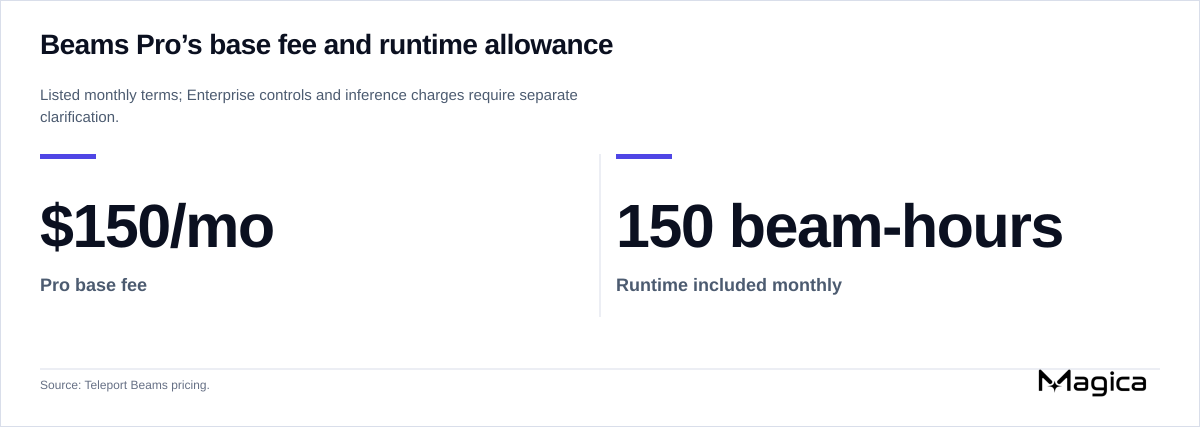
Teleport lists Pro at $150 monthly with 150 beam-hours included; this is not a complete deployment-cost estimate. Source: Teleport Beams.
The Beams pricing page lists Pro at $150 a month, with a two-vCPU, 8 GB RAM virtual machine in US West (Oregon).
| Usage measure | Included monthly in Pro | Overage rate |
|---|---|---|
| Runtime | 150 beam-hours | $0.29/beam-hour |
| Monthly active users | 5 | $20/user |
| Protected resources | 25 | $5/resource |
| Egress | 300 GB | $0.15/GB |
A beam-hour means one beam running for one hour. Users and resources are not recounted across ephemeral runtimes.
Agentic access requests and existing-cluster connectivity require custom-priced Enterprise terms. The Enterprise list also includes session summaries and risk scoring, but the comparison table marks these in both tiers.
Inference terms conflict too: Pro advertises 10 million included tokens, while the estimator excludes inference and describes planned managed inference at provider cost plus 10%. These ambiguities require clarification before the base fee can support a deployment-cost comparison.
The launch offers no Beams-specific adoption count or comparative operating-cost study.
Prospective users need to establish whether approved plans enforce the intended permissions, whether revocation cuts off active infrastructure access, and whether monitoring catches harmful behavior without excessive false alarms. They also need a workload-specific quote that covers the required Enterprise controls and clarifies inference charges. Those security and operating-cost results will determine whether Beams’ approach makes production access practical at the scale a customer needs.
Alibaba’s Qwen4-Max preview gives developers a fixed model to test through November 25. API access requires Token Plan, while claimed coding gains remain unquantified in the launch materials.
Railway estimates stolen customer keys generated about $740,000 in unauthorized AI spending after an October intrusion. Secrets from up to about 100,000 workspaces could have been decrypted, and the company says it will cover losses providers decline to refund.
Anthropic expects retail investors worldwide to receive up to 20% of its IPO, potentially $12.9 billion at the proposed upper price. Access through six brokerage channels depends on demand and broker rules, while a separate technology-company investment would help finance vast infrastructure commitments and founders and a special trust retain control.
Anthropic's seven founders plan equal IPO share sales worth about $250 million each at the proposed midpoint. Their sales make up 2.9% of the public offering, while the company seeks much larger financing under a structure that limits public investors' voting influence.
Nvidia’s independent directors retained Wachtell Lipton partner Joon H. Kim for an investigation into reports of a foreign intelligence effort targeting co-founder and CEO Jensen Huang. The board previously expressed confidence in Huang; the appointment provides no findings or timetable.
RRE Ventures led the funding for Graphon’s enterprise memory infrastructure. The startup is pitching connected, persistent context across different agents, but benchmark gains leave deployment costs and commercial scale unresolved.
Goldman Sachs, a lead bank on Anthropic’s IPO, reportedly forecasts $685 billion in annual revenue by 2030. The Claude developer has substantial cash reserves and rapidly growing sales, but rising compute costs, competitive pricing and delivery risks complicate the enterprise growth case.
Memories Upload pays contributors for accepted first-person video and sells annotated data to robotics developers. Its million-hour collection claim leaves open how much footage improves robot performance, while contributors surrender ownership without royalties.
OpenAI has acquired AI travel concierge Odessia and is bringing its founder, former Sonder chief Francis Davidson, into its travel effort. The standalone service has closed, leaving its future role alongside ChatGPT’s existing travel partners unclear.
Anthropic says expected advances from future models have triggered its research-acceleration threshold. An outside assessment finds faster progress but does not certify compliance with that threshold, while the voluntary policy leaves consequential decisions about safeguards and continued development with the company.
OpenAI’s free business-profile beta adds branded agents for eligible U.S. ecommerce and online service firms. The agents can also serve as paid-ad destinations, while OpenAI controls distribution and businesses bear responsibility for outputs.
New York will connect more than 80 researchers with Empire AI computing resources to evaluate advanced AI systems and advise state oversight, expanding a center first announced in January.
Anthropic’s amended IPO filing raises its Microsoft spending commitment while disclosing an exit right from a $34.9 billion Lambda agreement. Google’s larger commitment was already disclosed earlier, and expensive short-term computing continues to squeeze margins.
The cash deal would bring Oura’s existing AI and physician care partner under its ownership. The $159 annual integration already connects members to doctors, but geographic limits, extra service costs and unproven clinical benefits qualify the expansion.
Reddit is testing AI-organized review pages for roughly 10,000 products. The pages link back to users’ conversations, but lack purchase verification—a safeguard Amazon says it uses for its own AI review highlights.
The renamed MegaETH Foundation is funding its own products after an earlier shift away from its accelerator. Its December inference market must show how it improves on existing services that already route requests by price and reliability.
Cambridge startup Tendrils Compute has raised a Benchmark-led seed round to build processors based on interaction nets. Its backers see an opening in branching workloads, including AI agents, but theoretical parallelism has yet to establish a commercial hardware advantage.
Google and Artificial Analysis launched a 200-task test of AI agents working with visually dense professional files. Google's study finds close leading scores and sharply different API bills, as its new Carbon model reaches customers alongside the Argon alternative.
Google is widening paid access to Gemini 4 Carbon for complex coding, business and scientific work. Gemini API token rates double after November 30, while benchmark results show that its cost advantage depends on the task and reasoning setting.
MiniMax has released downloadable weights for H3-Image, a model combining image generation and editing at native 16-megapixel resolution. Local deployment offers an alternative to its paid API, but hardware demands and a restrictive community license qualify the promise of open access.