Editorial Team
7 min read
Anthropic’s linked billing beta lets customers use their existing Claude API billing terms in third-party apps without sharing API keys. App fees can remain, and requests still use the app provider’s capacity and data arrangements.
Anthropic, which develops the Claude AI assistant and supplies its models through a developer API, launched linked billing in beta on November 17, 2026. The feature lets customers authorize third-party apps to charge supported Claude requests to their own Claude Platform organization—their API billing account—without sharing an API key, according to Anthropic’s release notes.
The commercial appeal is that customers can use an existing Anthropic commitment across supported apps, while app developers avoid storing customers’ API keys and can leave model invoicing to Anthropic. The company’s announcement names 19 supporting platforms. That is a list of integrations, rather than a measure of how many customers have adopted the beta.
That gives Anthropic a direct billing relationship for usage inside other companies’ products. Customers still need to assess the app’s own charges and operating arrangements before treating the connection as a replacement for an existing AI purchasing setup.
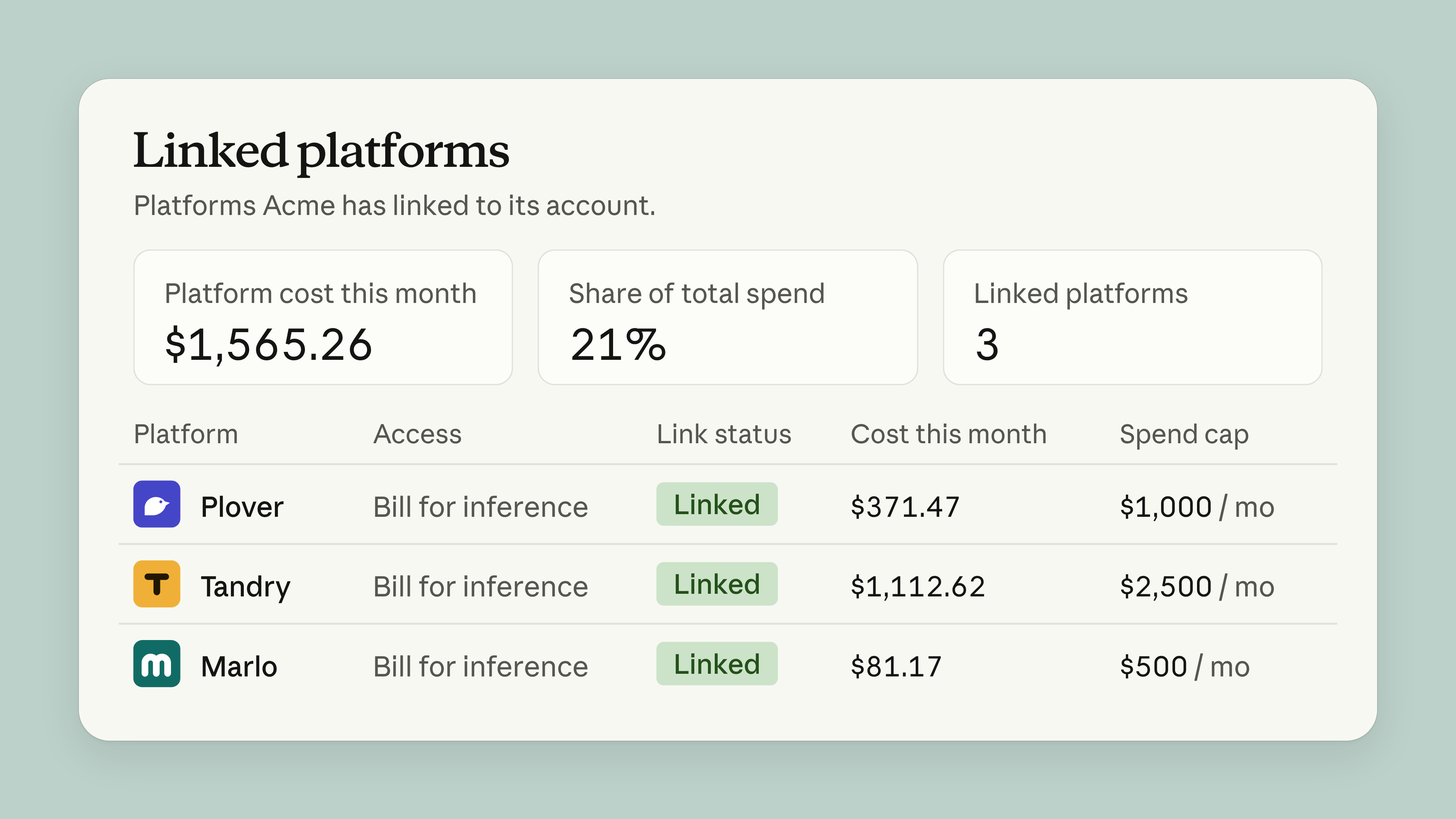
Anthropic’s illustrative dashboard shows spending and caps for linked platforms. Names and amounts are examples. Source: Anthropic.
Claude’s original introduction already offered a developer API and described integrations with third-party products. Linked billing extends that distribution model with a different payment mechanism. Anthropic launched user profiles on October 20, 2026, allowing platforms to identify the end customer behind a request so that safety enforcement could target that customer rather than the whole platform. The billing beta adds payer selection to that attribution infrastructure.
Customers link through an Anthropic-hosted sign-in and approval process using OAuth, instead of pasting an API key into an app. An administrator or billing-role user approves on behalf of the organization. One approval covers the organization, and the link survives the approver’s departure, Anthropic says in its setup guidance.
The app identifies the customer and sends a billing policy with each supported request. The API reference specifies that selecting the user profile charges the linked customer; omitting the policy or selecting the app itself leaves the app provider responsible. If the customer cannot be billed, Anthropic rejects the customer-paid request rather than silently charging the developer.
Direct provider billing through an intermediary has precedent. OpenRouter, a service that routes requests to multiple model providers, explains in its bring-your-own-key announcement that customers can use provider API keys, receive the provider’s bill and apply existing credits, negotiated rates or provisioned throughput. Its page flags an August 2026 pricing change to a plan-dependent allowance measured by list-price inference cost, so the original request-count allowance is no longer a current comparison. Against that alternative, Anthropic’s change is the hosted authorization flow that replaces handing over a customer API key.
Anthropic’s guidance says all linked customers share the app provider’s rate limits, model access and service tier. Moving payment therefore does not bring a customer’s own capacity allocation into the app. Requests run under the provider’s agreement with Anthropic; the customer’s IP allowlists, encryption keys and data-retention settings do not apply.
Eliminating stored customer API keys removes a credential-management task, while leaving the app’s own authentication design consequential. A report describing Anthropic’s documentation says an app’s operator service account can bill any linked customer by default. It also describes optional OAuth access tokens restricted to one connection and expiring within an hour, for deployments such as customer-controlled sandboxes.
During the beta, Anthropic tells developers not to link customers whose usage requires HIPAA health-data or FERPA education-record privacy coverage, or customer-managed encryption keys. Customer zero-data-retention settings and business associate agreements do not carry over either.
Eligibility also follows the billing relationship. Customers must have a Claude Platform organization that pays Anthropic directly. Organizations paying through AWS, Google Cloud or Azure marketplaces cannot use linked billing, nor can Claude subscription plans themselves. Purchased API credits and qualifying invoiced billing can pay; monthly API credits bundled with Max, Ultra and Team subscriptions cannot. Anthropic also excludes credits from its partner, venture-capital and startup programs while their support is still being rolled out.
Coverage is narrower than all Claude-powered work. The beta supports the Messages and Chat Completions endpoints, but excludes Message Batches and Claude Managed Agents. Customer-paid requests cannot use billable code execution; developers must cover those requests themselves if they want to serve them.
Customers can impose a monthly cap on each app, set a default cap for apps without their own, and unlink at any time. A default applies separately to each app rather than creating one shared allowance. Reaching either an app cap or the organization’s overall monthly limit stops customer-paid requests.
The billing documentation contains a consequential qualification: caps count token costs and web-search fees at list prices before negotiated discounts. A cap therefore need not equal the amount on the customer’s invoice. Developers cannot see the customer’s cap, how much of it has been used, or the customer’s actual rates.
Developers also need their own operational records. A successful response does not identify the payer, and the usage analytics cover both developer-paid and customer-paid requests. Anthropic warns against using the delayed figures to enforce a developer’s own spending cutoff. Developers cannot reconstruct customer invoices from those figures.
Anthropic sends the app no notification when a customer unlinks. Its guidance says unlinking usually stops new calls within about 10 seconds; calls already running finish and are billed to the customer. Correct customer attribution also remains essential: a customer-paid request naming another customer’s profile will bill that other customer.
Work management software provider Asana is one of the launch integrations, adding linked billing to its existing AI features. Asana’s implementation guide says customers continue paying for their Asana plan and also pay Asana a per-request fee for AI features, even while Anthropic directly bills the underlying model usage. The guide directs customers to an Asana representative for their rate.
Asana also makes a product choice beyond Anthropic’s per-request flexibility. Once linked, customers cannot split eligible AI usage between Anthropic and Asana, and enabling linked billing automatically disables other model providers for organizations already using Asana’s AI features. Customers must request access and work with a representative before the linking interface is enabled.
There is a setup caveat for organizations starting with Asana AI disabled: Asana says other providers can receive calls between enabling AI and completing the Claude link. It tells customers seeking to prevent that usage to disable the other provider toggles promptly.
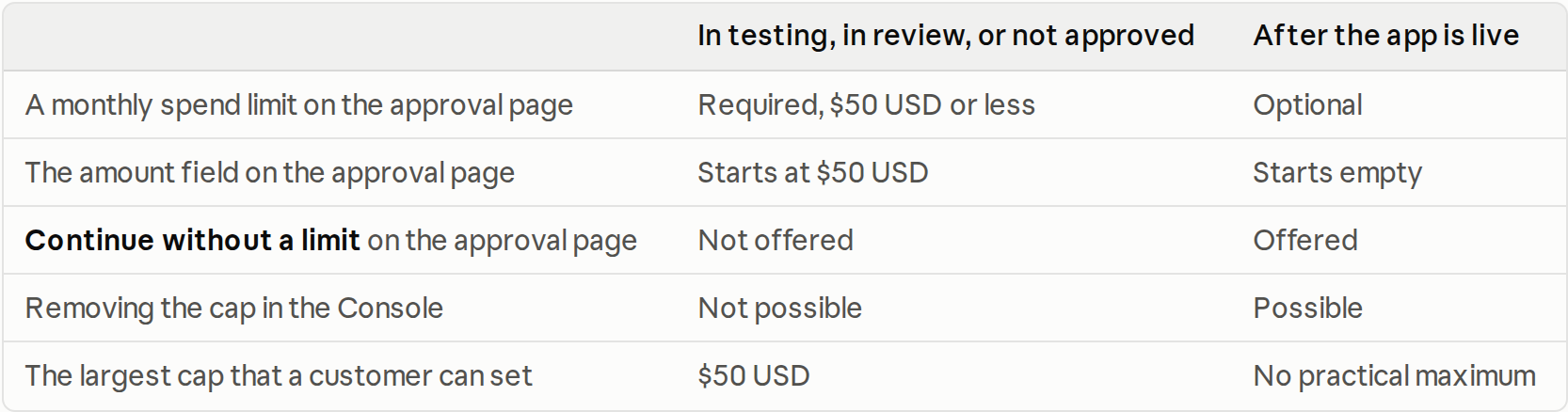
Anthropic’s documentation requires a monthly cap of $50 USD or less during testing. Customers can raise or remove it once the app is live. Source: Claude Platform documentation.
New integrations begin in testing, with up to 10 named test users and a required monthly cap of $50 or less per linked customer. Anthropic’s guidance says that, unless the developer organization has invoiced billing, domain verification and an Anthropic app review precede going live. Existing customer API-key integrations can remain alongside linked billing during migration.
Before switching, buyers need an app-specific quote that separates the Anthropic model charge from the remaining software and AI-feature fees, plus confirmation that the provider’s capacity and data arrangements fit the intended workload.
Developers must decide which features to mark as customer-paid and what happens when billing fails or a customer unlinks. They can pause the feature or explicitly resend requests at their own expense. Customers need those service terms alongside the pricing to decide whether moving a workload onto their existing Anthropic commitment improves the deal.
Lenovo reported record quarterly revenue of $30.2 billion as its infrastructure business swung into profit. A $1.91 billion noncash warrant charge drove a reported loss, while expanding inventories and overdue receivables raised the stakes for cash collection.
Google expects to invest $1 billion in U.S. data center community programs through 2027. Its commitments on taxes, power costs and disclosure address hosting terms, while voters favored limits in 40 of 41 local ballot contests covering both binding restrictions and advisory questions.
Alibaba traded near HK$80 before earnings as US restrictions threatened overseas computing access. Its June results show accelerating cloud growth alongside heavy capital spending and widening AI application losses, while the new rules leave licensing routes and exemptions.
Vero Security is launching a free learning community alongside its commercial platform for enforcing enterprise AI policies. Its $11 million seed round backs a bid to automate recurring security work, but performance and pricing comparisons remain unproven.
Sarvam says its new Token Factory hosts Chinese and domestic AI models on privately funded Indian infrastructure. Its engineering claims and a rival’s price challenge put the commercial strategy under scrutiny alongside its publicly backed domestic-model mandate.
Google is replacing AI Ultra’s individual YouTube Premium benefit with family coverage at no extra cost in eligible countries. The upgrade adds household value, but cheaper subscriptions still matter to the buying decision.
An August fundraising initiative has produced no deployed capital, according to a report, as lenders seek more protection than Nvidia has offered to back customers’ chip purchases.
Anthropic’s reported $83 IPO price implies a fully diluted valuation of about $1.5 trillion. The final share count remains unresolved, while its prospectus shows rapid revenue growth, positive operating cash flow and $70.7 billion in commitments due in the year after September 30.
Colette Kress, Nvidia’s interim CEO and its CFO since 2013, promised December raises and equity awards ahead of the usual spring cycle. The undisclosed package comes as falling shares unsettle employees and the board rejects founder Jensen Huang’s return.
Palo Alto Networks agreed to buy Applied Compute for $4.5 billion in stock, pairing enterprise AI security with model adaptation and hosting. Its plans also call for less than $3 billion in infrastructure spending through fiscal 2030 and near-term margin pressure.
Google is rolling out temporary conversations in AI Mode that stay out of account history and personalization. Its help documentation says data collection continues and describes exceptions to the restriction on model training.
The Claude developer is expected to begin Nasdaq trading on November 19, with options potentially following Monday. Its proposed public offering could total $57.75 billion to $64.35 billion before fees, alongside a private placement, while founders and a benefit trust hold substantial governance powers.
Microsoft plans to use Intel Foundry’s EMIB packaging for its own Azure silicon under an expanded infrastructure agreement that also secures multi-year Xeon supply. Chip identities, deployment dates and packaging economics remain undisclosed.
A 3-2 vote stopped SpaceX’s request for a decade-long county property tax abatement from advancing. A separate city incentive hearing was announced for December, while the company’s investment plans remain unresolved.
Anthropic is reportedly considering more shares at well above $80 each. A separate $26 billion private placement adds to the financing stakes as rapid revenue growth meets vast computing commitments.
Pika’s Enact research preview lets creators move subjects, give actors notes and steer a camera during video generation. Its technical demonstrations show how the controls work, but consumer access, pricing and production reliability remain unresolved.
The NYU philosopher and 2026 Berggruen Prize winner sees no reason to attribute consciousness to current language models. His skepticism contrasts with Anthropic's experiments in model welfare, while research indicators leave open what future systems could become.
The Center for AI Safety joined critics from opposing AI camps in accusing Anthropic of weakening its safeguards. The company’s filing documents both commercial pressure to advance and a recent development pause, making the dispute about what restraint is binding.
Microsoft detailed Azure tools at Ignite that let AI agents reuse processed context, alongside new isolation and networking controls. The announcements leave total savings unquantified, while previews and customer operating duties limit the rollout.
Linq says its a16z-led Series B values the company at $1 billion after more than one billion messages. The funding backs a broader agent infrastructure business, with new HD calling and computer access extending a platform still dependent on communications providers.