Editorial Team
9 min read
Z.AI’s next flagship model is reportedly behind schedule as rival providers tighten distillation defenses. US licensing rules for overseas computing threaten further delays, with Moonshot forecasting longer release cycles if its access is cut off entirely. Interim releases and alternative suppliers complicate the picture.
China’s Z.AI, also known as Zhipu AI and the developer of the GLM model family, has fallen behind schedule on its next flagship model, GLM-5.5, according to a report based on people familiar with the matter. Stronger defenses against extracting training data from competing models have contributed to the delay, one person said; new US controls on rented computing threaten to extend it.
The two pressures affect different inputs. Distillation lets developers teach a model using responses generated by another model, potentially reducing development time and cost. Overseas data centres let them use advanced US processors without importing the chips into China. Restrictions on both routes put the speed and economics of catching up with US competitors under pressure, although the reported launch forecasts remain conditional.
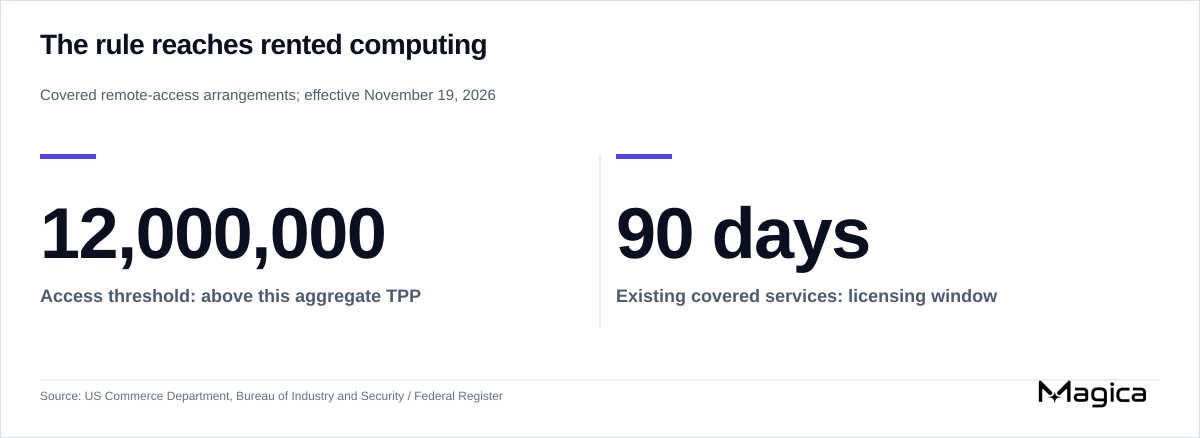
The US Commerce Department’s rule sets an access threshold above 12,000,000 aggregate TPP for specified customers and gives existing covered providers 90 days from its effective date to obtain licenses. Source: Federal Register.
Z.AI had planned to launch GLM-5.5 in November, two people familiar with the matter said in the report. One said the model was designed with roughly 3 trillion parameters, a measure of model size, and was held up partly by increasingly effective safeguards against distillation. The company hoped to complete training and release it by year-end, but the new computing restrictions could move the launch into the first quarter of 2027 or later, that person said.
Zhipu has a development record predating the current dispute. Its prospectus traces its founding to June 2019 by a team with academic roots at Tsinghua University, and records the release of the open-source GLM-130B model in 2022. It supplies models to businesses, public-sector customers and individual users, with more than 8,000 institutional customers as of June 30, 2025, according to the filing.
The company has continued releasing products. On November 23, it released GLM-5.4, built on an existing model with 750 billion parameters, according to the report. Z.AI says a new design lets it match the performance of models with 2 trillion to 3 trillion parameters. The report supplies no common benchmark or computing-cost comparison for that claim. Z.AI did not immediately respond to the report’s request for comment.
Beijing-based Moonshot AI, the developer of the Kimi model family, faces a different exposure. Founded in 2023 and backed by investors including Alibaba, it gained prominence in 2024 for long-text analysis and AI search. It released the open-source Kimi K2 in July 2025, touting coding and agent capabilities in its announcement, as described in an earlier report. That release followed competitive pressure from DeepSeek’s low-cost models. K2.5 followed in January 2026 and K3 in July, the current report says.
A person familiar with Moonshot’s operations said it rents computing power for training and prioritises overseas providers. Internally, it expects its usual six-month interval between major releases could become 12 months or longer if overseas access is cut off entirely. The person said domestic capacity could not fill that shortfall and estimated that Kimi K4 could slip to around mid-2027. These are reported internal expectations, rather than an announced release schedule.
The Commerce Department’s Bureau of Industry and Security, which administers the export controls, made its interim final rule effective on November 19. It extends controls to covered data-centre arrangements supplying large amounts of computing to or for companies headquartered in China and other restricted destinations, including arrangements involving a restricted ultimate parent.
The threshold is more than 12 million aggregate total processing performance, or TPP, a regulatory measure that sums the processing performance of covered chips. The report describes this as roughly equivalent to 750 Nvidia H100 processors. Capacity can be counted across digitally or physically linked data centres that operate as a unified whole; changing the location of a server does not by itself settle whether access is covered.
Data centres must check customers’ direct and indirect ownership or control. Existing providers of covered services have 90 days from the effective date to obtain licenses, and applications under the new remote-access provision will be reviewed case by case. The rule therefore does not establish that either developer has already lost all its overseas computing.
The rule also adds licensing requirements for advanced chips going to Indonesia, Malaysia, Singapore, Thailand and Brazil, with an exclusion for qualifying US-headquartered recipients or ultimate parents subject to reporting. Its remote-access exception for commercial recommender systems is narrowly defined: it excludes systems that generate novel text, images, software or other content, even if they also recommend products.
This builds on chip restrictions dating to 2022 and subsequent controls on supplies for restricted companies abroad. It also formally rescinds the never-enforced AI Diffusion Rule, including its model-weights controls. The policy shift combines tighter oversight of specific computing arrangements with removal of that broader framework.
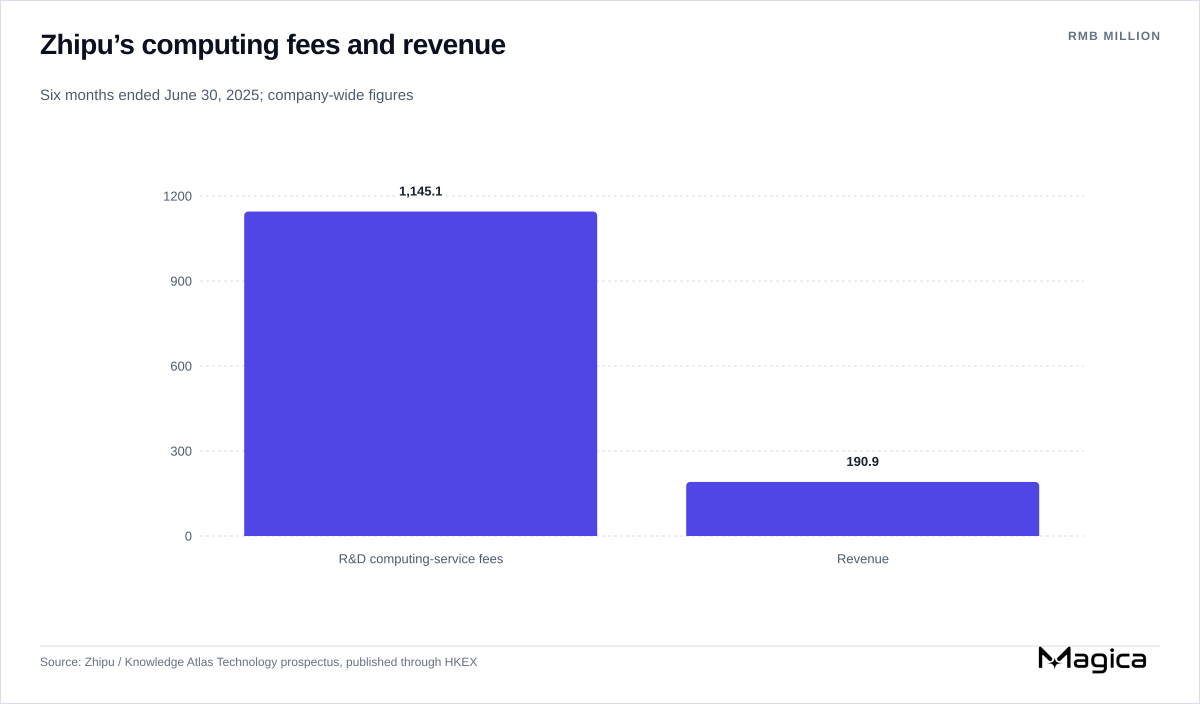
Company-reported figures from Zhipu’s prospectus compare R&D computing-service fees with revenue for the first half of 2025. The fees are company-wide development expenses; the filing does not identify their overseas share. Source: Zhipu prospectus.
Zhipu’s prospectus records about RMB1.145 billion in computing-service fees within RMB1.595 billion of research and development expenses for the six months ended June 30, 2025. Those fees were about 72% of R&D spending and six times the company’s RMB190.9 million revenue for the same period, calculated from the filing. They measure a company-wide development expense, not a per-model training bill or the cost of serving each customer; the filing does not identify the overseas share.
Most revenue in that period came from on-premise deployments. The cloud-based deployment business recorded a gross loss margin of 0.4%, which Zhipu attributed to price reductions in line with the market and its strategy of winning market share through competitive pricing. These historical figures show pressure on monetisation; they do not establish current margins.
Zhipu subsequently raised HK$4.35 billion in its January 2026 Hong Kong listing and planned to use most proceeds for R&D, according to the listing report. Capital and permission to use advanced processors are separate constraints.
Zhipu was already subject to US restrictions before this rule. Its prospectus disclosed that the company and nine subsidiaries joined the US Entity List in January 2025, restricting access to certain goods, software and technology under US export rules. It said it had not relied on items subject to those rules during the filing’s track-record period and had suffered no material business or financial impact. Its directors’ expectation of no material near-term effect expressly assumed that the restrictions would not expand. That assessment does not settle exposure to the November 2026 rule.
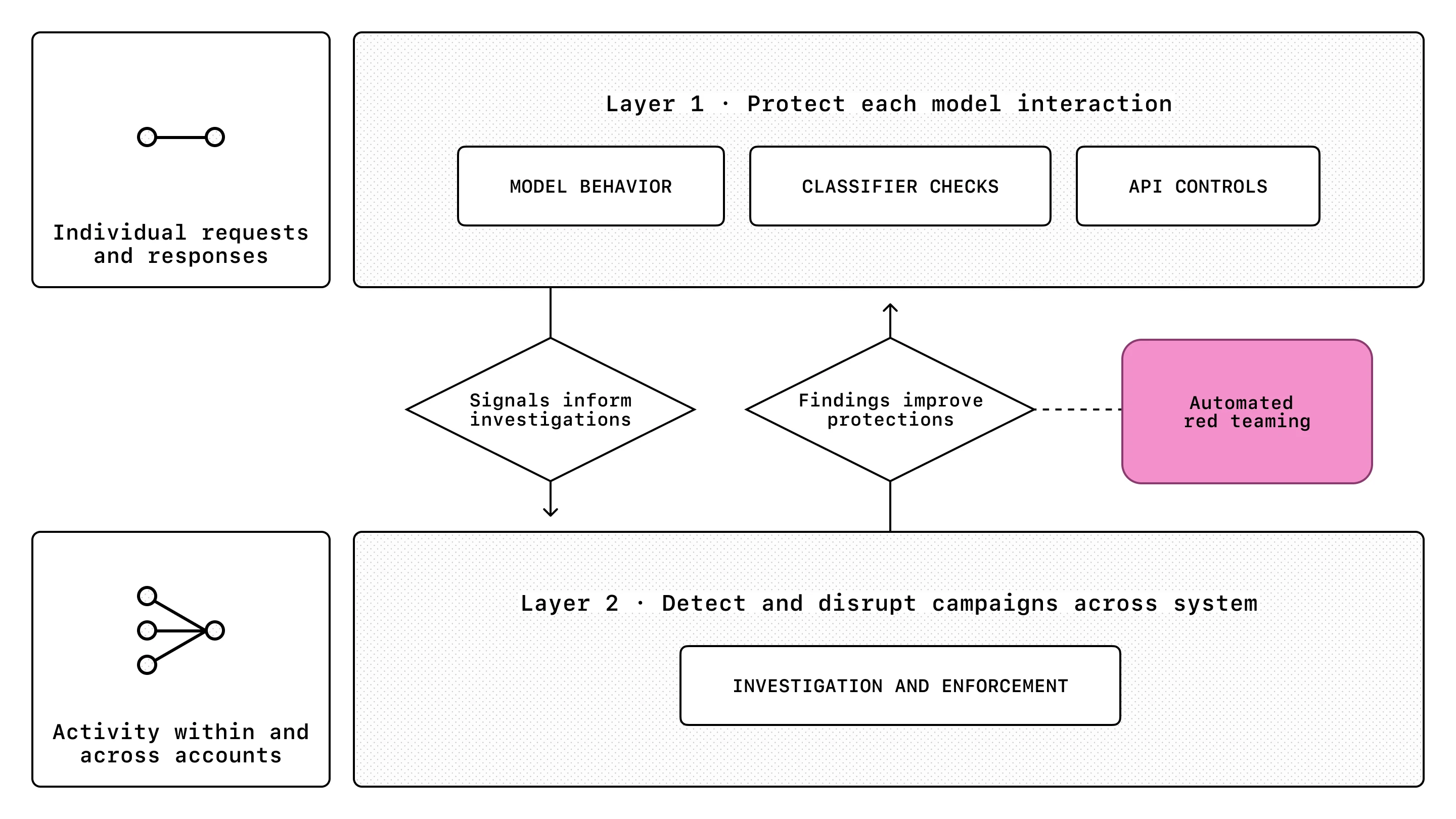
OpenAI’s diagram illustrates its company-reported approach to distillation defenses, combining protections for individual requests with campaign investigation and enforcement. Source: OpenAI.
Anthropic, developer of Claude, says its new defenses focus on protecting the intermediate reasoning that models generate before answering. It combines restrictions on moving that reasoning between accounts and models, detection systems, usage limits and account bans.
The company estimates that the amount of Claude reasoning extracted by distillers on its own platform fell by roughly 90% to 99% after its new safeguards. That is a provider’s estimate of extracted reasoning-token volume, not a measurement of the resulting slowdown at Chinese laboratories. Anthropic also says it has yet to face a highly sophisticated, persistent attempt to circumvent the new measures and does not know how long the gains will last.
OpenAI, developer of the GPT models, describes a similar combination of reasoning protections and campaign enforcement. It says its internal adaptive testing found attacks extracting reasoning from an earlier request succeeded 54.0% of the time against GPT-6 Astra’s original safeguards, compared with 0.2% against GPT-6.2 Astra’s updated safeguards, aggregated across six attacker models. Those results compare different model-and-safeguard combinations in testing; they are not directly comparable with Anthropic’s estimated extraction volumes.
Both companies argue that unauthorized distillation can transfer capabilities without transferring safeguards, especially in cybersecurity and biology. OpenAI also explicitly supports stronger export controls as a way to maintain a US lead. Their role is therefore both defensive and competitive: they control access to valuable model outputs while competing with the developers accused of extracting them.
There are costs on the supplier side too. Anthropic says it has turned away meaningful revenue and trillions of tokens of paying traffic. Some legitimate developers have had to change integrations, and its classifiers can mistakenly block benign requests. Since September 24, it has charged for requests blocked in specified safeguard areas, including distillation, where it says false positives are below 0.1%.
The allegations remain contested. OpenAI attributes a core part of a September extraction campaign to individuals associated with Moonshot. The current report says Anthropic has accused both Moonshot and Z.AI of distillation campaigns. It also recounts Moonshot’s rejection, in comments to a Chinese business publication in July, of suggestions that Kimi K3’s performance came from distillation; Moonshot instead credited original architectural changes. Moonshot did not immediately respond to the current report’s request for comment.
Moonshot has stepped up efforts to rent computing in Europe and plans to approach Chinese chipmakers about training on their processors, according to a person cited in the report. The same person said it has begun distilling from Google and Meta models as obtaining data from OpenAI and Anthropic has become harder. Google and Meta did not immediately respond to requests for comment.
The report also cites an earlier account that Moonshot scrapped a $150 million arrangement to access Nvidia Blackwell chips through an Indonesian data centre; Moonshot declined to comment on that account. Separately, it cites reporting that Nvidia told manufacturing partners to stop server shipments to the four newly covered Southeast Asian countries. Nvidia did not immediately respond to the current report’s request for comment.
Renting in Europe does not by itself resolve a rule that follows the customer and its ultimate parent. The next concrete test is whether covered providers secure the required licenses within the transition period, and how much usable capacity remains available afterward. Alternative processors and model outputs offer possible substitutes, but the report does not quantify how much lost access they could replace. Confirmed launch dates, resource requirements and measured performance will be needed to establish the cost and effectiveness of that substitution.
Capita is seeking fresh equity and creditor support after replacing its chief executive. Pension recovery costs are only part of its profit downgrade, while government figures show unresolved cases still growing.
Provisional CBS figures show AI use more than doubled among Dutch businesses with at least two workers in 2026. Text generation spread rapidly, while reported productivity gains leave the size of the economic payoff unresolved.
The Global Electronics Association says AI servers are absorbing scarce circuit-board materials and crowding out other industries. New factories are coming, but upstream constraints and uncertain demand complicate the response.
Google says Gemini Live’s Guided Vision is available on iOS, extending visual descriptions and spoken camera-framing help to iPhone users. Device eligibility and regional coverage remain unclear, and Google warns against using it for navigation.
The Dutch government wants Congress to keep the MATCH Act out of its annual defence bill. The proposal would tighten controls on ASML’s China business, including servicing, despite existing Dutch restrictions on advanced chipmaking equipment.
The London startup’s pre-seed round backs research and testing for patient-facing AI. Its founders bring medical-device deployment experience, but benchmark findings and customer submissions do not yet establish real-world safety.
Switzerland’s cybersecurity chief says five confirmed AI-agent attacks affected businesses including three critical-infrastructure operators. Four attacks breached systems, but no major outages were reported, and the public evidence leaves the attackers and specific consequences unknown.
SemiAnalysis reports that Amazon’s Trainium3 delivers up to 2.28 times the tokens per modeled dollar of Nvidia’s GB300 NVL72 in an AgentX preview. The result expands public evidence for custom AI chips, but validation, model matching and customer pricing still determine its practical value.
Microsoft says Chinese and North Korean hacking groups have adopted ARTEX, an AI penetration-testing framework that coordinates existing tools. Its spread across models and software forks complicates efforts to contain abuse through a single provider.
Neuralink says its LINK pivotal study is recruiting people with severe paralysis from ALS to assess digital device control, daily independence and long-term safety. Earlier participant gains and technical setbacks frame the test; the implant remains investigational.
India’s IT secretary says Sarvam’s commercial hosting of foreign AI models does not conflict with its publicly supported domestic model development. Eligibility for proposed inference support remains unresolved.
Manufacturing partners have reportedly told buyers that Nvidia will not permit server orders to ship to Malaysia, Singapore, Thailand and Indonesia as they assess new US export controls. The uncertainty is already reaching cloud-project financing.
Trustly’s existing owners are funding new AI payment products after job cuts. New quarterly results show rising payment volumes and revenue, but weaker earnings than a year earlier.
The Pentagon denies reports that officials weighed production powers to pressure Nvidia to restore Jensen Huang. Nvidia confirms senior government input, but its board’s foreign-intelligence investigation remains open.
Perplexity says users are choosing Google's new model over rival offerings, with daily token volume doubling in three days. The 120-billion figure is cumulative, and the early demand leaves retention and task economics unresolved.
Kioxia says a proof of concept paired Nvidia software with about 1.1 PB of raw SSD capacity to expand the datasets GPUs can access. The demonstration establishes a capacity proposition, while workload performance and deployment economics remain undisclosed.
Google’s November 25 update adds Familiar Face alerts and remote siren controls to two Walmart Onn outdoor cameras. The expansion makes inexpensive Nest alternatives more capable, while the value depends on subscription access and reliable video playback.
OpenAI is testing a combined Chat and Work experience with a small group of Pro subscribers. A shared allowance arriving more broadly in December will put advanced conversations and delegated tasks on the same budget, but the size of any resulting loss of access remains unknown.
Sellers are seeking buyers for thousands of Nvidia B300 chips, while Asian data centers try to replace Chinese customers affected by U.S. controls. Rental prices have fallen, but short contracts remain scarce and operators face demanding financing terms.
Lenders are delaying or reassessing financing for Asian data centers serving Chinese technology firms as new US licensing rules put chip purchases and customers’ access to computing capacity in doubt.