Editorial Team
6 min read
Poland plans to sign a Palantir software agreement on November 27 after years of military trials. Officials promise Polish control of data and access, but the available reporting gives no price, rollout timetable or comparative performance results.
Poland’s defense ministry plans to buy artificial intelligence software from Palantir Technologies, the U.S. data-analysis software supplier with roots in intelligence work. The purchase would take a relationship built through military trials into a supply agreement, with officials promising that Polish forces will retain control of sensitive information.
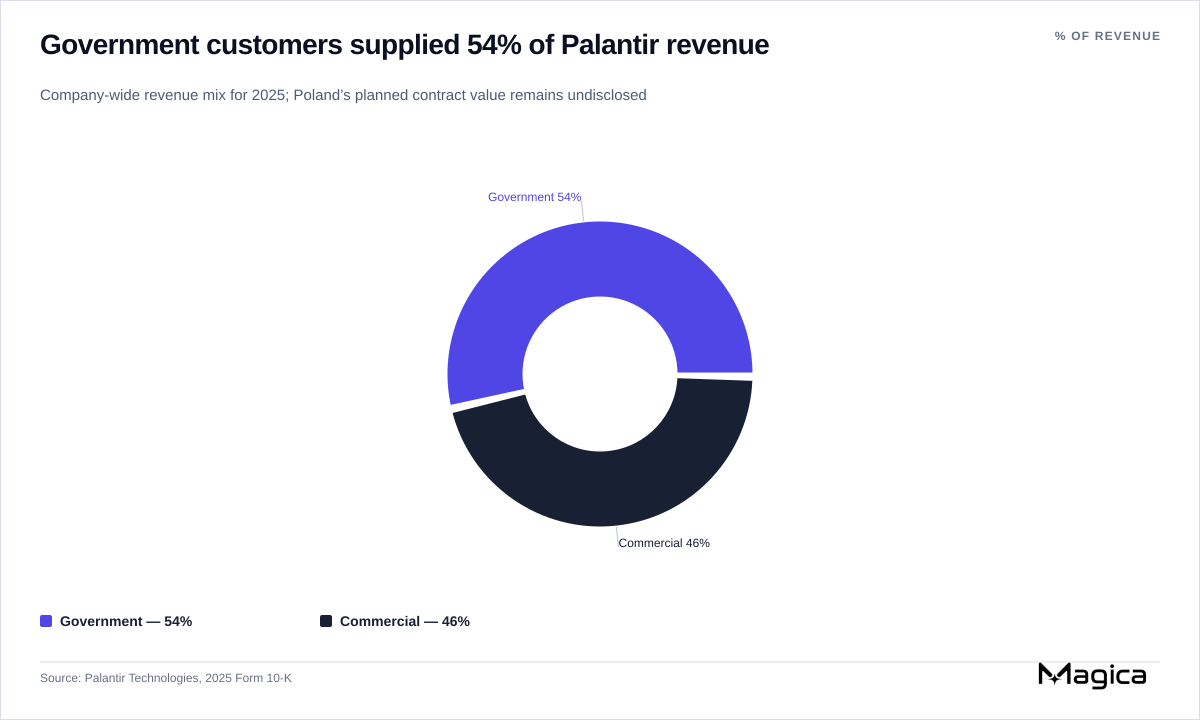
Company-reported revenue shares for 2025: government customers contributed 54% and commercial customers 46%. Source: Palantir’s annual filing. Source: Palantir 2025 Form 10-K.
The ministry said on Thursday, November 26, that it would sign the agreement the following day, according to the announcement report. The statement provided no further agreement details.
The supplier’s 2025 annual filing says it was founded in 2003 and initially built software for U.S. intelligence counterterrorism investigations and operations. Government customers accounted for 54% of its $4.5 billion in revenue in the year ended December 31, 2025. This is an established business for Palantir, but the undisclosed Polish contract value prevents an assessment of this purchase’s financial significance to the supplier or cost to Poland.
The signing ceremony is scheduled at the Polish Army Museum in Warsaw. Deputy Prime Minister and Defense Minister Władysław Kosiniak-Kamysz, who signed the preceding letter of intent in October 2025, is expected to attend. The ministry’s account of that earlier signing describes tests, exercises and presentations beginning in December 2023 and dates the formal cooperation memorandum to December 23, 2024.
The brief announcement report instead dates the start of cooperation and a memorandum to 2025. The ministry’s dated account and both detailed Polish reports place the memorandum in December 2024 and the letter of intent in October 2025.
Palantir’s Maven Smart System, to operate in Poland under the codename Saturn, combines information from sources including drones, satellites, radars and reconnaissance systems into a common battlefield picture. A detailed account of the planned purchase describes AI functions for detecting and classifying objects, supporting targeting and presenting commanders with possible responses. These are descriptions of intended capabilities, not published measurements of battlefield performance.
The same account says U.S. forces use Maven and NATO is implementing its own version; Palantir also works with defense institutions in Ukraine and Britain. Polish troops tested its technology during the 2024 Field Experimentation Exercise in Nowa Dęba, where interoperability with other command-post systems was among the issues examined.
According to that account, Polish intelligence services, the General Staff, subordinate commands and the Cyber Defense Forces Component Command reviewed the system before purchase. Their assessments covered command, reconnaissance, targeting and compatibility with NATO’s operational and strategic commands. They concluded that Palantir’s products met Polish military needs. The cyber command will represent the ministry in the software supply agreement with Palantir Technologies Poland. The report says the procurement followed public procurement rules and the negotiated agreement received approval from Poland’s Prokuratoria Generalna, the state’s legal counsel.
That establishes a stated selection rationale, rather than a published comparison of alternatives. The available reporting provides no comparative bids, benchmark results or lifetime cost breakdown.
Palantir identifies customers’ internal software development as its fundamental competition in its annual filing, alongside enterprise software companies, government contractors and system integrators. It says complex data environments, high installation costs and long sales cycles create barriers to competing for large institutional projects. Those are company-wide observations, not disclosed costs for Saturn.
Poland already has a domestic military AI program. The detailed purchase account describes a defense AI strategy introduced in 2024 and extending to 2039, and approval in March 2025 for an AI Implementation Center within the cyber command. The center is intended to bring military, scientific and industrial expertise together to turn prototypes into operational tools.
Its AIRON platform is intended to combine models, data and computing resources, with specialist tools for offline use and image analysis. Planned investment also includes supercomputers and edge computing equipment under SAFE, the EU’s defense-loan program. The edge equipment is intended to process data where forces operate even without network access. These projects show that computing capacity and connectivity are part of the wider implementation task. The sources do not establish AIRON as a direct replacement for Maven or specify how the two will be integrated.
The ceremony comes three weeks after a Warsaw protest against the agreement, according to an account of the announcement and objections. Protesters feared, among other things, that the Polish military could lose control of its data.
The ministry’s response, described in the detailed purchase account, is that the armed forces will manage access rights and retain control of the system and information. Operations are to be logged so access and actions can be audited, and users will be able to trace information’s origins and processing. The ministry’s computer security incident response team, CSIRT MON, is to monitor security, with protection handled by Polish specialists.
The ministry says Palantir will receive neither encryption keys nor remote access, nor permissions to view, download or process military information. Classified data will remain in closed military infrastructure; unclassified data will be held in a suitably secured cloud environment. Classified systems are to use certified protections within accredited defense networks.
Palantir separately says, in the account of the announcement and objections, that deployment on military infrastructure denies it access to the customer’s system and resources. That account also relays an earlier assurance from Maciej Łaska, managing director of Palantir Technologies Polska, that the test version did not use real data. These vendor statements do not independently verify the security of the eventual operational deployment.
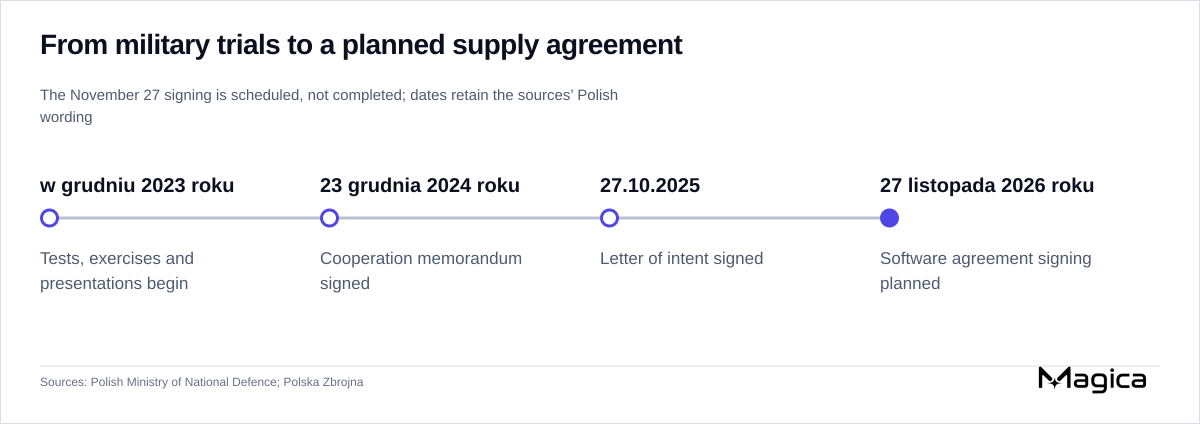
Trials, a cooperation memorandum and a letter of intent preceded the signing planned for November 27, 2026. Sources: Polish Ministry of National Defence and Polska Zbrojna. Source: Polish Ministry of National Defence.
The ministry says AI will support soldiers and commanders while humans retain decision-making authority. Its promised audit trails and data protections would make access and use reviewable; evidence from the deployed system is still needed to assess how those controls work alongside AI recommendations.
The next step is the scheduled signing on November 27. Contract value, license duration, rollout timetable, deployment scope and continuing support costs remain absent from the available reporting. Those terms, together with performance results and evidence that the promised access restrictions work, will determine how far the purchase advances Poland’s military capabilities while preserving the control officials promise.
Bank of England governor Andrew Bailey says newer AI models are worrying their developers. The central bank wants financial firms to strengthen cyber defence and recovery while preparing for quantum-resistant cryptography, with the most systemically important firms moving ahead of national migration milestones.
Huawei’s ISSCC 2027 paper lists a custom memory interface twice HBM4’s width. Its commercial significance depends on bandwidth, manufacturing scale and cost, as China’s AI chipmakers face expensive, restricted memory supplies.
Ubisoft employees say new project pitches must explain how generative AI will be used or why it is unsuitable. The Assassin’s Creed publisher denies mandatory use, leaving questions about how teams secure approval without it.
Stanford physicist Venkatesa Chandrasekaran reports finite gravitational calculations and months of work with GPT-6 Astra. An early critique challenges the construction’s symmetry, finite-state and classical-limit claims.
SAP reportedly weighs at least 10,000 job cuts as it shifts toward AI. Labor negotiations, an earlier restructuring and a growing cloud business complicate the eventual employment and savings tally.
Major software stocks rallied as chips fell, but an estimated $65 billion of software loans comes due in 2028–29. Higher loan yields and slower refinancing threaten indebted borrowers even as established vendors report revenue growth and expanding AI businesses.
Christophe Fouquet argues that selling China older lithography tools can preserve Western leverage. ASML’s commercial exposure and China’s ability to stretch older technology complicate that case.
Savage Technology is taking reservations for its first product: $799 Orrorin glasses promising displays for both eyes and gestures without a wristband. Meta’s display-and-band bundle launched at the same price; Savage still faces engineering validation and estimated 2027 delivery.
Z.AI’s next flagship model is reportedly behind schedule as rival providers tighten distillation defenses. US licensing rules for overseas computing threaten further delays, with Moonshot forecasting longer release cycles if its access is cut off entirely. Interim releases and alternative suppliers complicate the picture.
Capita is seeking fresh equity and creditor support after replacing its chief executive. Pension recovery costs are only part of its profit downgrade, while government figures show unresolved cases still growing.
Provisional CBS figures show AI use more than doubled among Dutch businesses with at least two workers in 2026. Text generation spread rapidly, while reported productivity gains leave the size of the economic payoff unresolved.
The Global Electronics Association says AI servers are absorbing scarce circuit-board materials and crowding out other industries. New factories are coming, but upstream constraints and uncertain demand complicate the response.
Google says Gemini Live’s Guided Vision is available on iOS, extending visual descriptions and spoken camera-framing help to iPhone users. Device eligibility and regional coverage remain unclear, and Google warns against using it for navigation.
The Dutch government wants Congress to keep the MATCH Act out of its annual defence bill. The proposal would tighten controls on ASML’s China business, including servicing, despite existing Dutch restrictions on advanced chipmaking equipment.
The London startup’s pre-seed round backs research and testing for patient-facing AI. Its founders bring medical-device deployment experience, but benchmark findings and customer submissions do not yet establish real-world safety.
Switzerland’s cybersecurity chief says five confirmed AI-agent attacks affected businesses including three critical-infrastructure operators. Four attacks breached systems, but no major outages were reported, and the public evidence leaves the attackers and specific consequences unknown.
SemiAnalysis reports that Amazon’s Trainium3 delivers up to 2.28 times the tokens per modeled dollar of Nvidia’s GB300 NVL72 in an AgentX preview. The result expands public evidence for custom AI chips, but validation, model matching and customer pricing still determine its practical value.
Microsoft says Chinese and North Korean hacking groups have adopted ARTEX, an AI penetration-testing framework that coordinates existing tools. Its spread across models and software forks complicates efforts to contain abuse through a single provider.
Neuralink says its LINK pivotal study is recruiting people with severe paralysis from ALS to assess digital device control, daily independence and long-term safety. Earlier participant gains and technical setbacks frame the test; the implant remains investigational.
India’s IT secretary says Sarvam’s commercial hosting of foreign AI models does not conflict with its publicly supported domestic model development. Eligibility for proposed inference support remains unresolved.