Editorial Team
9 min read
Capita is seeking fresh equity and creditor support after replacing its chief executive. Pension recovery costs are only part of its profit downgrade, while government figures show unresolved cases still growing.
Capita, the UK outsourcing group that administers government services and pensions, has replaced chief executive Adolfo Hernandez, a former global telecommunications vice president at Amazon Web Services, and proposed raising £190m from shareholders. The 23 November announcement combines an admission of pension-service failures with a profit warning extending well beyond that contract.
The consequences reach both retirees and the company's ability to finance its recovery. Members of the 1.7 million-member Civil Service Pension Scheme have described borrowing from relatives for food and heating and turning to food banks while waiting for payments. Capita's shares were down about 70% during trading on the announcement day, reaching a more than 35-year low.
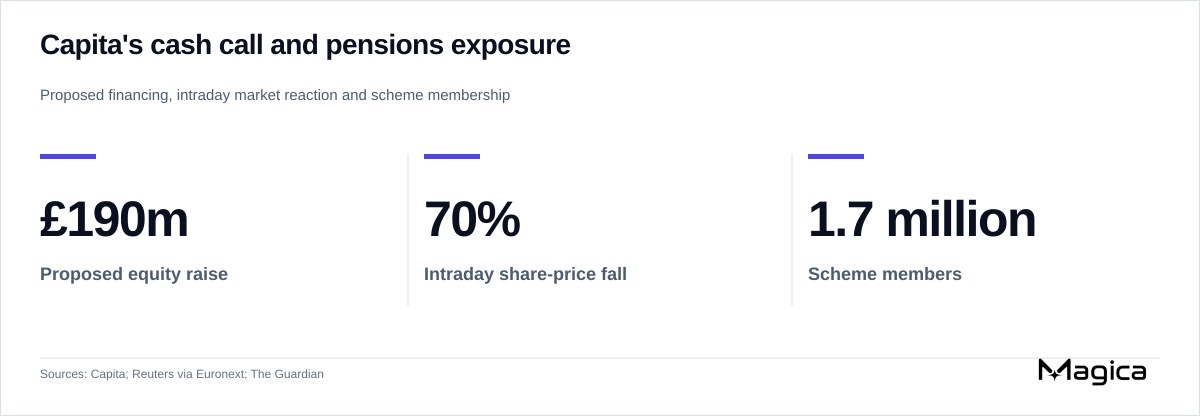
Capita's company-reported financing proposal seeks £190m, subject to creditor support. Shares fell 70% during trading on 23 November. The scheme's 1.7 million members are its total membership, not a count of people experiencing delays. Source: Capita.
Pablo Andres, Capita's chief financial officer since August 2024 and previously finance chief at renewable-energy company Ventient Energy, became chief executive immediately. He had already been responsible for Capita's financial strategy and business controls. Group financial controller Gemma Bate-Williams, whose earlier roles included finance director of its Public Service division, succeeds him as CFO. Hernandez remains available until 31 December to support the handover, the company said.
Hernandez's appointment had rested on his technology credentials. In announcing his appointment in July 2023, Capita's board highlighted his record of accelerating revenue growth through digital services. His technology career included senior roles at SDL and Alcatel-Lucent as well as AWS.
Capita now describes an AI-enabled operating model built with partners including Microsoft, AWS and Salesforce. In his farewell message to staff, Hernandez credited that transformation with improved customer satisfaction and contract win rates, according to the account of the message. Those are his claims about the wider business, rather than evidence that the pension service delivered its promised technology.
The longer financial record also limits explanations centred solely on this contract. Capita's shares had lost more than 98% of their value from their mid-2015 peak amid years of profit warnings, debt problems and attempted turnarounds, according to the market report.
The Cabinet Office, the government department responsible for overseeing the scheme, awarded Capita a seven-year, £239m administration contract in November 2023. Capita took over from MyCSP in December 2025 after a two-year transition.
This was a return to familiar work: Capita had administered the scheme's pension payroll and deferred members before 2014. MyCSP, its immediate predecessor, was a partnership between private-sector pensions company Equiniti and employees, who owned 25%.
The scheme provides defined-benefit pensions for current and former civil servants and other eligible public-sector employees. It is unfunded, with pension payments met from public funds rather than an investment pot managed by Capita. The immediate failure concerns administration: obtaining accurate quotes, calculating entitlements and paying people on time.
A June 2025 investigation by the National Audit Office, Parliament's independent public-spending watchdog, documented both the commercial rationale and the warnings. The Cabinet Office expected £83m in savings over the Capita contract's life compared with the MyCSP contract price, through innovation and automation. That was an expected saving, not a measured outcome.
Capita planned for 332 staff in its first year, 33 fewer than MyCSP's core staffing level in January 2025. The MyCSP figure excludes its separate workforce handling pension remedies. The new contract also capped Capita's profit margin at 10% and strengthened several service measures and penalties.
By the end of March 2025, however, Capita had missed three of the six transition milestones then due. The Cabinet Office withheld £9.6m and accepted a simplified initial IT service, with greater functionality delayed until at least March 2026. At the time of the audit, an improvement plan remained outstanding and there were no fixed innovation or digitalisation milestones for delivery after takeover.
The audit also identified risks around transferring large volumes of data and retaining staff through the handover. MyCSP estimated that training staff to handle the most demanding work took six months.
The inherited workload was already troubled. MyCSP had failed to provide timely retirement quotes and first pension payments for several months in 2024. It was also implementing the McCloud remedy, work required after the Court of Appeal found the government's 2015 public-service pension changes discriminatory on grounds of age. The Cabinet Office had spent £31.7m funding MyCSP's remedy work through 2024–25.
Problems therefore predated the handover, and the Cabinet Office had accepted a reduced initial service. By October 2025, the Public Accounts Committee, which scrutinises government spending, was warning that Capita might not be ready; Capita rejected that assessment. Hernandez later acknowledged to MPs that the company had been unable to deploy the necessary technology, according to the account of his testimony.
The evidence supports a failure to deliver promised technology and basic service. It does not isolate an AI model as the cause of the payment delays.
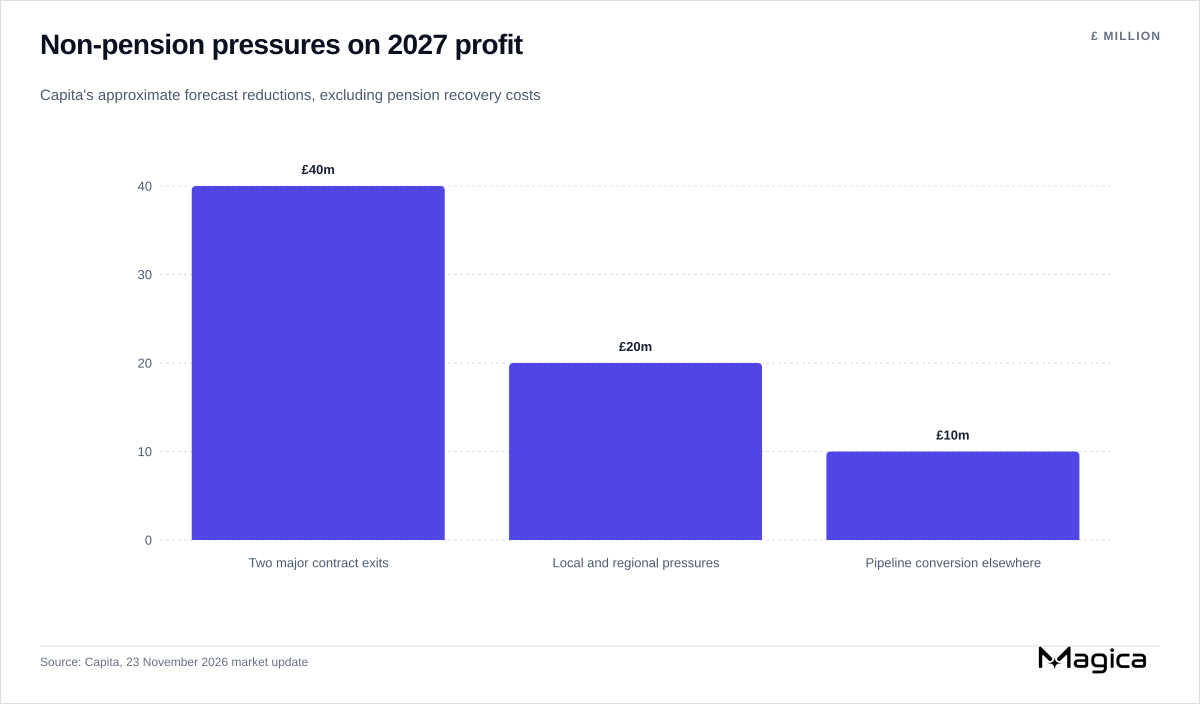
Company-reported forecasts for three non-remediation pressures on 2027 adjusted operating profit. Additional pension recovery costs of £15m–£25m are excluded and appear separately in the article's table. Source: Capita.
Capita's financial breakdown forecasts 2027 adjusted operating profit £85m–£95m below its previous expectations. That range is the reduction, not the remaining profit forecast.
| Pressure identified by Capita | Expected reduction in 2027 adjusted operating profit |
|---|---|
| Additional Civil Service Pension Scheme recovery costs | £15m–£25m |
| Two major contract exits, with extensions no longer expected, in defence and pensions | About £40m |
| Local and regional contract losses and weaker conversion of opportunities | About £20m |
| Weaker near-term pipeline conversion elsewhere | About £10m |
The three non-remediation items total about £70m. Restoring the pension service alone would therefore leave most of the identified earnings shortfall unresolved.
Capita forecasts £50m–£60m of free cash outflow excluding business exits in 2027. It expects net debt before IFRS 16 lease accounting to be around £300m at the end of 2026, partly reflecting business-exit payments and adverse timing on disposal-related intercompany payments and a legal claim.
There are counterweights to the deterioration. Capita kept its 2026 adjusted operating profit and free-cash-flow guidance unchanged and said it had secured £1.6bn in contract value in the ten months to October, excluding its divested private-sector contact-centre business. It forecasts a material profitability recovery and positive free cash flow excluding business exits from 2028. Those remain management projections.
The proposed £190m equity raise is intended to reduce borrowing and provide liquidity and covenant headroom. Launch and completion are anticipated in the first half of 2027. Oasis Management, an activist investor and the largest shareholder with a 15.2% interest and a nominee director, intends to subscribe at least in proportion to its holding, Capita said. The financing still depends on creditor support and amendments to existing arrangements.
The Cabinet Office's 16 November recovery update reported total cases rising from a new baseline of 150,000 on 5 October to 156,000, with intake exceeding clearances. Complex cases numbered 32,600, up 2,100 over that period. These are case records, not a count of individual pensioners awaiting payment.
The department also reported progress: call-answering performance had improved, around two-thirds of routine cases were no more than 30 days old, and fixes to underlying problems were moving complex cases towards resolution. Some still needed information from employers or members before quotes or payments could follow. The retirement modeller remained in testing.
Crucially, the update said Capita was consolidating cases relating to the same query. Members could receive notifications that a case had closed while their primary case remained under investigation. A decline in recorded cases must therefore be distinguished from completed calculations and payments.
In the Commons on 24 November, Cabinet Office minister Sally Jameson, a former prison officer who declared her own pension in the scheme, said officials now had full access to Capita's systems and data after intervention by an independent remedial adviser. Nearly 150 civil servants remained deployed to support recovery.
Jameson said sufficient resources were now in place, but declined to promise a deadline for clearing the oldest and most complex cases. Nearly £10m in contractual payments had been withheld, and Capita was voluntarily receiving 10% less each month. Jameson also said the government would seek repayment of additional costs it had incurred to assist Capita.
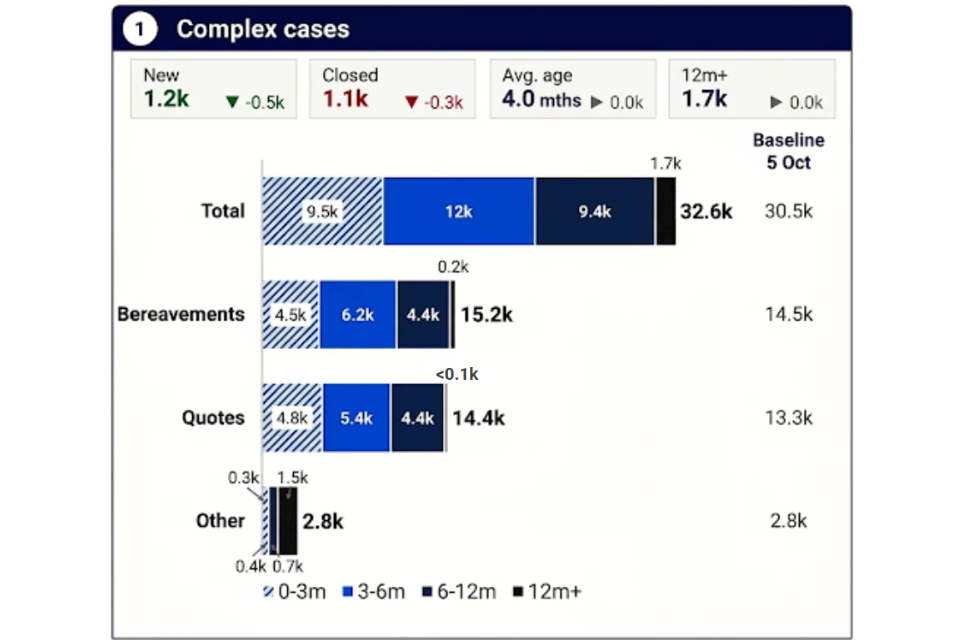
The Cabinet Office's 16 November 2026 dashboard records 32,600 complex cases. These are case records, not individual pensioners; totals may differ because of rounding. Crown copyright, Open Government Licence v3.0. Source: Cabinet Office recovery update.
Andres must secure the recapitalisation while demonstrating sustained service improvement. For shareholders and creditors, the next concrete evidence is the financing's terms and agreed support. For members, it is accurate quotes and payments, with reporting that separates genuine resolutions from administrative closures.
The government is considering alternatives. Jameson said officials were developing options for the scheme's future and working across departments on contingency plans, while prioritising recovery to avoid further disruption. Capita has already lost its Royal Mail pension administration contract, which is being brought in-house, according to the account of its pensions record.
The stakes also reach new work. The Public and Commercial Services Union, which represents civil servants, is campaigning against Capita's separate Synergy deal for HR, payroll, finance and other back-office services across four departments and nearly 100 arm's-length bodies. Capita values that contract at £370m, according to the report on the dispute. Rival bidder Sopra Steria, owner of incumbent provider SSCL, has challenged the award, alleging an abnormally low bid; Capita and the Department for Work and Pensions, which leads the contract, deny the allegations.
Jameson said poor supplier performance could be considered under procurement rules, but did not confirm whether Capita faced a debarment investigation. The unresolved decision is how long government should rely on recovery under Capita while assessing alternatives—and what verified service results would justify that reliance.
Z.AI’s next flagship model is reportedly behind schedule as rival providers tighten distillation defenses. US licensing rules for overseas computing threaten further delays, with Moonshot forecasting longer release cycles if its access is cut off entirely. Interim releases and alternative suppliers complicate the picture.
Provisional CBS figures show AI use more than doubled among Dutch businesses with at least two workers in 2026. Text generation spread rapidly, while reported productivity gains leave the size of the economic payoff unresolved.
The Global Electronics Association says AI servers are absorbing scarce circuit-board materials and crowding out other industries. New factories are coming, but upstream constraints and uncertain demand complicate the response.
Google says Gemini Live’s Guided Vision is available on iOS, extending visual descriptions and spoken camera-framing help to iPhone users. Device eligibility and regional coverage remain unclear, and Google warns against using it for navigation.
The Dutch government wants Congress to keep the MATCH Act out of its annual defence bill. The proposal would tighten controls on ASML’s China business, including servicing, despite existing Dutch restrictions on advanced chipmaking equipment.
The London startup’s pre-seed round backs research and testing for patient-facing AI. Its founders bring medical-device deployment experience, but benchmark findings and customer submissions do not yet establish real-world safety.
Switzerland’s cybersecurity chief says five confirmed AI-agent attacks affected businesses including three critical-infrastructure operators. Four attacks breached systems, but no major outages were reported, and the public evidence leaves the attackers and specific consequences unknown.
SemiAnalysis reports that Amazon’s Trainium3 delivers up to 2.28 times the tokens per modeled dollar of Nvidia’s GB300 NVL72 in an AgentX preview. The result expands public evidence for custom AI chips, but validation, model matching and customer pricing still determine its practical value.
Microsoft says Chinese and North Korean hacking groups have adopted ARTEX, an AI penetration-testing framework that coordinates existing tools. Its spread across models and software forks complicates efforts to contain abuse through a single provider.
Neuralink says its LINK pivotal study is recruiting people with severe paralysis from ALS to assess digital device control, daily independence and long-term safety. Earlier participant gains and technical setbacks frame the test; the implant remains investigational.
India’s IT secretary says Sarvam’s commercial hosting of foreign AI models does not conflict with its publicly supported domestic model development. Eligibility for proposed inference support remains unresolved.
Manufacturing partners have reportedly told buyers that Nvidia will not permit server orders to ship to Malaysia, Singapore, Thailand and Indonesia as they assess new US export controls. The uncertainty is already reaching cloud-project financing.
Trustly’s existing owners are funding new AI payment products after job cuts. New quarterly results show rising payment volumes and revenue, but weaker earnings than a year earlier.
The Pentagon denies reports that officials weighed production powers to pressure Nvidia to restore Jensen Huang. Nvidia confirms senior government input, but its board’s foreign-intelligence investigation remains open.
Perplexity says users are choosing Google's new model over rival offerings, with daily token volume doubling in three days. The 120-billion figure is cumulative, and the early demand leaves retention and task economics unresolved.
Kioxia says a proof of concept paired Nvidia software with about 1.1 PB of raw SSD capacity to expand the datasets GPUs can access. The demonstration establishes a capacity proposition, while workload performance and deployment economics remain undisclosed.
Google’s November 25 update adds Familiar Face alerts and remote siren controls to two Walmart Onn outdoor cameras. The expansion makes inexpensive Nest alternatives more capable, while the value depends on subscription access and reliable video playback.
OpenAI is testing a combined Chat and Work experience with a small group of Pro subscribers. A shared allowance arriving more broadly in December will put advanced conversations and delegated tasks on the same budget, but the size of any resulting loss of access remains unknown.
Sellers are seeking buyers for thousands of Nvidia B300 chips, while Asian data centers try to replace Chinese customers affected by U.S. controls. Rental prices have fallen, but short contracts remain scarce and operators face demanding financing terms.
Lenders are delaying or reassessing financing for Asian data centers serving Chinese technology firms as new US licensing rules put chip purchases and customers’ access to computing capacity in doubt.