Editorial Team
5 min read
The Dutch government wants Congress to keep the MATCH Act out of its annual defence bill. The proposal would tighten controls on ASML’s China business, including servicing, despite existing Dutch restrictions on advanced chipmaking equipment.
The Netherlands is lobbying to detach proposed US chipmaking restrictions from annual defence legislation, warning of damage to European industry. Sjoerd Sjoerdsma, its minister of foreign trade and development cooperation and a former diplomat and D66 lawmaker, said on November 26 that the proposal went “way too far”.
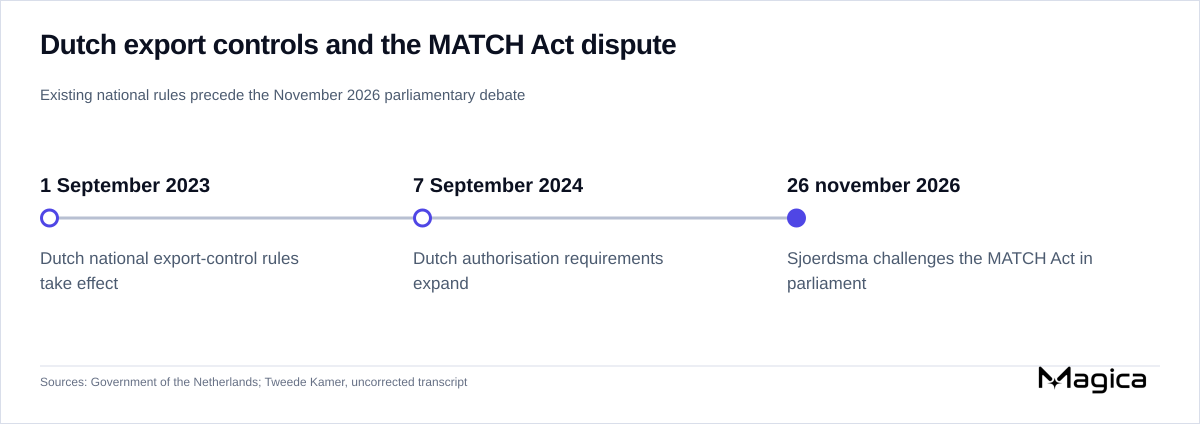
Dutch licensing rules preceded Sjoerdsma’s parliamentary challenge to the proposed MATCH Act. Sources: Dutch government and Tweede Kamer. Source: Dutch government export-control announcement.
The bipartisan Multilateral Alignment of Technology Controls on Hardware Act, or MATCH Act, would push US allies including the Netherlands and Japan to adopt tougher export controls on China or face restrictions imposed by Washington on their semiconductor equipment, according to the account of Thursday’s parliamentary debate. Congress is negotiating whether to attach it to the annual defence policy bill.
ASML, the Netherlands-based manufacturer of machines needed to make computer chips, is central because it dominates immersion deep ultraviolet lithography, used to create chip circuitry. Japan’s Nikon is a smaller competitor. The proposal targets technology China still depends on importing.
Sjoerdsma has held the trade portfolio since February 23. His official profile records diplomatic service from 2005 to 2012 and membership of the Dutch House of Representatives for D66 from 2012 to 2023, with responsibilities including foreign and European affairs. He is leading trade diplomacy over a company whose exports already face Dutch licensing decisions.
The cabinet is working with the European Commission, Germany and France to prevent the bill’s attachment. Sjoerdsma said other European semiconductor industries would also suffer and warned of the precedent for US intervention.
Z.AI’s next flagship model is reportedly behind schedule as rival providers tighten distillation defenses. US licensing rules for overseas computing threaten further delays, with Moonshot forecasting longer release cycles if its access is cut off entirely. Interim releases and alternative suppliers complicate the picture.
In the uncorrected parliamentary transcript, he said the Netherlands already shared and acted on allies’ security concerns. His objection was to unilateral measures with extraterritorial reach, which he said infringed Dutch sovereignty. He also argued that the proposed restrictions covered technology that could not be used for AI chips. That technical objection is his assessment.
Dutch policy has itself tightened. A September 2024 government announcement expanded authorisation requirements for advanced DUV equipment, building on rules in force since September 2023. The government said such equipment, combined with other countries’ technology, could produce advanced semiconductors for military applications. Applications for exports outside the EU were to be assessed individually; the measure was not a blanket export ban.
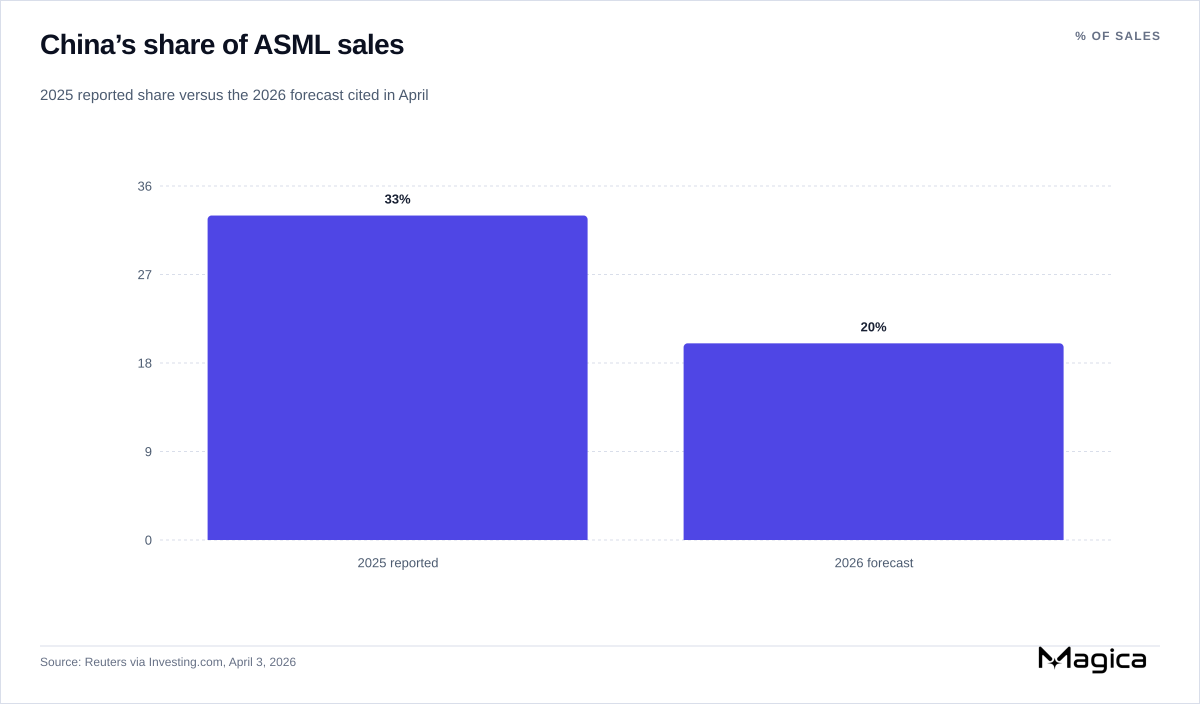
Company-reported China sales share: 33% in 2025 and a January forecast of 20% for 2026, as reported by Reuters. These figures do not measure potential MATCH Act losses. Source: Reuters via Investing.com.
The April account of the MATCH Act’s introduction described the sponsors’ objectives as protecting the US lead in artificial intelligence and ensuring allied suppliers faced the same restrictions as US competitors. Earlier US rounds of restrictions had been led by presidents rather than Congress.
That account said the proposal would prohibit sales or servicing of the targeted equipment to leading Chinese chipmakers SMIC, Hua Hong, Huawei, CXMT and YMTC. Existing coordinated rules already blocked ASML’s most advanced tools from China, while allowing sales of older DUV equipment to Chinese chipmakers and to leading South Korean and Taiwanese companies operating there. The proposal would close off those sales too, extending its consequences beyond Chinese-owned customers. ASML declined to comment when the proposal emerged.
The same report put China’s share of ASML’s 2025 sales at 33% and said the company had forecast in January that it would fall to 20% in 2026. Thursday’s reporting repeated ASML’s expectation of about 20% this year. The forecast describes the market’s importance, not the revenue the bill would eliminate.
ASML is also reporting strong business growth. According to the account of the debate and recent results, the company reported record third-quarter sales of €11.7 billion in October on AI-driven demand. Net profit was €5 billion, against €2.1 billion in the same quarter a year earlier. Those results do not establish how readily lost China business could be replaced.
Servicing restrictions would reach machines already delivered as well as future shipments. Neither account quantifies the China servicing revenue affected, and the final restrictions remain unsettled. Estimating the financial impact requires both the enacted scope and a matching breakdown of ASML’s business.
Sjoerdsma rejected the suggestion that Washington wanted to destroy ASML. His reading of conversations with congressional supporters was that they wanted to manage US strategic dependencies. He also said there was no indication ASML wanted to move its home base out of the Netherlands. At the same time, he challenged the consistency of allowing high-end US AI chips to go to China while demanding further limits on Dutch equipment.
Congress is expected to take up its annual defence bill in December, according to the debate report. Sjoerdsma told parliament that attaching the MATCH Act to legislation unlikely to fail had increased its chances of passage. He described intensified lobbying, including contacts with Congress as well as the US administration.
He plans to raise the issue with EU trade counterparts on Monday and described intensive contacts with Japan, Germany and South Korea. If the bill passes, he said, implementation would proceed in phases, leaving the US administration to decide how to put its measures into effect.
The Netherlands is examining bilateral and European options, including whether additional instruments are needed, but Sjoerdsma did not specify them. His fallback is to seek to prevent enforcement. The next consequential questions are whether Congress retains the provisions, which equipment and customers the final language covers, and how Washington chooses to enforce it.
Capita is seeking fresh equity and creditor support after replacing its chief executive. Pension recovery costs are only part of its profit downgrade, while government figures show unresolved cases still growing.
Provisional CBS figures show AI use more than doubled among Dutch businesses with at least two workers in 2026. Text generation spread rapidly, while reported productivity gains leave the size of the economic payoff unresolved.
The Global Electronics Association says AI servers are absorbing scarce circuit-board materials and crowding out other industries. New factories are coming, but upstream constraints and uncertain demand complicate the response.
Google says Gemini Live’s Guided Vision is available on iOS, extending visual descriptions and spoken camera-framing help to iPhone users. Device eligibility and regional coverage remain unclear, and Google warns against using it for navigation.
The London startup’s pre-seed round backs research and testing for patient-facing AI. Its founders bring medical-device deployment experience, but benchmark findings and customer submissions do not yet establish real-world safety.
Switzerland’s cybersecurity chief says five confirmed AI-agent attacks affected businesses including three critical-infrastructure operators. Four attacks breached systems, but no major outages were reported, and the public evidence leaves the attackers and specific consequences unknown.
SemiAnalysis reports that Amazon’s Trainium3 delivers up to 2.28 times the tokens per modeled dollar of Nvidia’s GB300 NVL72 in an AgentX preview. The result expands public evidence for custom AI chips, but validation, model matching and customer pricing still determine its practical value.
Microsoft says Chinese and North Korean hacking groups have adopted ARTEX, an AI penetration-testing framework that coordinates existing tools. Its spread across models and software forks complicates efforts to contain abuse through a single provider.
Neuralink says its LINK pivotal study is recruiting people with severe paralysis from ALS to assess digital device control, daily independence and long-term safety. Earlier participant gains and technical setbacks frame the test; the implant remains investigational.
India’s IT secretary says Sarvam’s commercial hosting of foreign AI models does not conflict with its publicly supported domestic model development. Eligibility for proposed inference support remains unresolved.
Manufacturing partners have reportedly told buyers that Nvidia will not permit server orders to ship to Malaysia, Singapore, Thailand and Indonesia as they assess new US export controls. The uncertainty is already reaching cloud-project financing.
Trustly’s existing owners are funding new AI payment products after job cuts. New quarterly results show rising payment volumes and revenue, but weaker earnings than a year earlier.
The Pentagon denies reports that officials weighed production powers to pressure Nvidia to restore Jensen Huang. Nvidia confirms senior government input, but its board’s foreign-intelligence investigation remains open.
Perplexity says users are choosing Google's new model over rival offerings, with daily token volume doubling in three days. The 120-billion figure is cumulative, and the early demand leaves retention and task economics unresolved.
Kioxia says a proof of concept paired Nvidia software with about 1.1 PB of raw SSD capacity to expand the datasets GPUs can access. The demonstration establishes a capacity proposition, while workload performance and deployment economics remain undisclosed.
Google’s November 25 update adds Familiar Face alerts and remote siren controls to two Walmart Onn outdoor cameras. The expansion makes inexpensive Nest alternatives more capable, while the value depends on subscription access and reliable video playback.
OpenAI is testing a combined Chat and Work experience with a small group of Pro subscribers. A shared allowance arriving more broadly in December will put advanced conversations and delegated tasks on the same budget, but the size of any resulting loss of access remains unknown.
Sellers are seeking buyers for thousands of Nvidia B300 chips, while Asian data centers try to replace Chinese customers affected by U.S. controls. Rental prices have fallen, but short contracts remain scarce and operators face demanding financing terms.
Lenders are delaying or reassessing financing for Asian data centers serving Chinese technology firms as new US licensing rules put chip purchases and customers’ access to computing capacity in doubt.