Editorial Team
6 min read
Christophe Fouquet argues that selling China older lithography tools can preserve Western leverage. ASML’s commercial exposure and China’s ability to stretch older technology complicate that case.
Christophe Fouquet, ASML’s president and chief executive and a former leader of its extreme ultraviolet technology business, is arguing for controlled sales of older chipmaking equipment to China. The Dutch lithography supplier’s case is that continued access can preserve Western leverage by reducing the incentive to build domestic replacements.
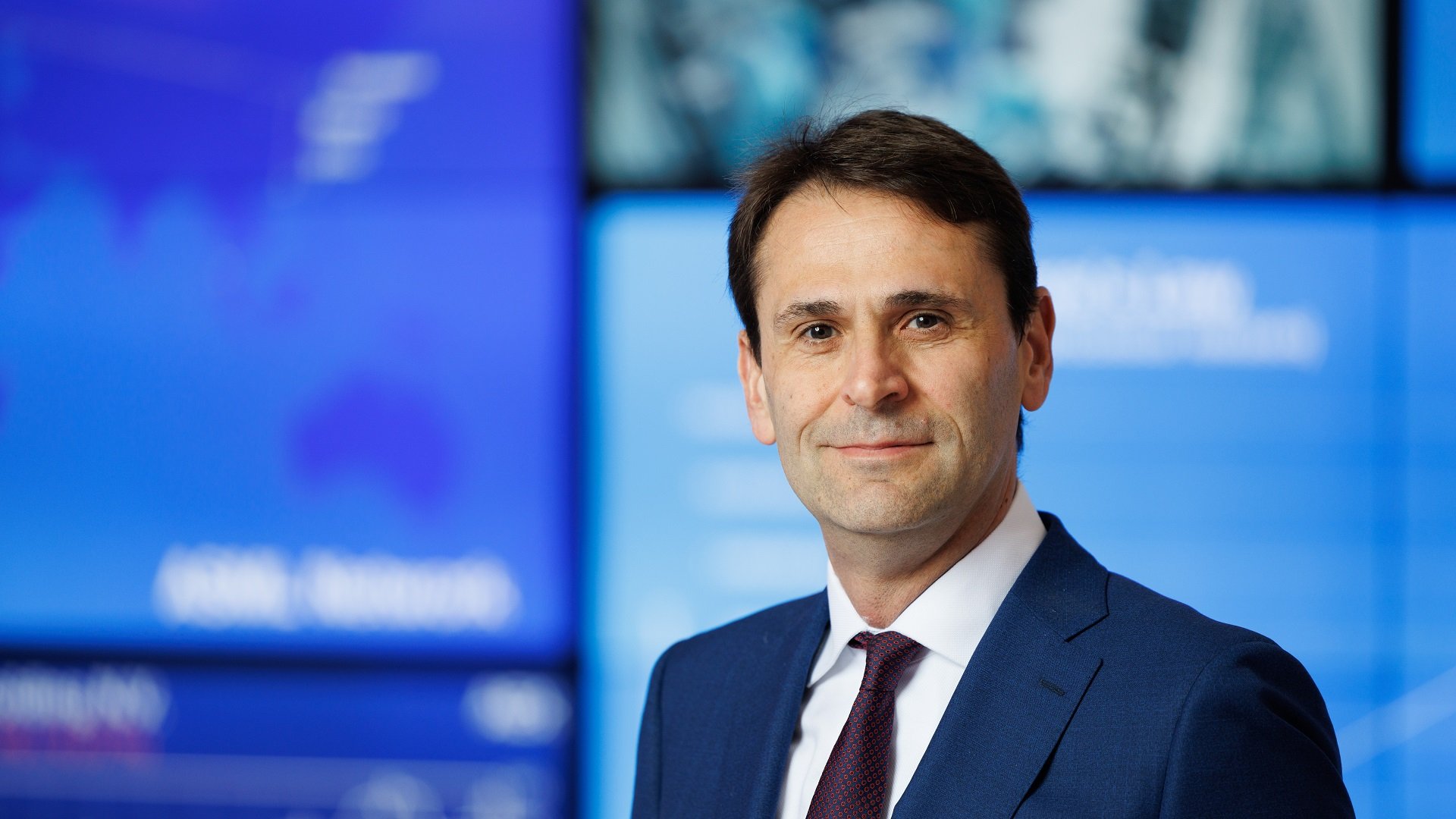
Christophe Fouquet became ASML’s president and chief executive in April 2024. Photo: ©ASML. Source: ASML executive appointment.
In a Future Proof interview described in a November 25 report, Fouquet argued that controls should protect the most advanced technology while avoiding restrictions that induce China to accelerate domestic development. He warned against encouraging a country to “double down or triple down on development.”
Lithography uses light to print patterns on silicon during chip manufacturing. ASML is the sole manufacturer of extreme ultraviolet, or EUV, lithography systems, used for critical layers of the most advanced chips. Fouquet became CEO in April 2024 after serving as executive vice president of EUV technology and then chief business officer, according to his appointment profile. His argument combines experience with the protected technology and responsibility for a business constrained by export rules.
His argument is that a managed “generation gap” can keep Chinese manufacturers buying older Western equipment while frontier tools remain restricted. Fouquet said ASML had maintained market share close to 100% in China for almost 30 years because customers expected access to its technology. That is his account of the relationship, rather than proof that continued access will prevent substitution.
A further account of his remarks says Fouquet described restrictions reaching systems introduced after 2013, with eight newer generations having followed. That measures the gap in equipment generations, not necessarily the gap in finished-chip capabilities.
Bank of England governor Andrew Bailey says newer AI models are worrying their developers. The central bank wants financial firms to strengthen cyber defence and recovery while preparing for quantum-resistant cryptography, with the most systemically important firms moving ahead of national migration milestones.
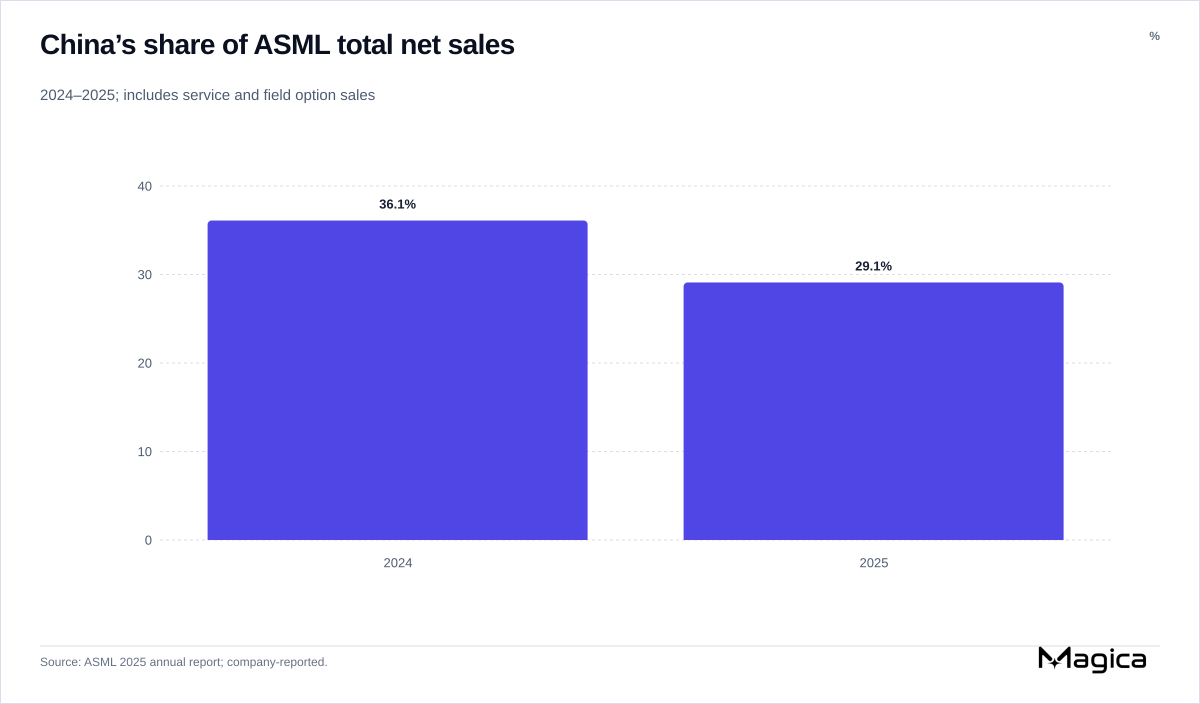
Company-reported China shares of ASML’s total net sales, including service and field option sales. Chart: Magica; source: ASML. Source: ASML 2025 annual report.
China’s share of ASML’s system sales fell from 41% in 2024 to 33% in 2025, according to that account. It also cites estimates of more than 300 accumulated ASML machines in China after heavy purchases of deep ultraviolet (DUV) scanners in 2024 and 2025. New restrictions therefore confront a substantial existing equipment base.
System sales exclude service and field option sales. ASML’s 2025 annual report puts customers in China at 29.1% of total net sales in 2025, against 36.1% in 2024. Applying those rounded shares to reported worldwide net sales implies roughly €9.5 billion from China in 2025, down from €10.2 billion in 2024. Meanwhile, worldwide net sales rose 15.6% to €32.7 billion. China exposure shrank while the overall business grew.
ASML’s monopoly also needs a boundary. Its annual report identifies Canon and Nikon as direct competitors in DUV systems—the older technology at the center of the access debate. ASML’s unique position in EUV does not mean it is the only supplier across lithography.
A second account of the interview describes Fouquet’s warning that Chinese alternatives could erode Western suppliers’ position. The annual report itself identifies competition driven by ambitions for self-sufficiency as a risk. Neither establishes how much continued access would reduce that incentive.
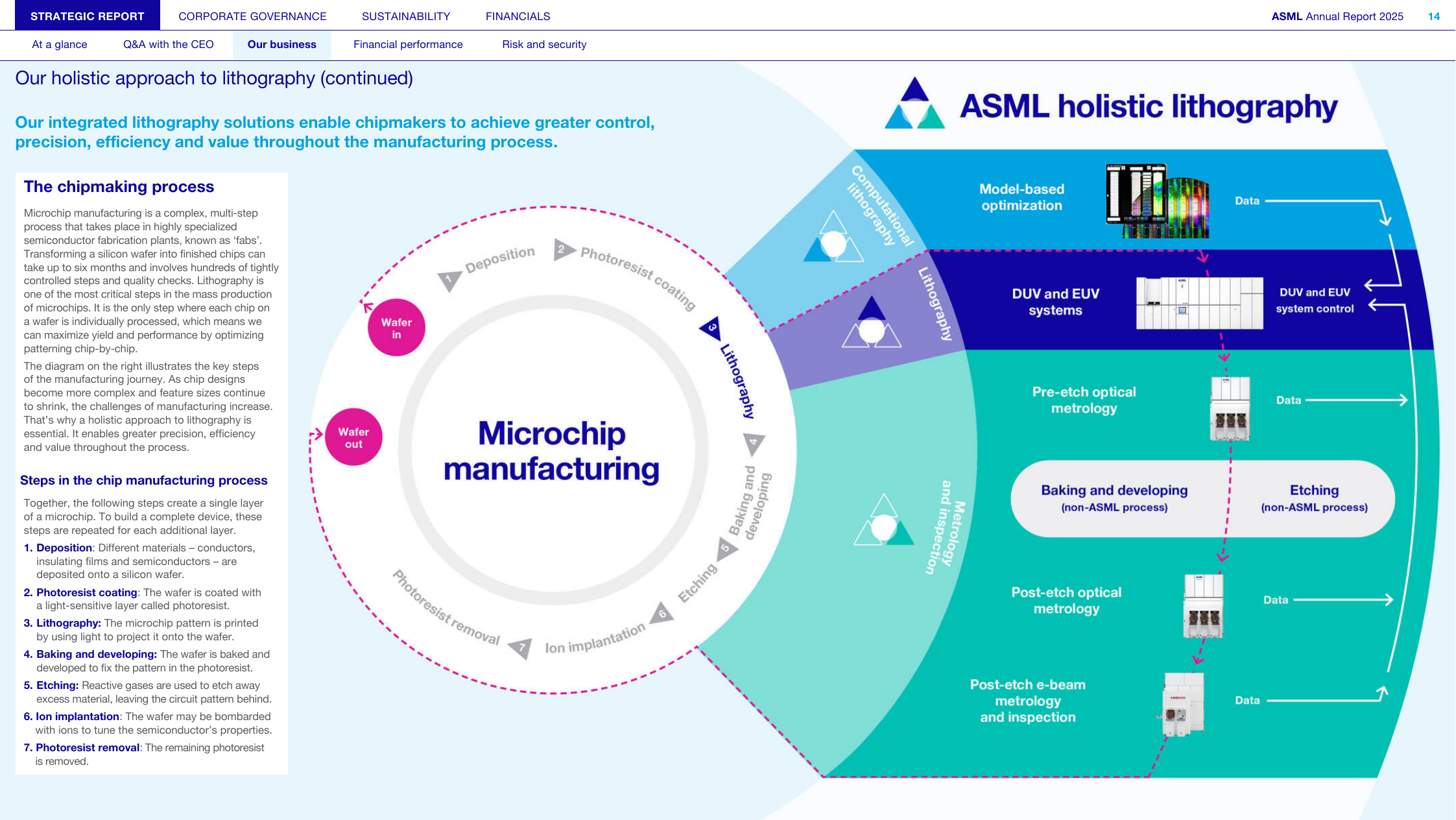
ASML’s diagram shows lithography alongside computational models, metrology and inspection in chipmaking. Source: ASML 2025 annual report. ©ASML. Source: ASML 2025 annual report.
DUV is not simply obsolete equipment. ASML says it produces the majority of layers in microchips, including layers that do not require EUV. The company also says approximately 95% of the systems it sold in the preceding 30 years remain in use, and it offers refurbishment, upgrades and support to extend their working lives.
In an October 2023 technical analysis, chip research firm TechInsights said its teardown of Chinese technology company Huawei’s Mate 60 Pro phone confirmed a processor made with Chinese contract chip manufacturer SMIC’s second-generation 7nm process.
TechInsights noted that chipmakers TSMC and Intel had also fabricated 7nm products without EUV. It said immersion DUV can support that process, although production cycles are longer and yields probably lower. The firm further argued that repeated patterning could take SMIC to 5nm and potentially 3nm, with yield and cost penalties. Those were assessments of technical potential, distinct from its demonstrated 7nm finding.
The distinction matters for controls: restricting access can constrain production economics without making every advanced chip impossible. The analysis supplies no quantified cost or yield comparison from which to judge how competitive such production would be.
Replication also involves more than replacing one machine supplier. ASML’s annual report says about 80% of its bill of materials comes from suppliers and identifies optics maker Carl Zeiss SMT as its sole source of critical lenses, mirrors and other optical components. That dependence illustrates the wider industrial capabilities behind lithography; it does not establish a timetable for Chinese alternatives.
The Dutch government’s rationale directly addresses this problem. Its September 2024 explanation said selected DUV equipment, combined with other technologies, could help produce advanced semiconductors used in military applications. The expansion built on rules introduced in September 2023 and required case-by-case export authorisation for destinations outside the EU; the government explicitly distinguished that requirement from an export ban.
A further expansion announced for April 2025 extended licensing to selected measuring and inspection equipment. The government’s stated objective was to control who obtains which technologies, while limiting disruption to the international chip industry. The mechanism already involves selective permissions, rather than a choice between unrestricted trade and a complete cutoff.
Fouquet’s intervention is an argument about how to set controls, rather than an announced change to them. The unresolved decision is where permissions should stop: permitted equipment can expand Chinese manufacturing capability, while denied access may strengthen the incentive to replace foreign suppliers.
The evidence needed to judge that tradeoff goes beyond ASML’s market share. It includes what chips permitted equipment can produce, at what cost and yield, and whether access actually slows adoption of domestic alternatives. The interview accounts offer no measurable threshold for an acceptable gap or demonstration that continued sales will preserve it.
Huawei’s ISSCC 2027 paper lists a custom memory interface twice HBM4’s width. Its commercial significance depends on bandwidth, manufacturing scale and cost, as China’s AI chipmakers face expensive, restricted memory supplies.
Ubisoft employees say new project pitches must explain how generative AI will be used or why it is unsuitable. The Assassin’s Creed publisher denies mandatory use, leaving questions about how teams secure approval without it.
Stanford physicist Venkatesa Chandrasekaran reports finite gravitational calculations and months of work with GPT-6 Astra. An early critique challenges the construction’s symmetry, finite-state and classical-limit claims.
SAP reportedly weighs at least 10,000 job cuts as it shifts toward AI. Labor negotiations, an earlier restructuring and a growing cloud business complicate the eventual employment and savings tally.
Poland plans to sign a Palantir software agreement on November 27 after years of military trials. Officials promise Polish control of data and access, but the available reporting gives no price, rollout timetable or comparative performance results.
Major software stocks rallied as chips fell, but an estimated $65 billion of software loans comes due in 2028–29. Higher loan yields and slower refinancing threaten indebted borrowers even as established vendors report revenue growth and expanding AI businesses.
Savage Technology is taking reservations for its first product: $799 Orrorin glasses promising displays for both eyes and gestures without a wristband. Meta’s display-and-band bundle launched at the same price; Savage still faces engineering validation and estimated 2027 delivery.
Z.AI’s next flagship model is reportedly behind schedule as rival providers tighten distillation defenses. US licensing rules for overseas computing threaten further delays, with Moonshot forecasting longer release cycles if its access is cut off entirely. Interim releases and alternative suppliers complicate the picture.
Capita is seeking fresh equity and creditor support after replacing its chief executive. Pension recovery costs are only part of its profit downgrade, while government figures show unresolved cases still growing.
Provisional CBS figures show AI use more than doubled among Dutch businesses with at least two workers in 2026. Text generation spread rapidly, while reported productivity gains leave the size of the economic payoff unresolved.
The Global Electronics Association says AI servers are absorbing scarce circuit-board materials and crowding out other industries. New factories are coming, but upstream constraints and uncertain demand complicate the response.
Google says Gemini Live’s Guided Vision is available on iOS, extending visual descriptions and spoken camera-framing help to iPhone users. Device eligibility and regional coverage remain unclear, and Google warns against using it for navigation.
The Dutch government wants Congress to keep the MATCH Act out of its annual defence bill. The proposal would tighten controls on ASML’s China business, including servicing, despite existing Dutch restrictions on advanced chipmaking equipment.
The London startup’s pre-seed round backs research and testing for patient-facing AI. Its founders bring medical-device deployment experience, but benchmark findings and customer submissions do not yet establish real-world safety.
Switzerland’s cybersecurity chief says five confirmed AI-agent attacks affected businesses including three critical-infrastructure operators. Four attacks breached systems, but no major outages were reported, and the public evidence leaves the attackers and specific consequences unknown.
SemiAnalysis reports that Amazon’s Trainium3 delivers up to 2.28 times the tokens per modeled dollar of Nvidia’s GB300 NVL72 in an AgentX preview. The result expands public evidence for custom AI chips, but validation, model matching and customer pricing still determine its practical value.
Microsoft says Chinese and North Korean hacking groups have adopted ARTEX, an AI penetration-testing framework that coordinates existing tools. Its spread across models and software forks complicates efforts to contain abuse through a single provider.
Neuralink says its LINK pivotal study is recruiting people with severe paralysis from ALS to assess digital device control, daily independence and long-term safety. Earlier participant gains and technical setbacks frame the test; the implant remains investigational.
India’s IT secretary says Sarvam’s commercial hosting of foreign AI models does not conflict with its publicly supported domestic model development. Eligibility for proposed inference support remains unresolved.