Editorial Team
6 min read
Savage Technology is taking reservations for its first product: $799 Orrorin glasses promising displays for both eyes and gestures without a wristband. Meta’s display-and-band bundle launched at the same price; Savage still faces engineering validation and estimated 2027 delivery.
Savage Technology, a Hong Kong startup developing its first product, is taking reservations for Orrorin Glasses, promising full-color displays for both eyes and small pinch gestures at the wearer’s side without a ring, wristband or controller. The $799 glasses remain in engineering validation, with Savage estimating shipments from March 2027, according to coverage of its announcement.
Savage is initially targeting developers, asking them to build apps for its own operating system before the hardware ships. Its proposed advantage is a particular combination of weight, binocular displays and input without another wearable. Display glasses with gesture controls have already launched at the same starting price, and Orrorin does not offer the room-mapping capabilities of the Apple headset invoked in its marketing.
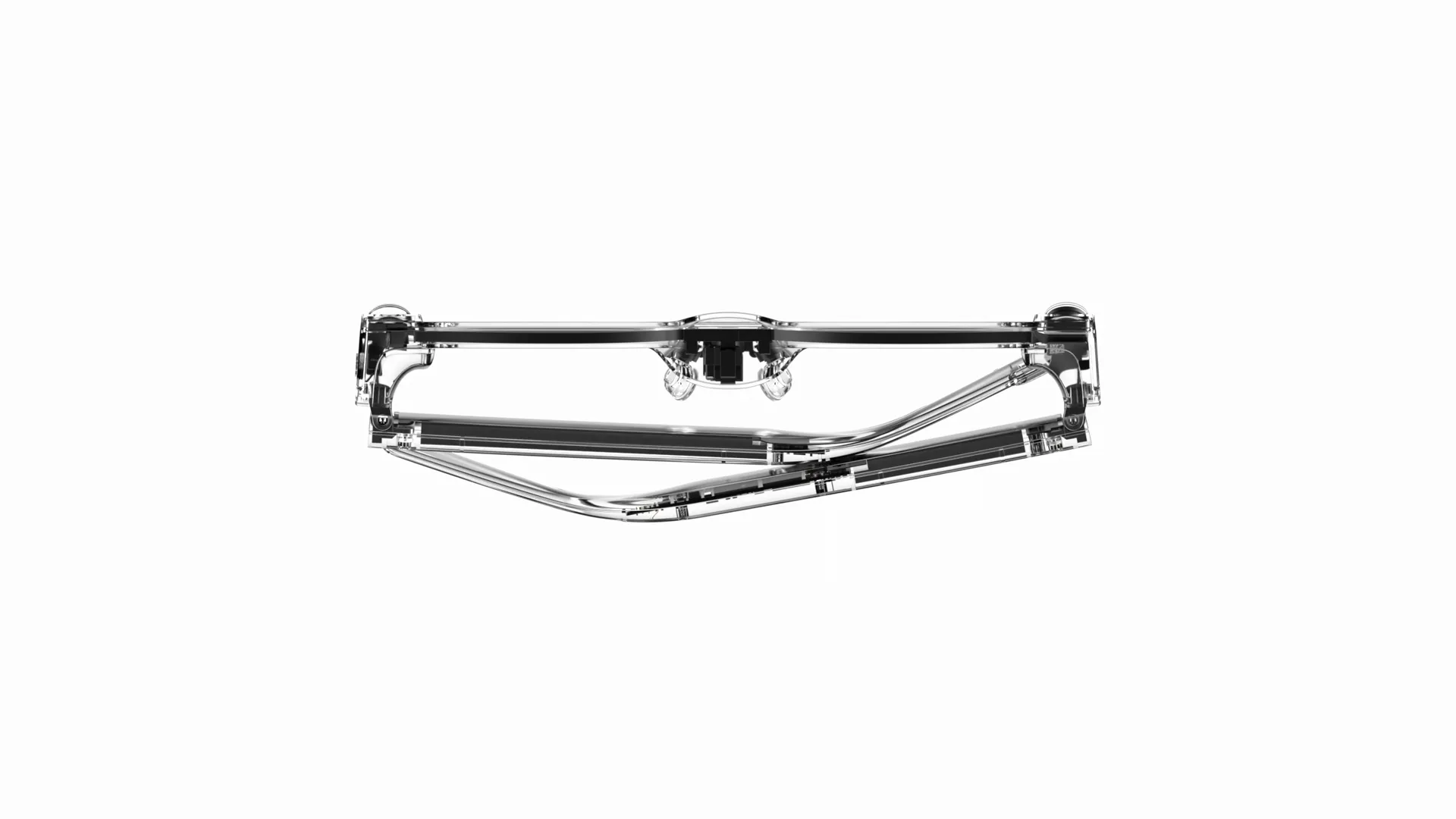
Savage Technology’s promotional render of Orrorin Glasses, which remain in engineering validation. Source: SavageTech.
On its product page, Savage advertises “Vision Pro–level interaction” in a 45-gram frame. The reference is to Apple’s spatial-computing headset, whose interface uses eyes and hand gestures. Orrorin borrows the pinch concept but uses eye tracking to fade the display when the wearer looks away, rather than to select interface elements.
Savage’s FAQ, cited in the announcement coverage, says Orrorin lacks positional tracking and spatial mapping. It therefore cannot anchor virtual windows in a room as Vision Pro does. That substantially limits the scope of the comparison.
Savage’s advertised “25× lighter” figure also needs its denominator: the company compares Orrorin’s stated weight with an M5 Vision Pro headset weighing 750–800 grams plus its 353-gram external battery. That is approximately one twenty-fifth of the combined weight, rather than a comparison of equivalent computing or display capabilities.
Savage lists binocular MicroLED displays at 500 × 380 resolution and 60 Hz, with brightness up to 1,800 nits. A gives the display field of view as 25 degrees. These are advertised specifications, not independent measurements of readability or outdoor performance.
Bank of England governor Andrew Bailey says newer AI models are worrying their developers. The central bank wants financial firms to strengthen cyber defence and recovery while preparing for quantum-resistant cryptography, with the most systemically important firms moving ahead of national migration milestones.
The hardware list includes a front-facing global-shutter camera and two inward-facing eye cameras. Savage promises up to 10 hours of typical use from batteries totaling 450 mAh, while cautioning that endurance varies with use and settings. Neither that capacity nor the advertised runtime establishes how long the glasses will last under a particular app workload.
There is some demonstration evidence, but it is limited. The report describes phone footage recorded through the glasses by Savage co-founder Elena Shi: pinches appeared accurate and responsive, and a pinch-and-hold gesture activated voice input to the AI coding tool Codex. It also says the footage cannot objectively establish display quality. Separately, Savage’s website cautions that on-screen content shown in videos is rendered for illustration. The demonstrations do not establish repeatable gesture performance or measured battery life in everyday use.
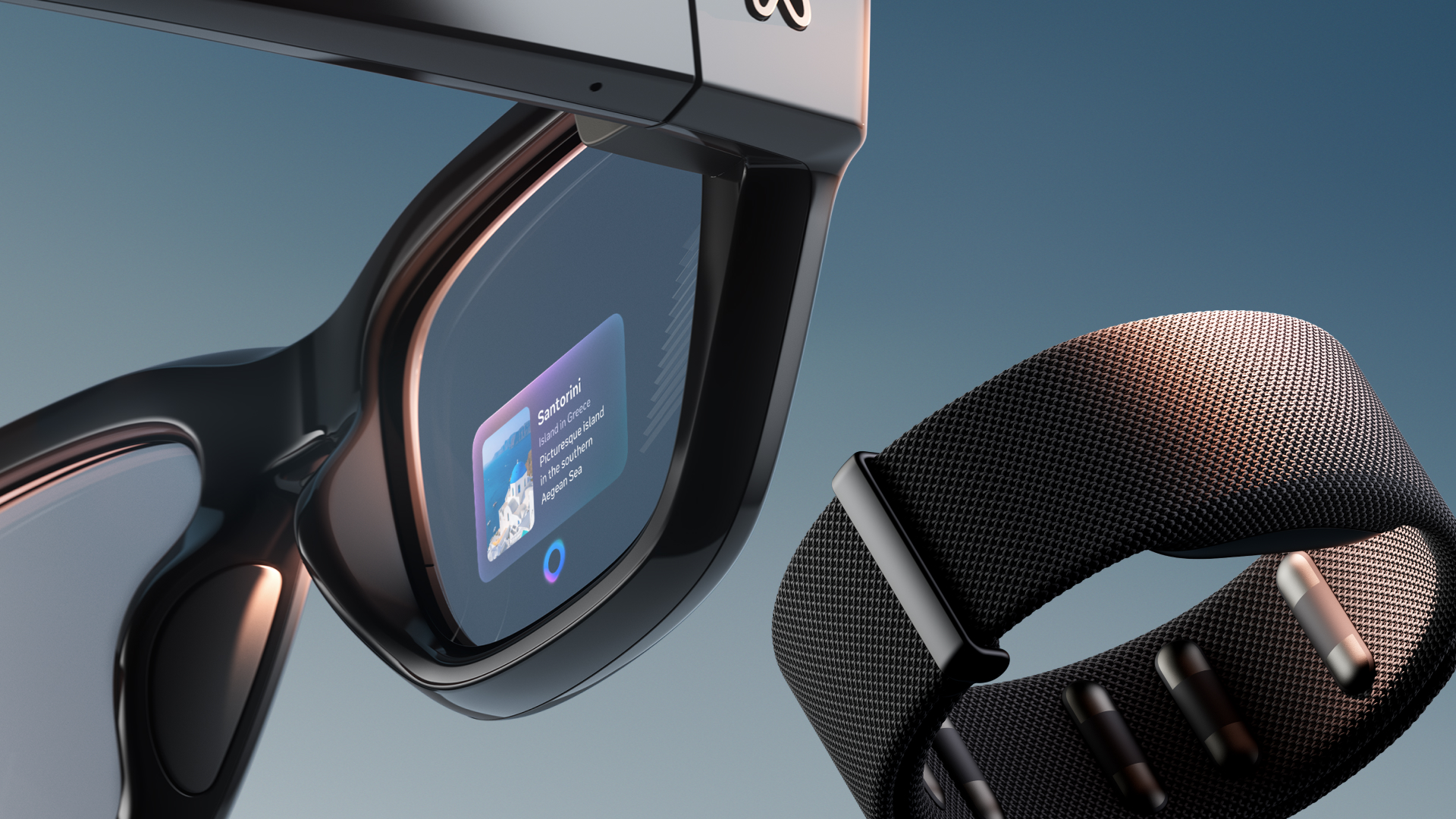
Meta’s promotional render of Meta Ray-Ban Display and its accompanying Meta Neural Band. Source: Meta.
Meta Ray-Ban Display, Meta’s glasses with a screen for the right eye, uses the accompanying Meta Neural Band for gesture control. The band translates muscle activity at the wrist into commands, allowing subtle finger movements to control the glasses without touching the frame, according to Meta’s launch announcement.
That announcement set a starting US price of $799 for both the glasses and band. Its September 30, 2025 update said they were available to purchase at selected US retailers. That is a documented launch price and availability baseline, rather than a verified current retail offer.
Savage’s proposed distinction is two-eye displays without an extra wearable, not a lower price against that bundle. The wristband is also an alternative input mechanism, not simply an accessory surcharge: Meta says it supports scrolling and clicking through muscle signals. Its announcement describes messaging, visual AI answers, live captions and translations, and walking navigation initially limited to selected cities in beta. Savage is entering a category with an existing product and stated everyday uses, rather than creating display-based gesture control from scratch.
Standard Ray-Ban Meta glasses lack displays, as the Orrorin announcement coverage notes. They should not be treated as equivalent to Meta Ray-Ban Display—or as evidence that Savage’s display proposition has no competitor.
Savage’s proprietary operating system, SavageOS Oldowan, and its developer offering are described in coverage of the product announcement. The company says apps compile directly to machine code, run on the glasses and can be tested in a computer simulator before installation. Its advertised SDK exposes hand-tracking and eye-input APIs; the product page says apps are developer-signed and sandboxed.
The website labels an app-building workflow using the AI coding tools Claude Code or Codex as upcoming. Developers would supply a Savage instruction file, describe an app, and have the coding tool build it, run it in a simulator and install it on the glasses. That is a proposed development workflow, not evidence of a mature app catalog.
In the demonstration report, Shi says an open protocol lets users connect their own AI agents, extending the proposed interface beyond Claude Code and Codex. Controlling agents through the glasses does not establish that those agents execute there. The specification report also lists Bluetooth 5.4 connectivity to other devices.
Savage lists 64 MB of memory and 4 GB of storage, and promises that all AI processing happens on the device. It also promises that neither Savage nor third-party apps can access raw camera images or audio recordings. These are vendor commitments about processing and privacy; their implementation remains to be independently tested in a shipping product.
Savage lists $199 Founder Edition and $29 Early Bird reservation deposits, each credited toward the $799 total. Its product-page terms say Early Bird deposits are fully refundable before balance payment; Founder Edition refunds may subtract a legally justified deduction. The smaller amounts reserve a future purchase rather than buy glasses at those prices.
The announcement coverage gives Savage’s estimated shipment dates as March 2027 for Founder Edition buyers and May 2027 for Early Bird buyers. Savage itself cautions that shipping dates are estimates. As this is its first product, buyers have no prior Savage product release against which to judge delivery execution.
Before paying the balance or committing substantial development effort, buyers and builders need evidence from production hardware: consistent recognition of small gestures, readable displays under varied lighting, endurance measured against stated workloads, and tools that produce useful apps. Those results would determine whether removing the wristband yields a practical alternative to a display-glasses system that has already reached retail.
Huawei’s ISSCC 2027 paper lists a custom memory interface twice HBM4’s width. Its commercial significance depends on bandwidth, manufacturing scale and cost, as China’s AI chipmakers face expensive, restricted memory supplies.
Ubisoft employees say new project pitches must explain how generative AI will be used or why it is unsuitable. The Assassin’s Creed publisher denies mandatory use, leaving questions about how teams secure approval without it.
Stanford physicist Venkatesa Chandrasekaran reports finite gravitational calculations and months of work with GPT-6 Astra. An early critique challenges the construction’s symmetry, finite-state and classical-limit claims.
SAP reportedly weighs at least 10,000 job cuts as it shifts toward AI. Labor negotiations, an earlier restructuring and a growing cloud business complicate the eventual employment and savings tally.
Poland plans to sign a Palantir software agreement on November 27 after years of military trials. Officials promise Polish control of data and access, but the available reporting gives no price, rollout timetable or comparative performance results.
Major software stocks rallied as chips fell, but an estimated $65 billion of software loans comes due in 2028–29. Higher loan yields and slower refinancing threaten indebted borrowers even as established vendors report revenue growth and expanding AI businesses.
Christophe Fouquet argues that selling China older lithography tools can preserve Western leverage. ASML’s commercial exposure and China’s ability to stretch older technology complicate that case.
Z.AI’s next flagship model is reportedly behind schedule as rival providers tighten distillation defenses. US licensing rules for overseas computing threaten further delays, with Moonshot forecasting longer release cycles if its access is cut off entirely. Interim releases and alternative suppliers complicate the picture.
Capita is seeking fresh equity and creditor support after replacing its chief executive. Pension recovery costs are only part of its profit downgrade, while government figures show unresolved cases still growing.
Provisional CBS figures show AI use more than doubled among Dutch businesses with at least two workers in 2026. Text generation spread rapidly, while reported productivity gains leave the size of the economic payoff unresolved.
The Global Electronics Association says AI servers are absorbing scarce circuit-board materials and crowding out other industries. New factories are coming, but upstream constraints and uncertain demand complicate the response.
Google says Gemini Live’s Guided Vision is available on iOS, extending visual descriptions and spoken camera-framing help to iPhone users. Device eligibility and regional coverage remain unclear, and Google warns against using it for navigation.
The Dutch government wants Congress to keep the MATCH Act out of its annual defence bill. The proposal would tighten controls on ASML’s China business, including servicing, despite existing Dutch restrictions on advanced chipmaking equipment.
The London startup’s pre-seed round backs research and testing for patient-facing AI. Its founders bring medical-device deployment experience, but benchmark findings and customer submissions do not yet establish real-world safety.
Switzerland’s cybersecurity chief says five confirmed AI-agent attacks affected businesses including three critical-infrastructure operators. Four attacks breached systems, but no major outages were reported, and the public evidence leaves the attackers and specific consequences unknown.
SemiAnalysis reports that Amazon’s Trainium3 delivers up to 2.28 times the tokens per modeled dollar of Nvidia’s GB300 NVL72 in an AgentX preview. The result expands public evidence for custom AI chips, but validation, model matching and customer pricing still determine its practical value.
Microsoft says Chinese and North Korean hacking groups have adopted ARTEX, an AI penetration-testing framework that coordinates existing tools. Its spread across models and software forks complicates efforts to contain abuse through a single provider.
Neuralink says its LINK pivotal study is recruiting people with severe paralysis from ALS to assess digital device control, daily independence and long-term safety. Earlier participant gains and technical setbacks frame the test; the implant remains investigational.
India’s IT secretary says Sarvam’s commercial hosting of foreign AI models does not conflict with its publicly supported domestic model development. Eligibility for proposed inference support remains unresolved.