Editorial Team
7 min read
The London startup’s pre-seed round backs research and testing for patient-facing AI. Its founders bring medical-device deployment experience, but benchmark findings and customer submissions do not yet establish real-world safety.
Fault Line, a London startup that evaluates patient-facing clinical AI and the tests used to assess it, has launched with £2.3 million to expand its research and engineering teams. It is building a business around a consequential gap: a benchmark score does not by itself establish that a healthcare product is safe.
The company said in its funding announcement that venture investors Concept Ventures and Frontline Ventures co-led the round. The money will fund validation of new testing methods and publication of safety evidence. For healthcare organisations buying AI that talks directly to patients, the question is whether those methods expose failures that existing checks miss—and remain useful after a product changes.

Fault Line founders Ben Carrington, Max Rollwage and George Prichard. Photo: Concept Ventures. Source: Concept Ventures.
Fault Line’s founders are co-CEOs Benjamin Carrington, also known as Ben, and Max Rollwage, and chief technology officer George Prichard. Their current roles appear in Concept’s portfolio listing; a funding report says they previously led AI, research and regulatory teams at Limbic, a developer of mental-health AI medical-device software. A separate report drawing on Fault Line’s announcement dates the company’s founding to 2026.
In its customer case study, Fault Line says its founders led regulatory strategy, clinical AI research and commercial rollout of a mental-health chatbot that earned Class IIa medical-device status in the UK. The company says that product has since assessed more than 650,000 patients and is used by nearly half of NHS Talking Therapies services. That is relevant experience of deployment and procurement, although those figures describe the founders’ previous work rather than Fault Line’s own customer scale.
Fault Line describes itself as an independent safety research organisation, offering research, evaluation engineering and safety validation. Its announcement also states a clear commitment to deployment: the company believes autonomous AI care is necessary to expand healthcare capacity. Its commercial proposition is to help developers generate evidence for buyers and medical-device compliance, while improving their products’ safety controls.
In its announcement, Fault Line says its first study found that none of the leading mental-health AI benchmarks it examined could reliably distinguish a safe chatbot from a deliberately unsafe one. The funding report describes its experiment as testing seven chatbot versions, ranging from one that never advised users to seek help in a crisis to one following detailed safety protocols.
The company assessed two properties: sensitivity to differences in chatbot safety and the realism of test conversations, measured by how readily they could be distinguished from real conversations. It says no benchmark performed strongly on both. These are claims about the evaluations tested, rather than evidence that every clinical AI evaluation is ineffective.
In a second study, which Fault Line says it conducted with the UK’s AI Security Institute and the University of Oxford, it identified 22 dimensions of potential patient harm, including missed mental-health crises and unsafe medication advice. Of 36 clinical benchmarks assessed against that framework, the broadest covered 16 dimensions, leaving six uncovered.
Coverage is not a patient injury rate, and the company acknowledges an important limitation: some benchmarks deliberately target narrow risks or clinical capabilities that exclude safety handling. Such a benchmark can serve its intended purpose without providing comprehensive product assurance.
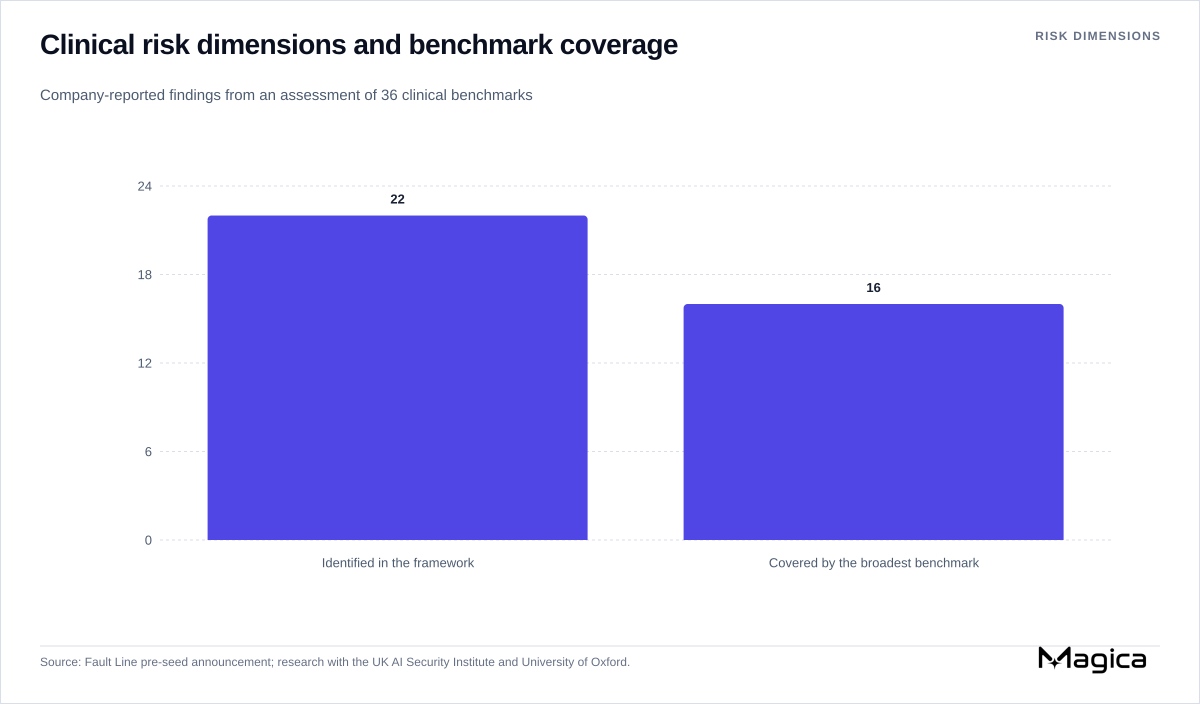
Company-reported: Fault Line identified 22 clinical risk dimensions; the broadest of 36 assessed benchmarks covered 16. Coverage measures scope, not patient injury rates; some benchmarks deliberately target narrower tasks. Source: Fault Line.
The question of whether automated safety tests work predates this financing. A human-validation study published on June 29, 2026 examined VERA-MH—Validation of Ethical and Responsible AI in Mental Health—an open-source benchmark for chatbot suicide-risk detection and response. Its proof-of-concept code was released in October 2025.
The study used 90 simulated conversations, each scored across five safety dimensions by three clinicians. The clinicians and an AI judge applied the same rubric. With GPT-4o as judge, chance-corrected reliability against clinician consensus was 0.81, with a 95% confidence interval of 0.75–0.87. That supports agreement under a shared scoring framework; it is not an 81% clinical safety score.
The more decision-relevant limit is what judges missed. Across four judge models, sensitivity for identifying ratings with “high potential for harm” ranged from 82 of 106 such conversation-dimension cases identified by clinician consensus (77.4%) to 90 of 106 (84.9%). High overall agreement therefore coexisted with missed harmful-behaviour ratings.
Simulation also remained imperfect. Clinicians’ assessments matched the prompted disclosure level in only 65 of 178 eligible ratings, or 36.5%; most mismatches were between adjacent categories. Those are clinician ratings, not 178 distinct conversations. The evaluated version used ten simulated user profiles, excluded under-18s and had not established whether results generalised to real conversations or user outcomes.
The study was supported internally by Spring Health, whose clinicians supplied the ratings; all authors disclosed employment and equity interests in Spring Care Inc. The authors warned that a single organisation’s clinicians may share assumptions and called for external validation of updated benchmark versions. VERA-MH supplies an existing, inspectable evaluation approach, while illustrating why reliability, realism and comprehensive safety are separate questions. The study does not establish how VERA-MH compares with Fault Line’s own methods.
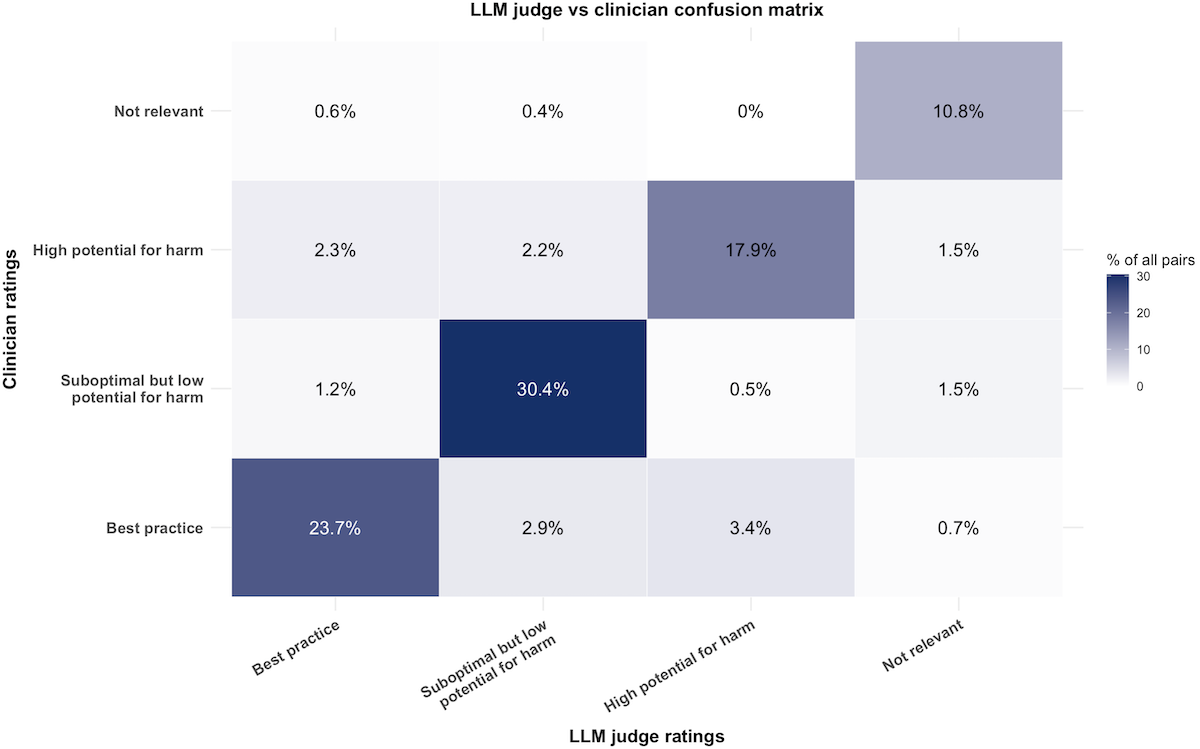
GPT-4o and individual clinician ratings across 1,350 pairs. Figure 2, unchanged, from Bentley KH et al., “AI Chatbot Suicide Risk Detection and Response: Human Validation Study of the Open-Source VERA-MH Safety Evaluation,” JMIR AI 2026;5:e92817, https://ai.jmir.org/2026/1/e92817/. © Kate H Bentley, Luca Belli, Adam M Chekroud, Emily J Ward, Emily R Dworkin, Emily Van Ark, Kelly M Johnston, Will Alexander, Millard Brown and Matt Hawrilenko. CC BY 4.0: https://creativecommons.org/licenses/by/4.0/. Source: VERA-MH human validation study.
Fault Line’s October 21 case study describes work for Neuly, an AI coach that uses voice and text to support parents and carers of neurodivergent children alongside their existing professional support. Fault Line says it ran more than 7,500 adversarial conversations across 22 clinical risk dimensions, with six weeks from the start of work to medical-device submission.
The case study describes an API connection, an initial audit, safety changes made by Neuly and repeat audits to check those changes. Results were translated into risk scoring aligned with ISO 14971 for the product’s technical file. Fault Line says the work helped Neuly register as a medical device, and that the two companies subsequently agreed to integrate testing more closely into Neuly’s software lifecycle.
The claimed economic benefit is repeatability: Fault Line says Neuly can generate evidence for a product update within minutes, with targeted checks showing the effect of changes within hours. These are the supplier’s claims about workflow speed, not independently measured cost savings or reduced patient harm. The case study provides no like-for-like cost comparison with manual testing.
It also makes the independence question concrete. Fault Line embeds researchers with development teams, recommends improvements and then evaluates the revised product. A separate testing organisation brings scrutiny beyond the developer’s internal checks, but buyers still need to understand who sets the criteria and how final validation is governed.
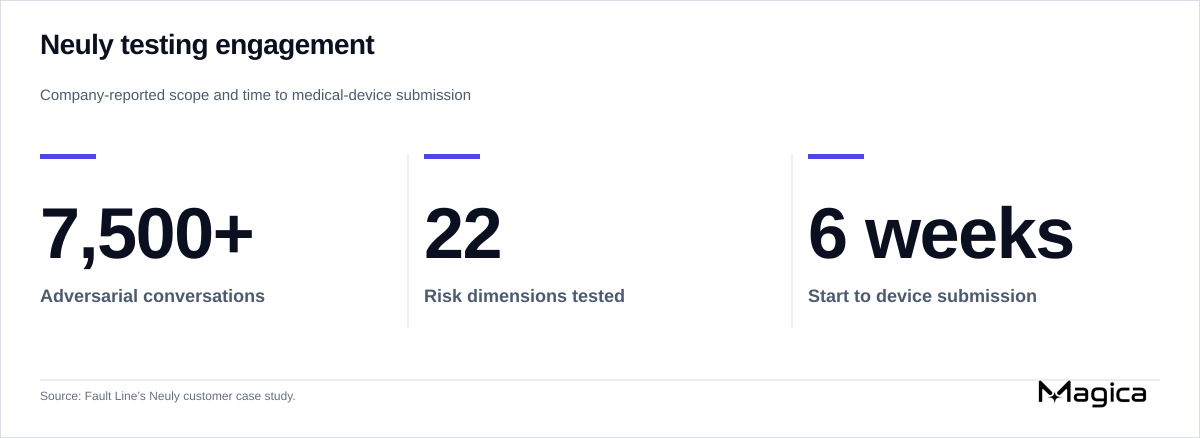
Company-reported figures for Fault Line’s Neuly engagement describe testing scope and submission timing; they do not measure reduced patient harm or regulatory approval. Source: Fault Line customer case study.
The funding announcement does not disclose pricing, revenue or customer numbers. The £2.3 million round finances a larger research and engineering effort; it does not establish the cost of continuously testing deployed products or the economics of delivering that service at scale.
For a buyer deciding whether to rely on Fault Line’s evidence, the next questions are specific: do its tests reliably catch unsafe behaviour in realistic interactions, do results hold after prompts or underlying models change, and can external evaluators reproduce them? Its own argument against overreading benchmark scores makes independent validation of those answers central to the business it is building.
Z.AI’s next flagship model is reportedly behind schedule as rival providers tighten distillation defenses. US licensing rules for overseas computing threaten further delays, with Moonshot forecasting longer release cycles if its access is cut off entirely. Interim releases and alternative suppliers complicate the picture.
Capita is seeking fresh equity and creditor support after replacing its chief executive. Pension recovery costs are only part of its profit downgrade, while government figures show unresolved cases still growing.
Provisional CBS figures show AI use more than doubled among Dutch businesses with at least two workers in 2026. Text generation spread rapidly, while reported productivity gains leave the size of the economic payoff unresolved.
The Global Electronics Association says AI servers are absorbing scarce circuit-board materials and crowding out other industries. New factories are coming, but upstream constraints and uncertain demand complicate the response.
Google says Gemini Live’s Guided Vision is available on iOS, extending visual descriptions and spoken camera-framing help to iPhone users. Device eligibility and regional coverage remain unclear, and Google warns against using it for navigation.
The Dutch government wants Congress to keep the MATCH Act out of its annual defence bill. The proposal would tighten controls on ASML’s China business, including servicing, despite existing Dutch restrictions on advanced chipmaking equipment.
Switzerland’s cybersecurity chief says five confirmed AI-agent attacks affected businesses including three critical-infrastructure operators. Four attacks breached systems, but no major outages were reported, and the public evidence leaves the attackers and specific consequences unknown.
SemiAnalysis reports that Amazon’s Trainium3 delivers up to 2.28 times the tokens per modeled dollar of Nvidia’s GB300 NVL72 in an AgentX preview. The result expands public evidence for custom AI chips, but validation, model matching and customer pricing still determine its practical value.
Microsoft says Chinese and North Korean hacking groups have adopted ARTEX, an AI penetration-testing framework that coordinates existing tools. Its spread across models and software forks complicates efforts to contain abuse through a single provider.
Neuralink says its LINK pivotal study is recruiting people with severe paralysis from ALS to assess digital device control, daily independence and long-term safety. Earlier participant gains and technical setbacks frame the test; the implant remains investigational.
India’s IT secretary says Sarvam’s commercial hosting of foreign AI models does not conflict with its publicly supported domestic model development. Eligibility for proposed inference support remains unresolved.
Manufacturing partners have reportedly told buyers that Nvidia will not permit server orders to ship to Malaysia, Singapore, Thailand and Indonesia as they assess new US export controls. The uncertainty is already reaching cloud-project financing.
Trustly’s existing owners are funding new AI payment products after job cuts. New quarterly results show rising payment volumes and revenue, but weaker earnings than a year earlier.
The Pentagon denies reports that officials weighed production powers to pressure Nvidia to restore Jensen Huang. Nvidia confirms senior government input, but its board’s foreign-intelligence investigation remains open.
Perplexity says users are choosing Google's new model over rival offerings, with daily token volume doubling in three days. The 120-billion figure is cumulative, and the early demand leaves retention and task economics unresolved.
Kioxia says a proof of concept paired Nvidia software with about 1.1 PB of raw SSD capacity to expand the datasets GPUs can access. The demonstration establishes a capacity proposition, while workload performance and deployment economics remain undisclosed.
Google’s November 25 update adds Familiar Face alerts and remote siren controls to two Walmart Onn outdoor cameras. The expansion makes inexpensive Nest alternatives more capable, while the value depends on subscription access and reliable video playback.
OpenAI is testing a combined Chat and Work experience with a small group of Pro subscribers. A shared allowance arriving more broadly in December will put advanced conversations and delegated tasks on the same budget, but the size of any resulting loss of access remains unknown.
Sellers are seeking buyers for thousands of Nvidia B300 chips, while Asian data centers try to replace Chinese customers affected by U.S. controls. Rental prices have fallen, but short contracts remain scarce and operators face demanding financing terms.
Lenders are delaying or reassessing financing for Asian data centers serving Chinese technology firms as new US licensing rules put chip purchases and customers’ access to computing capacity in doubt.