Editorial Team
6 min read
Microsoft’s president says AI-assisted vulnerability discovery is forcing faster software repairs and raising disruption risks. But he says Microsoft’s own recent outage was unrelated to AI, leaving incident-by-incident evidence crucial to judging the warning.
Microsoft president and vice chair Brad Smith, the company’s former general counsel who became president in 2015, warned on November 22 that AI-assisted discovery of software flaws is creating a patching race that could bring months of disruption. His warning came as he apologized for a global Microsoft outage that he said had a separate cause.
In the interview on “Face the Nation,” Smith described a race between defenders and attackers using increasingly effective tools to find weaknesses in code. Faster repairs, particularly on older infrastructure, can leave less time to test changes and increase the risk of outages, he said.
Smith linked a substantial part of the recent outages to that pressure. But the interview did not provide incident-by-incident evidence establishing how many failures resulted from AI-driven patching. Businesses face competing risks: leaving vulnerabilities exposed and interrupting services while repairing them.
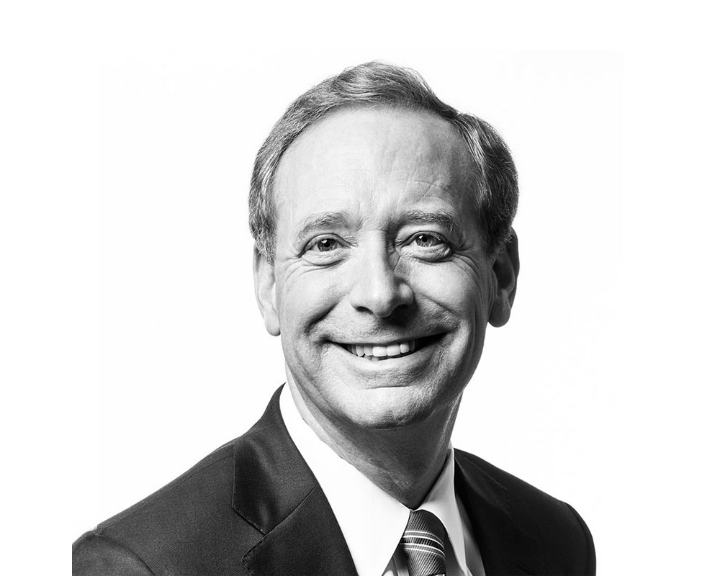
Microsoft vice chair and president Brad Smith. Official portrait: Microsoft. Source: GeekWire.
The Microsoft disruption began November 12 and extended into November 13, affecting Microsoft 365, including Exchange Online and Outlook email services used by businesses and government agencies, according to the account of the recent disruptions. Smith said software updated four months earlier interacted with a newer update and a change in network traffic. He said it was neither a cyberattack nor linked to AI.
Microsoft had published two reports in the preceding 10 days, completed nine corrective steps and planned another 13, Smith said. Those are the company’s account of its response, rather than an independent assessment that the underlying risks have been resolved.
Satya Nadella says Claude Code caught Microsoft off guard by moving AI coding toward the terminal. Microsoft’s response includes managing rival agents in VS Code, while its investment and cloud commitments with Anthropic complicate the competitive picture.
A report examining Microsoft’s final incident account identifies a specific testing failure. Microsoft said its tests did not adequately represent the hardware and traffic combination encountered. The reporting describes tests on older servers, while the bug disabled newer, more powerful machines under load. It also describes safeguards spreading the failure rather than containing it. Microsoft’s final account did not specify what the July update was intended to fix.
That limits an explanation centered on aging equipment alone. Testing and failure containment also matter when the affected hardware is newer.
Smith brings experience representing Microsoft on security and public-policy questions. When he became president in 2015, chief executive Satya Nadella assigned him a larger role in external relationships and public representation, according to the appointment report and reproduced employee email. The appointment also gave him responsibility for initiatives including security and privacy. His warning comes from an executive representing a supplier whose customers are seeking an explanation for lost service.
The broader interview underscored Microsoft’s infrastructure stake. Host Margaret Brennan cited the company’s website as listing more than 600 data centers in 34 countries. Smith described cloud services that support business operations, video streaming and gaming. Reliability affects activities far beyond AI applications.
Smith’s argument is that AI changes the speed of an existing security problem. Finding a flaw helps a defender repair it, but can also help an attacker exploit it. Organizations trying to act first must absorb more changes into systems whose interactions are difficult to predict.
He offered no measured outage rate or numerical forecast of how often AI-assisted patching would cause failures.
Update failures already had consequences at scale before this warning. In its July 2024 account of a faulty update from independent cybersecurity vendor CrowdStrike, Microsoft estimated that 8.5 million Windows devices were affected—less than 1% of all Windows machines. Microsoft attributed the wide economic and societal consequences to the vendor’s use by enterprises running critical services.
That estimate measures affected devices in a different incident, not the extent of this month’s disruption. It illustrates why a small share of a platform can still matter when failures reach organizations others depend on.
The business challenge also predates the current AI tools. An April 2022 National Institute of Standards and Technology guide framed enterprise patching as preventive maintenance and a necessary business cost. Its definition includes prioritizing updates and verifying their installation, alongside finding and installing them. The guide also identifies prevention of operational disruptions as a benefit of patching, alongside preventing compromises and data breaches. Repairing flaws is itself a reliability measure, as well as work that must be managed safely.
The next test is evidence separating individual failures from a shared explanation. On the same program, former Cybersecurity and Infrastructure Security Agency director Chris Krebs said his understanding was that the recent aviation ground stop was not caused by AI, while noting that investigation details were still to come. He characterized that incident as a system upgrade, distinguishing hardware changes from other incidents that might have an AI element.
Treasury Secretary Scott Bessent offered reassurance about banks on the same program. He attributed the recent JPMorgan disruption to a security patch causing a glitch and argued that banks’ long cybersecurity experience made them resilient. His reassurance concerned financial institutions; it did not establish that every recent outage shared that cause.
The panel differed over household preparations. Dmitri Alperovitch, chairman of the Silverado Policy Accelerator think tank and a co-founder of CrowdStrike, predicted more outages and said he was keeping cash and supplies available against temporary loss of access to services. Samantha Vinograd, a former Department of Homeland Security counterterrorism official, said she was neither stocking up nor canceling travel. She emphasized redundancy and fallback plans to avoid a single point of failure.
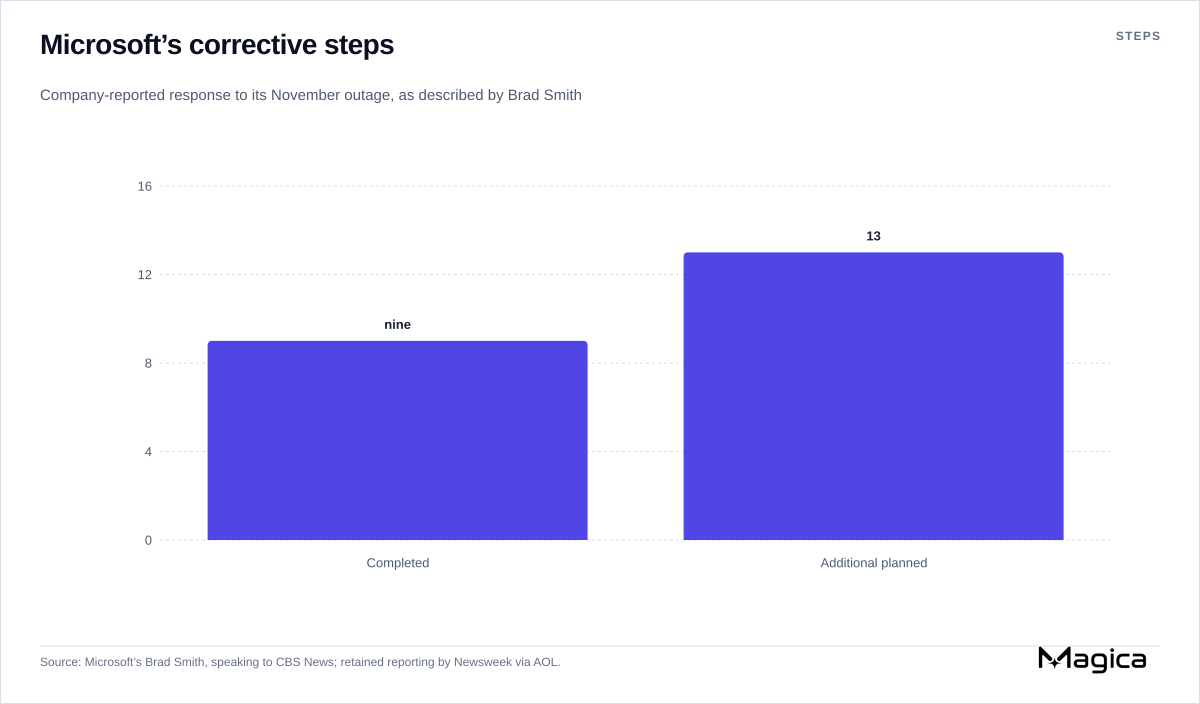
Company-reported: Smith said Microsoft had completed nine corrective steps and planned 13 more; the counts do not establish that underlying risks are resolved. Source: AOL.
Smith’s prescription was to keep installing phone and laptop security patches while organizations revise patching practices, improve coordination among IT teams and upgrade legacy infrastructure. He also called for closer government-industry cooperation and better sharing of threat intelligence.
What remains unresolved is how much of the recent disruption reflects accelerated security repairs, how much reflects other upgrades, and whether corrective measures reduce recurrence. Microsoft’s promised corrective steps offer one concrete test. Incident reports identifying the changes involved, the testing performed and the recovery failures—and evidence that corrective work prevents recurrence—will help establish whether organizations can sustain faster repairs more reliably.
Apple’s reported Siri layoffs targeted older infrastructure, while a beta update points to some migration onto newer systems. The harder test is delivering app control promised in 2024 and subsequently delayed.
Zhipu says GLM-5.4 adds vision and stronger coding to its subscription service, with larger usage quotas. Undisclosed credit rates and benchmarks leave its value unresolved as the company expands a cloud business backed by substantial financing.
The London consumer law business has secured seed funding led by Insight Partners to expand beyond conveyancing. Its bet is on delivering legal work directly, but claimed growth has yet to establish a cost or service advantage over competing practices.
Meta chief AI officer and former Scale AI CEO Alexandr Wang warns that unconstrained AI self-improvement threatens human control. His call for a different industry path follows an AI-assisted mathematical breakthrough, but neither that collaboration nor new research-automation data establishes fully autonomous science.
US President Donald Trump urged Nvidia to bring back its co-founder and former CEO Jensen Huang, despite a reported board statement against reinstatement and unresolved allegations involving Chinese intelligence and chip shipments.
Claude’s estimated October web visits rose 23.8%, but the figures measure neither paying customers nor job losses. A resurfaced account of Dario Amodei discussing immersive games at OpenAI raises a separate question about how AI’s builders approach its social consequences.
OpenAI wants frontier labs to tie development limits to prediction loss and monitoring milestones. Its internal figures offer a starting point, but datasets differ across companies and the metric misses major reasoning gains.
A 2,000-cubic-metre tank and mobile pumping capacity address northern Hong Kong flooding, while AI tools help position crews and detect rising water. Official records distinguish established monitoring from three-site forecasting trials, with costs disclosed but comparative performance results absent.
Reported server price demands reach 45% above earlier agreements. HPE explicitly permits repricing before shipment, while XTX's disputed Dell order raises a sharper question: what happens when a buyer says it paid extra for a fixed price?
OpenRouter disclosed provider removals after investigations into inference data handling. Separate notices describe forwarded requests, a compromised deployment and stolen prompt samples, exposing different weaknesses behind privacy assurances.
Lawyers seeking a quarter of Apple's $250 million settlement fund expect participating buyers to recover at least $61 per eligible iPhone. The estimate depends on claims volume, deductions and final court approval.
Nasdaq-100 futures rose as much as nearly 3% in Sunday evening reports after a punishing selloff. The holiday-shortened week brings earnings and inflation tests for a market still questioning the AI investment boom.
Foreign intelligence officials describe a Chinese state security team helping companies obtain restricted AI chips and collecting semiconductor intelligence. The reported campaign predates the Megaspeed controversy, while new US rules target a separate route: remote access to computing power abroad.
Elon Musk says Tesla cars will retain AI4 while AI5 goes to Optimus. An upgraded AI4 remains in development, hardware costs are rising, and older-car owners still lack a retrofit date.
Visa Crypto Labs is testing an invitation-only wallet for US users to earn and spend OUSD through AI agents. Card verification links agents to owners, but marketplace admission, work acceptance and live identity checks remain separate hurdles.
Treasury Secretary Scott Bessent said responsibility for disputed China chip sales must be established before he backs Jensen Huang’s return to Nvidia, despite President Donald Trump’s support.
Employee equity at Anthropic’s IPO price is reportedly worth $232 billion, while book rightsholders await a first settlement installment estimated at $2,203.56 per work. Vesting, shared copyrights and founder voting rights complicate the comparison.
Moore Threads is preparing a December 29 reveal for Lushan, a desktop GPU pitched at gaming and local AI inference. Its claimed memory record remains unquantified, and capacity alone will not establish performance or value.

Amazon is in advanced talks to buy Decart, whose software helps AI models run efficiently across chips. The reported deal could strengthen AWS’s Trainium business, with conditional payments and five-year founder commitments making execution central to its value.