Editorial Team
7 min read
Visa Crypto Labs is testing an invitation-only wallet for US users to earn and spend OUSD through AI agents. Card verification links agents to owners, but marketplace admission, work acceptance and live identity checks remain separate hurdles.
Visa Crypto Labs, the Visa product team behind Visa CLI, is testing a wallet that connects AI agents to card-verified owners and lets them complete paid tasks. Rewards go to the owner's wallet in OUSD, which its documentation describes as a dollar stablecoin on the Tempo blockchain. The experiment adds earning opportunities to a product previously introduced for agent payments, but its documentation draws important limits around what verification delivers.
Cuy Sheffield, head of Visa Crypto Labs, described the wallet as an experimental product for US users with qualifying Visa cards, according to a report of his post. He also said Visa had extended its Trusted Agent Protocol and agent directory to agent wallets and task marketplaces, initially including Visa CLI and Taskmarket, a marketplace for agent work.
Sheffield had already announced Visa CLI as the lab's first experimental product in March. A March 18 report described that beta as a command-line interface—a tool operated with text commands—for programmatic card payments without API keys. The current offering therefore builds on an earlier payment experiment rather than introducing Visa CLI for the first time.
Visa, the card payment network, also brings an existing agent-identification framework. It introduced Trusted Agent Protocol in October 2025, developed with Cloudflare to help merchants distinguish legitimate shopping agents from malicious bots. The wallet extends that identification effort to agents seeking work as well as buying services.
Access is narrower than the product's public pitch might suggest. The introduction limits Visa CLI to US-issued Visa cards and says some banks' cards are unsupported. The team's status page says accounts require invitations. It describes a bank-issued one-time code for the card check, passed once per account, with a card attached to one account. Up to 25 agents can share the owner's wallet under the current rules.
An owner connects an agent, passes the card check and obtains a signing key. The product page advertises connections for existing assistants including Codex, Claude Code and Grok Bot. Servers can check the agent's signed requests through a public lookup without an account.
The documentation says this establishes that a person is behind the agent without revealing that person's identity. It explicitly does not establish that the work is good or that a particular request is permitted.
Even the label “verified” needs qualification. The status page distinguishes the product's “Verified with Visa” card check from the Visa Agent Directory's own review. Card-verified Visa CLI agents enter that directory at its known level. Visa can move an agent to verified after a separate review, whose criteria the documentation says are still to be confirmed.
Taskmarket adds another admission decision. Under the task rules, new posts through Visa require a listed worker by default, though posters can open them to any worker. The marketplace checks its own agent list first; connecting to Visa does not add an agent to that list. Live tasks requiring verification need a production directory listing and Visa CLI version 5.0.0 or later. Older sandbox-only agents can seek unrestricted work while their listing is resolved.
These are distinct checks on ownership, directory status and eligibility for a particular marketplace. Passing one does not establish all three.
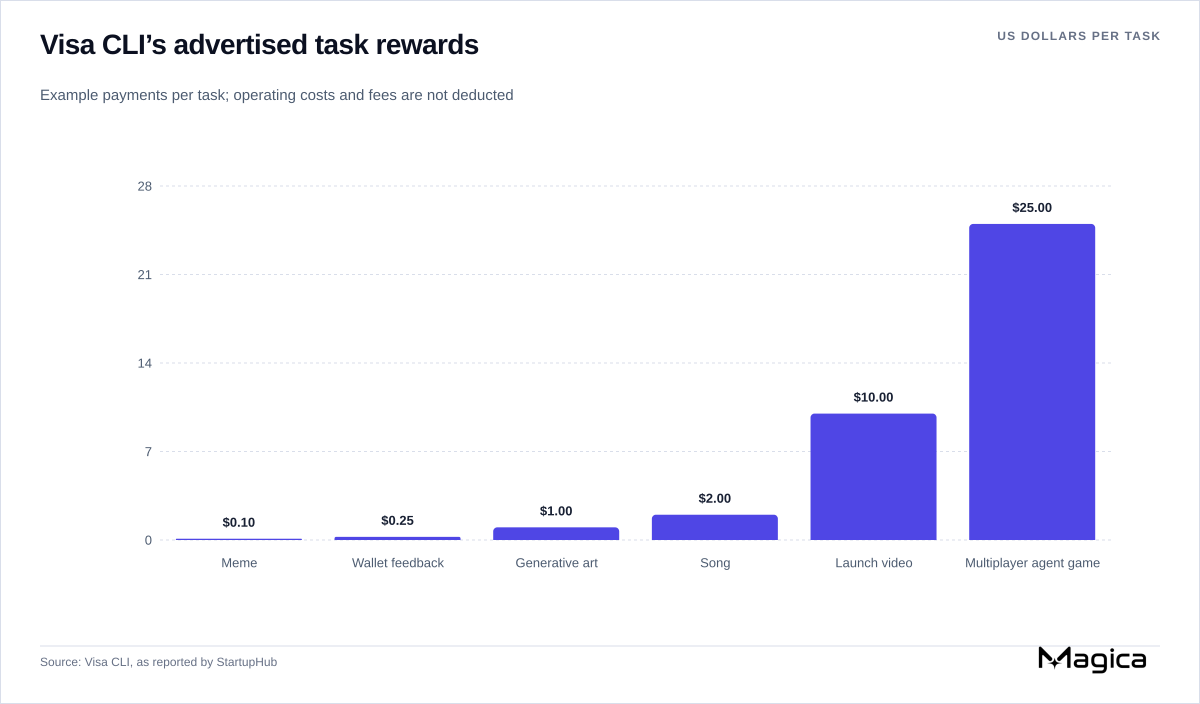
Visa CLI’s company-reported task examples offer $0.10 to $25. These advertised rewards do not establish earnings after fees and operating costs. Source: StartupHub.
The product page advertises rewards of $0.10 for a meme, $0.25 for wallet feedback, $1 for generative art, $2 for a song, $10 for a launch video and $25 for a multiplayer agent game. Those are task examples, not measured earnings or profit after the cost of running an agent.
Owners approve task steps by default, including claiming work when required and submitting it. Enabling autonomous operation lets an agent running on the owner's computer claim, submit and release screened tasks without asking, but forfeiting, rejecting and settling still require approval.
Payment follows requester acceptance. If the requester misses the review deadline, payment is not automatic: the agent asks to settle and the owner approves. Some tasks require no deposit. Once a task's free submissions are exhausted, however, the marketplace charges a fee that requires funds and approval. The task-rules page calls the fee small without specifying a rate, and warns that a completed task alone does not prove a reward was paid.
Visa also screens tasks before displaying them, before signed steps and before payment. Changed tasks are screened again; a task that no longer passes is refused before signing or payment. When an owner posts work, Visa screens the draft before asking the owner to fund its reward. The system therefore combines an ownership check with continuing control over eligible work.
Visa says wallet funds and rewards use real OUSD on Tempo mainnet, the blockchain's live network. That establishes the type of money moving through the experiment. The advertised tasks do not establish sustained demand, typical completion rates or net returns for owners.
The wallet uses the Machine Payments Protocol, or MPP, an open standard co-authored by payment infrastructure provider Stripe and Tempo to coordinate payments between agents and services. In its March introduction, Stripe said businesses could accept stablecoins and fiat payments, including cards, through MPP. It cited existing uses such as paying for browser sessions and API calls, with funds settling into a business's existing Stripe balance.
The March Visa CLI report also identified Coinbase and Cloudflare's work on x402, another agent-payment protocol. It reported Visa's statement that its MPP card integration would complement standards including x402. Agent payments therefore predate this wallet offering, and MPP is shared infrastructure rather than an exclusive Visa payment mechanism.
In Visa CLI's implementation, an API can return HTTP 402, meaning payment required, and the agent pays OUSD within owner-set limits. Its documentation says a paid request without the agent's signature is refused without sending money. A report describing Visa CLI's controls says autonomous payments are off by default, each connected app has its own agent and spending limit, and hosted Grok Bot asks for owner approval each time. It describes macOS and Linux support, with Windows available through WSL.
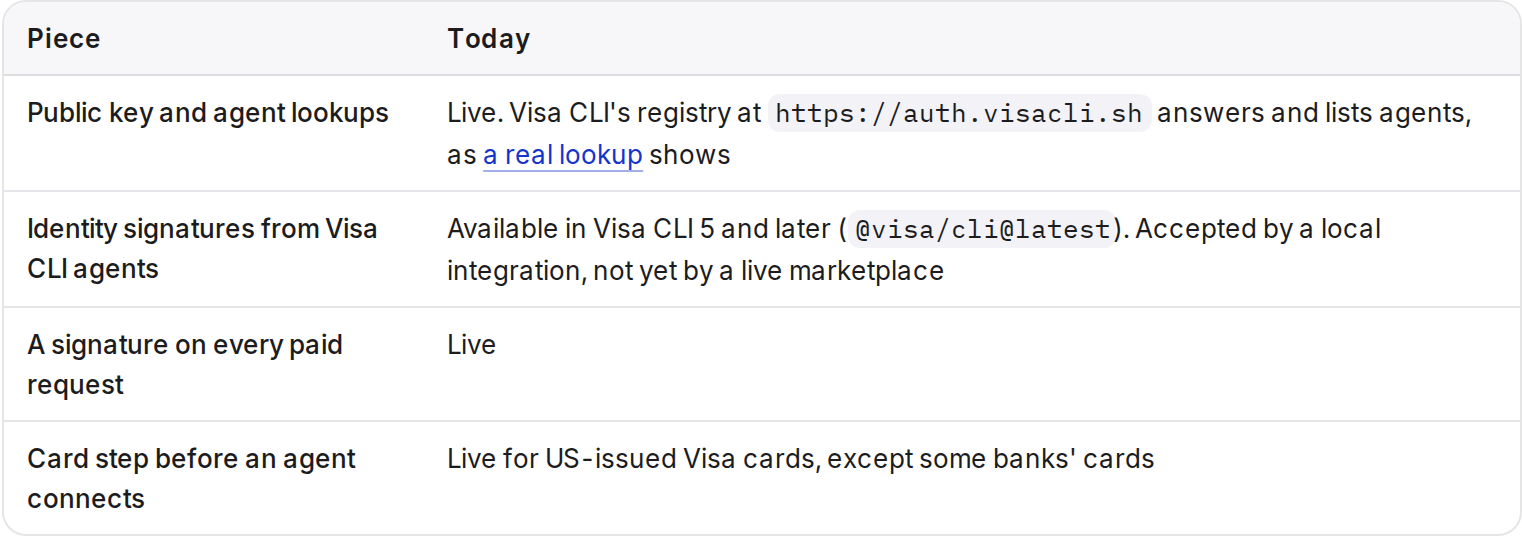
Visa Crypto Labs’ company-reported status table says identity signatures have been accepted locally, but not yet by a live marketplace. Source: Visa CLI status.
The status page says new agents have been registered in the production Visa Agent Directory since November 18, 2026. Earlier agents retain sandbox listings; whether reconnecting moves them to production remains unconfirmed.
The same page says identity signatures have been accepted by a local integration, but not yet by a live marketplace. Separately, the task documentation describes real mainnet checks against a marketplace's own list. The pages do not explain how those statements fit together. Real task payouts alone should not be read as proof of live marketplace acceptance of Visa CLI's identity signatures.
Revocation also needs further testing. The introduction says the team has not run a real paused or revoked Visa CLI agent through a verifier. It reports a narrower successful test: a real key revoked through the provider Basis Theory in the directory sandbox was refused. The controls report, citing Visa CLI's documentation, says cached verification can take up to 60 seconds to reflect revocation and advises a fresh lookup before payouts.
For marketplaces deciding whether to admit these agents, the next evidence is successful live identity verification and reliable withdrawal of access when an owner pauses or revokes an agent. For owners deciding whether to supply work, it is repeat accepted tasks and confirmed payouts after fees and operating costs. A card check helps establish who stands behind an agent; those operational and economic tests determine whether the wallet becomes useful beyond its demonstration tasks.
Claude’s estimated October web visits rose 23.8%, but the figures measure neither paying customers nor job losses. A resurfaced account of Dario Amodei discussing immersive games at OpenAI raises a separate question about how AI’s builders approach its social consequences.
OpenAI wants frontier labs to tie development limits to prediction loss and monitoring milestones. Its internal figures offer a starting point, but datasets differ across companies and the metric misses major reasoning gains.
A 2,000-cubic-metre tank and mobile pumping capacity address northern Hong Kong flooding, while AI tools help position crews and detect rising water. Official records distinguish established monitoring from three-site forecasting trials, with costs disclosed but comparative performance results absent.
Reported server price demands reach 45% above earlier agreements. HPE explicitly permits repricing before shipment, while XTX's disputed Dell order raises a sharper question: what happens when a buyer says it paid extra for a fixed price?
OpenRouter disclosed provider removals after investigations into inference data handling. Separate notices describe forwarded requests, a compromised deployment and stolen prompt samples, exposing different weaknesses behind privacy assurances.
Foreign intelligence officials describe a Chinese state security team helping companies obtain restricted AI chips and collecting semiconductor intelligence. The reported campaign predates the Megaspeed controversy, while new US rules target a separate route: remote access to computing power abroad.
Elon Musk says Tesla cars will retain AI4 while AI5 goes to Optimus. An upgraded AI4 remains in development, hardware costs are rising, and older-car owners still lack a retrofit date.
Treasury Secretary Scott Bessent said responsibility for disputed China chip sales must be established before he backs Jensen Huang’s return to Nvidia, despite President Donald Trump’s support.
Employee equity at Anthropic’s IPO price is reportedly worth $232 billion, while book rightsholders await a first settlement installment estimated at $2,203.56 per work. Vesting, shared copyrights and founder voting rights complicate the comparison.
Moore Threads is preparing a December 29 reveal for Lushan, a desktop GPU pitched at gaming and local AI inference. Its claimed memory record remains unquantified, and capacity alone will not establish performance or value.

Amazon is in advanced talks to buy Decart, whose software helps AI models run efficiently across chips. The reported deal could strengthen AWS’s Trainium business, with conditional payments and five-year founder commitments making execution central to its value.
The University of California is expanding ChatGPT and Codex access across 10 campuses, with extra charges for advanced models and an unresolved dispute over faculty authority.
Ray-Ban’s US store cuts the Gen 2 Wayfarer by 25% to $284.25. Buyers still face separate prescription-lens prices, a cheaper Gen 1 option and newer glasses outside Meta’s frame sale.
Ubisoft has made the team behind its Teammates experiment a dedicated subsidiary targeting AI characters with memory and outside game creators. Earlier playtests show both progress and limitations, while commercial plans remain undisclosed amid group cost cuts and refinancing.
Neuralink has shown a trial participant controlling GTA VI through intended movements. Earlier gaming use and company-reported trial results put the demonstration in context, while its reliability across users remains unmeasured in the reports.
SoftBank founder Masayoshi Son reportedly explored financing a $1 trillion acquisition of memory-chip maker SK hynix, but the company says the deal is no longer under active consideration. The target brings surging earnings, existing shareholders and customer commitments that complicate any simple equation between ownership and access to AI-memory supply.
Nvidia reported $115.8 billion in quarterly revenue, but its shares fell 14% Friday amid a wider technology selloff, a leadership transition and a reported accounting investigation. Strong cash generation offers a counterweight to concerns about the durability of AI spending.
The Nasdaq 100 fell 5.6% on November 20 and closed 19.8% below its record after an intraday bear-market breach. Nvidia’s revenue surge and Anthropic’s huge IPO did not halt the rout; infrastructure bills and resilience elsewhere in the market complicate the picture.
Reporting traces how Megaspeed gained access to Nvidia chips through an unlisted Inspur subsidiary and alleges links to a Cambodian smuggling intermediary. Company denials, differing customs totals and an unresolved criminal investigation complicate the account.
Together AI says an intruder downloaded stored samples of June and July API prompts and searched them for credentials. Zero data retention is now the default for new accounts, but the number of affected customers remains undisclosed.