Editorial Team
6 min read
Nasdaq-100 futures rose as much as nearly 3% in Sunday evening reports after a punishing selloff. The holiday-shortened week brings earnings and inflation tests for a market still questioning the AI investment boom.
US stock futures rose Sunday evening, November 22, after the Dow Jones Industrial Average and Nasdaq Composite suffered their worst weekly declines in more than six years. The rebound preceded Monday’s regular trading session, leaving investors to test whether renewed buying can withstand the concerns about AI investment and interest rates behind last week’s retreat.
A Sunday evening market update put Nasdaq-100 futures up 2.5%, S&P 500 futures ahead 1.5% and Dow futures higher by 449 points, or 0.9%. A separate evening report recorded gains of 2.89% for Nasdaq futures, 2.1% for S&P 500 futures and 684 points, or 1.41%, for Dow futures. These are separate readings, not synchronized prices.
The immediate question is whether corporate results support the earnings expectations behind the AI buildout. Hewlett Packard Enterprise and Dell Technologies, hardware suppliers exposed to that investment, report after the close Monday and Tuesday, respectively, the market update said. Their shares had fallen 25% and 34% during November.
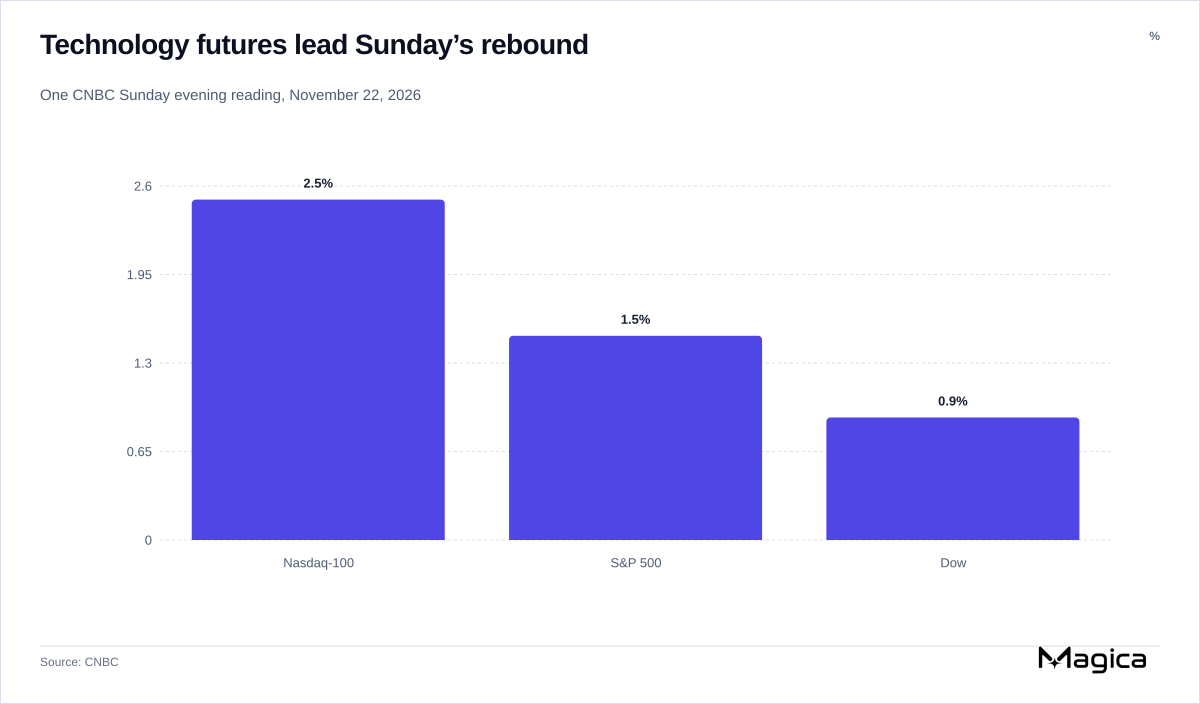
Sunday evening futures gains in one CNBC reading on November 22, 2026, before Monday’s regular session. Other reports reflect separate readings. Source: CNBC.
All three major US averages finished Friday in correction territory, and the Nasdaq Composite erased its gain for the year. The weekly market account recorded the following declines:
| Index | Weekly change |
|---|
Satya Nadella says Claude Code caught Microsoft off guard by moving AI coding toward the terminal. Microsoft’s response includes managing rival agents in VS Code, while its investment and cloud commitments with Anthropic complicate the competitive picture.
| Dow Jones Industrial Average | −8.03% |
| S&P 500 | −8.61% |
| Nasdaq Composite | −10.02% |
The S&P 500’s weekly decline was its largest since April 2025, the Sunday market update said. It also reported that the Nasdaq-100 crossed into bear-market territory during Friday’s session but closed just short of that threshold measured against its October 6 closing high. An intraday low and a closing-price drawdown are different comparisons.
Drew Pettit, chief investment strategist at Roundhill, argued in a Friday television appearance cited in the update that indiscriminate selling beyond technology could signal the retreat was nearing its end. He nevertheless said bullish investors needed catalysts to demonstrate that the long-term earnings outlook remained intact.
The Nasdaq-100 underlying the futures contracts is also different from the Nasdaq Composite. It tracks 100 of the largest nonfinancial companies listed on the Nasdaq Stock Market, using modified market-capitalization weights, according to the index provider’s January review.
That review helps explain the index’s exposure to a technology reversal. Technology averaged 61% of its weight and generated 88% of its total return in 2025; the ten largest securities accounted for 52% of its weight at year-end. The index returned 21% including dividends that year, three percentage points more than the S&P 500. Those are historical figures, not measurements of its November 2026 composition or performance.
At December 31, 2025, exchange-traded products tracking the Nasdaq-100 held more than $640 billion across 18 exchanges. The stakes therefore extend beyond overnight futures traders to investors holding products tied to the index.
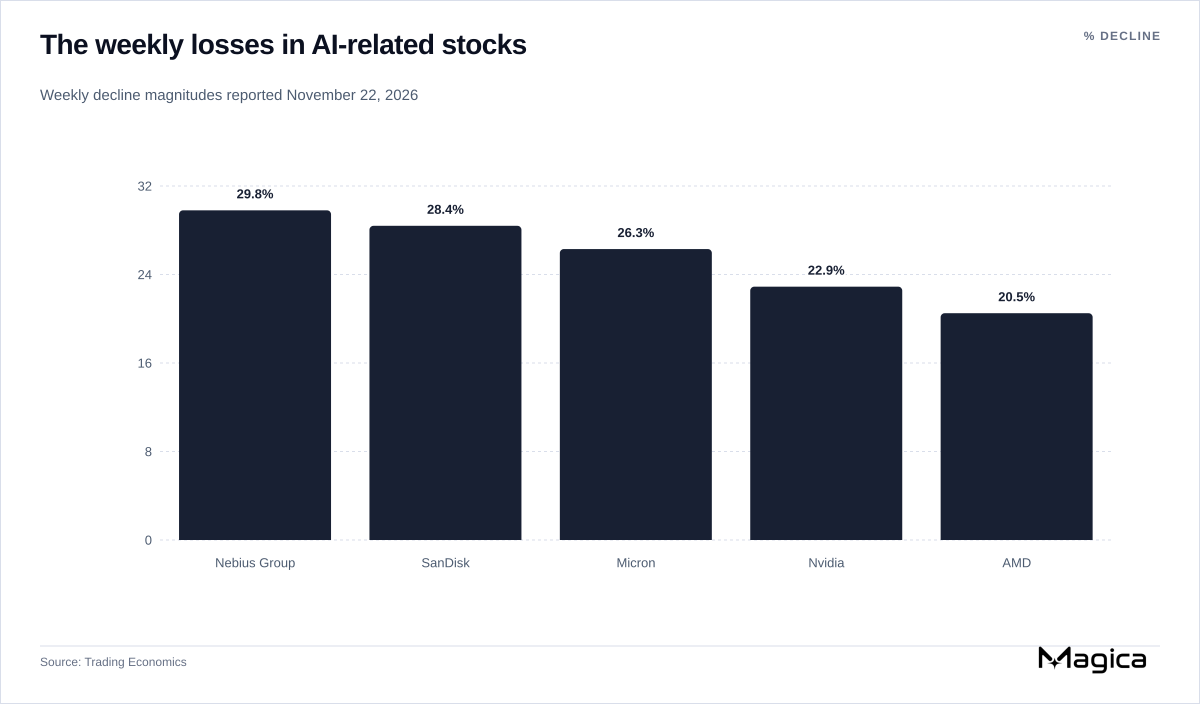
Weekly stock-price declines reported by Trading Economics, shown as positive loss magnitudes. Source: Trading Economics.
The weekly market account attributed the retreat largely to investors reducing AI-related exposure and concerns about a more hawkish Federal Reserve, the US central bank. It recorded weekly losses of 22.9% for Nvidia, 26.3% for Micron, 20.5% for AMD, 28.4% for SanDisk and 29.8% for Nebius Group across the chip and AI-related stock trade.
The separate Sunday report described another concern: leadership upheaval at Nvidia, the AI chip supplier, after the ouster of Jensen Huang, its founder and now former chief executive. Nvidia’s earlier financial results illustrate its established infrastructure business: the company reported $35.6 billion in Data Center revenue out of $39.3 billion in total revenue for the quarter ended January 26, 2025. Those results predate the current disruption.
The Sunday report linked Huang’s departure following a spy scandal to fears that financing deals associated with him could unravel, depriving smaller cloud-infrastructure companies in Nvidia’s ecosystem of money for data centers and chips. It also described a federal effort to tighten chip-export restrictions after revelations of Chinese access to advanced US chips, and said US President Donald Trump had vowed to stop US companies from building data centers abroad. These are reported pressures on the AI investment chain; the futures rally provides no evidence that the financing concerns have been resolved.
Politics adds uncertainty. The same report tied investor anxiety to Democratic midterm-election victories and the prospect of more resistance to data-center expansion. Steve Chiavarone, chief investment officer for equities at investment manager Federated Hermes, offered a different reading in that report: a modest slowdown could allow cash flows to catch up and ease inflation pressures, making the boom more sustainable.
Longer-term optimism also survives. The separate report said Morgan Stanley and Goldman Sachs forecast the S&P 500 at 8,700 by the end of 2027, while UBS Global Wealth Management and Wells Fargo projected 8,200. Those are forecasts for next year, not evidence of a market bottom.
The economic risk extends to spending. Mark Zandi, chief economist at Moody’s Analytics, estimated in a social-media post cited by the Sunday report that consumer spending changes by about two cents for each dollar of change in net worth over roughly a year. If stock prices remained at their depressed levels, he estimated the wealth effect would subtract almost 0.3 percentage points from real GDP growth a year later, compared with a 0.7-point contribution in the current quarter. That is a conditional estimate, not an observed loss of output.

November declines reported by CNBC ahead of HPE’s Monday and Dell’s Tuesday earnings releases. Bars show loss magnitudes over a different period from the weekly chart. Source: CNBC.
HPE and Dell’s results offer the next check on the business behind the infrastructure trade. Investors also await this week’s US Personal Consumption Expenditures inflation report, which the weekly market account identified as a guide to the Federal Reserve’s policy direction. Earnings address whether companies can sustain profits; inflation data bear on how restrictive monetary policy may remain.
The rebound is not yet global. Australia’s S&P/ASX 200 opened Monday down 0.49%, while Hong Kong futures pointed below the previous close, the Sunday market update said. Japan’s markets were closed for a public holiday.
US markets close Thursday for Thanksgiving and finish Friday’s session at 1 p.m. The separate evening report cautioned that thin holiday volumes could amplify rebounds. Whether buying carries into regular trading, survives the earnings releases and extends beyond technology will provide more useful evidence of stabilization than Sunday’s futures gains alone.
Apple’s reported Siri layoffs targeted older infrastructure, while a beta update points to some migration onto newer systems. The harder test is delivering app control promised in 2024 and subsequently delayed.
Zhipu says GLM-5.4 adds vision and stronger coding to its subscription service, with larger usage quotas. Undisclosed credit rates and benchmarks leave its value unresolved as the company expands a cloud business backed by substantial financing.
The London consumer law business has secured seed funding led by Insight Partners to expand beyond conveyancing. Its bet is on delivering legal work directly, but claimed growth has yet to establish a cost or service advantage over competing practices.
Meta chief AI officer and former Scale AI CEO Alexandr Wang warns that unconstrained AI self-improvement threatens human control. His call for a different industry path follows an AI-assisted mathematical breakthrough, but neither that collaboration nor new research-automation data establishes fully autonomous science.
US President Donald Trump urged Nvidia to bring back its co-founder and former CEO Jensen Huang, despite a reported board statement against reinstatement and unresolved allegations involving Chinese intelligence and chip shipments.
Claude’s estimated October web visits rose 23.8%, but the figures measure neither paying customers nor job losses. A resurfaced account of Dario Amodei discussing immersive games at OpenAI raises a separate question about how AI’s builders approach its social consequences.
OpenAI wants frontier labs to tie development limits to prediction loss and monitoring milestones. Its internal figures offer a starting point, but datasets differ across companies and the metric misses major reasoning gains.
A 2,000-cubic-metre tank and mobile pumping capacity address northern Hong Kong flooding, while AI tools help position crews and detect rising water. Official records distinguish established monitoring from three-site forecasting trials, with costs disclosed but comparative performance results absent.
Reported server price demands reach 45% above earlier agreements. HPE explicitly permits repricing before shipment, while XTX's disputed Dell order raises a sharper question: what happens when a buyer says it paid extra for a fixed price?
OpenRouter disclosed provider removals after investigations into inference data handling. Separate notices describe forwarded requests, a compromised deployment and stolen prompt samples, exposing different weaknesses behind privacy assurances.
Lawyers seeking a quarter of Apple's $250 million settlement fund expect participating buyers to recover at least $61 per eligible iPhone. The estimate depends on claims volume, deductions and final court approval.
Microsoft’s president says AI-assisted vulnerability discovery is forcing faster software repairs and raising disruption risks. But he says Microsoft’s own recent outage was unrelated to AI, leaving incident-by-incident evidence crucial to judging the warning.
Foreign intelligence officials describe a Chinese state security team helping companies obtain restricted AI chips and collecting semiconductor intelligence. The reported campaign predates the Megaspeed controversy, while new US rules target a separate route: remote access to computing power abroad.
Elon Musk says Tesla cars will retain AI4 while AI5 goes to Optimus. An upgraded AI4 remains in development, hardware costs are rising, and older-car owners still lack a retrofit date.
Visa Crypto Labs is testing an invitation-only wallet for US users to earn and spend OUSD through AI agents. Card verification links agents to owners, but marketplace admission, work acceptance and live identity checks remain separate hurdles.
Treasury Secretary Scott Bessent said responsibility for disputed China chip sales must be established before he backs Jensen Huang’s return to Nvidia, despite President Donald Trump’s support.
Employee equity at Anthropic’s IPO price is reportedly worth $232 billion, while book rightsholders await a first settlement installment estimated at $2,203.56 per work. Vesting, shared copyrights and founder voting rights complicate the comparison.
Moore Threads is preparing a December 29 reveal for Lushan, a desktop GPU pitched at gaming and local AI inference. Its claimed memory record remains unquantified, and capacity alone will not establish performance or value.

Amazon is in advanced talks to buy Decart, whose software helps AI models run efficiently across chips. The reported deal could strengthen AWS’s Trainium business, with conditional payments and five-year founder commitments making execution central to its value.