Editorial Team
6 min read
OpenAI's policy says personal-account Daybreak sessions may be used to improve models even when the global training switch is off. The company later promised a separate opt-out, but the scope, timing and treatment of safety-review data remain unsettled for researchers handling sensitive cyber work.
OpenAI's Trusted Access for Cyber program gives vetted defenders fewer model refusals for work such as vulnerability triage, malware analysis and patch validation. Its data-controls policy now creates a separate rule for those sessions on personal accounts: the global “Improve the model for everyone” switch does not necessarily block model-improvement use. Hours after users received that message, OpenAI promised another control. Until that control is documented, researchers cannot tell what boundary applies before they submit a sensitive artifact.
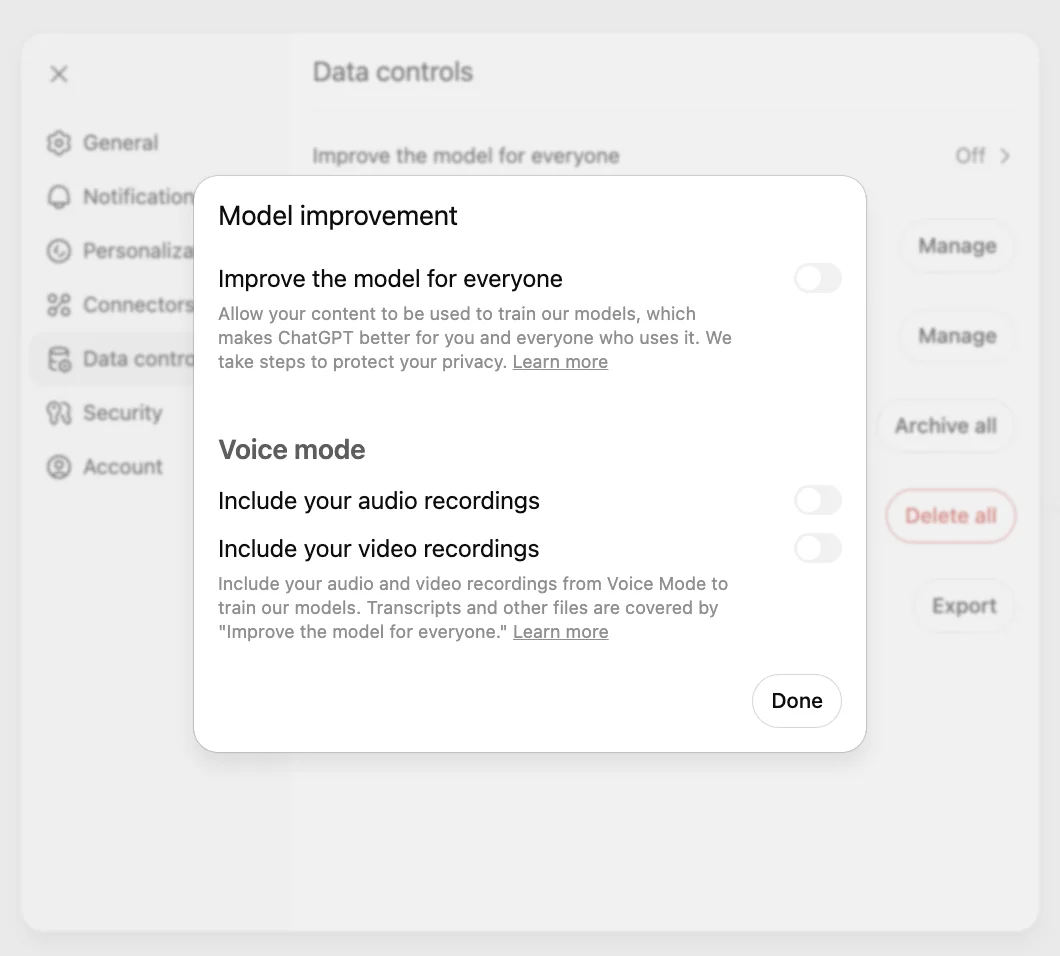
OpenAI Help Center screenshot of the account-wide “Improve the model for everyone” control turned off. Source: OpenAI Help Center.
The current data-controls page says that, on a personal account, OpenAI may use content from Trusted Access sessions such as Daybreak Blue to improve its models even when “Improve the model for everyone” is off. The same page says the setting still governs activity outside a Trusted Access session. This is a policy exception for a defined session type, not a claim that every conversation on the account is included.
Daybreak is OpenAI's Trusted Access for Cyber program. Its program documentation describes Blue as the individual-access tier with reduced refusals on supported mainline models for verified defensive work. Red is a more restricted tier for advanced authorized testing and cyber-specialized models; the current application path makes Red available to approved business and enterprise organizations, while individuals apply for Blue. Both tiers require additional approval.
That distinction matters to the privacy argument. A personal-account Blue session can contain an unpatched vulnerability, an exploit proof of concept, target details or incident data, but Blue is not the program's highest-capability tier. The relevant question is whether OpenAI's data treatment is clear enough for the kind of material the approved workflow invites researchers to handle.
The first user communications described in the report said the exception would begin on November 29. The same account says users shared emails stating that individual Daybreak Blue API access would end on November 20 while Codex access through ChatGPT sign-in would remain. The official Help Center page does not state either date, so these are user-reported deadlines rather than dates confirmed in the policy itself.
OpenAI then changed its message. A later notice told personal-account users they would receive a separate way to opt out of model improvement for Daybreak sessions and that more detail would come closer to November 29. The notice also says interactions flagged for safety review may still be used for safety purposes, including work intended to prevent advanced cyber capabilities from being misused.
That promise may restore a model-improvement choice without restoring the broader meaning users assigned to the global switch. The retained notice does not define the interface, the eligibility rules, whether the control covers every Daybreak interaction, how long flagged material is kept or who can access it. It also does not explain whether the proposed control applies to content already submitted before the change.
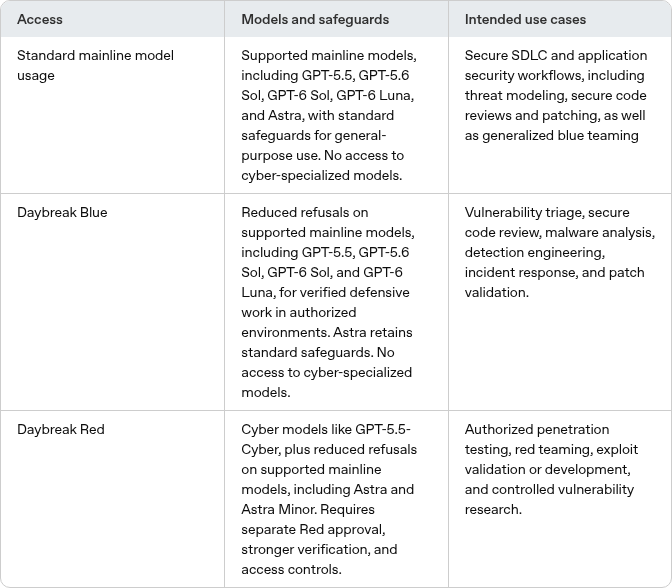
OpenAI Help Center table comparing Standard, Daybreak Blue and Daybreak Red access levels, safeguards and intended cybersecurity use cases. Source: OpenAI Daybreak overview.
OpenAI launched Trusted Access for Cyber on February 5 as an identity- and trust-based pilot for enhanced cyber capabilities. In its launch announcement, the company committed $10 million in API credits for defensive cybersecurity work. Those credits are a program commitment for teams, not a price or subsidy that answers what an individual researcher pays for a personal account.
The current Daybreak setup also imposes meaningful gates. Individual Blue applicants need an eligible paid plan, Advanced Account Security, at least one compatible physical FIDO2 hardware key and identity verification; completing the checklist does not guarantee approval. Organization access follows a separate onboarding path, and the documentation says approval does not itself turn on reduced refusals: a workspace or API project must enable the Daybreak control for an approved user or project.
Those controls explain why the API date matters. Personal-account researchers may need programmatic access for repeatable analysis, while a ChatGPT or Codex sign-in is a different product surface. The sources do not establish the cost or availability of a substitute for every affected researcher, so moving to an organization is not a proven frictionless workaround.
OpenAI's data-controls page says content from Business, Enterprise, Edu and Healthcare workspaces is not used to train its models by default. It also says API inputs and outputs are excluded by default. Those defaults create a clearer baseline than the personal Daybreak exception, but they do not make every organization eligible for Daybreak or guarantee the same access tier.
The market is developing parallel trust systems. An independent report described researchers temporarily losing Trusted Access after an error that OpenAI said required re-verification, and identified Anthropic's Cyber Verification Program as a similar effort. That episode is relevant context for reliability, but it does not establish that another provider offers the same models, access or data terms.
The practical choice for an independent researcher is therefore two-sided: Daybreak Blue offers a vetted route to fewer refusals for defensive work, while the personal-account data rule can reach the very material that makes that access valuable. OpenAI's $10 million credit commitment and the existence of a competing program show strategic investment in the category; they do not resolve the individual user's privacy calculation.
The next decision is whether a personal-account researcher can know the data boundary before sending a sensitive artifact. OpenAI needs to publish:
Until those details appear, the account-wide training switch is not a reliable proxy for a personal Daybreak session. The separate opt-out could close that gap, but the evidence needed to judge its scope and operation is still missing.
Jay Clayton confirmed an investigation into former Megaspeed executive Alice Huang and her firm, without resolving espionage or military-use allegations. Official records trace the chip-diversion inquiry to 2024, while separate reporting alleges Li Ming helped direct the business.
Satya Nadella says Claude Code caught Microsoft off guard by moving AI coding toward the terminal. Microsoft’s response includes managing rival agents in VS Code, while its investment and cloud commitments with Anthropic complicate the competitive picture.
Apple’s reported Siri layoffs targeted older infrastructure, while a beta update points to some migration onto newer systems. The harder test is delivering app control promised in 2024 and subsequently delayed.
Zhipu says GLM-5.4 adds vision and stronger coding to its subscription service, with larger usage quotas. Undisclosed credit rates and benchmarks leave its value unresolved as the company expands a cloud business backed by substantial financing.
The London consumer law business has secured seed funding led by Insight Partners to expand beyond conveyancing. Its bet is on delivering legal work directly, but claimed growth has yet to establish a cost or service advantage over competing practices.
Meta chief AI officer and former Scale AI CEO Alexandr Wang warns that unconstrained AI self-improvement threatens human control. His call for a different industry path follows an AI-assisted mathematical breakthrough, but neither that collaboration nor new research-automation data establishes fully autonomous science.
US President Donald Trump urged Nvidia to bring back its co-founder and former CEO Jensen Huang, despite a reported board statement against reinstatement and unresolved allegations involving Chinese intelligence and chip shipments.
Claude’s estimated October web visits rose 23.8%, but the figures measure neither paying customers nor job losses. A resurfaced account of Dario Amodei discussing immersive games at OpenAI raises a separate question about how AI’s builders approach its social consequences.
OpenAI wants frontier labs to tie development limits to prediction loss and monitoring milestones. Its internal figures offer a starting point, but datasets differ across companies and the metric misses major reasoning gains.
A 2,000-cubic-metre tank and mobile pumping capacity address northern Hong Kong flooding, while AI tools help position crews and detect rising water. Official records distinguish established monitoring from three-site forecasting trials, with costs disclosed but comparative performance results absent.
Reported server price demands reach 45% above earlier agreements. HPE explicitly permits repricing before shipment, while XTX's disputed Dell order raises a sharper question: what happens when a buyer says it paid extra for a fixed price?
OpenRouter disclosed provider removals after investigations into inference data handling. Separate notices describe forwarded requests, a compromised deployment and stolen prompt samples, exposing different weaknesses behind privacy assurances.
Lawyers seeking a quarter of Apple's $250 million settlement fund expect participating buyers to recover at least $61 per eligible iPhone. The estimate depends on claims volume, deductions and final court approval.
Microsoft’s president says AI-assisted vulnerability discovery is forcing faster software repairs and raising disruption risks. But he says Microsoft’s own recent outage was unrelated to AI, leaving incident-by-incident evidence crucial to judging the warning.
Nasdaq-100 futures rose as much as nearly 3% in Sunday evening reports after a punishing selloff. The holiday-shortened week brings earnings and inflation tests for a market still questioning the AI investment boom.
Foreign intelligence officials describe a Chinese state security team helping companies obtain restricted AI chips and collecting semiconductor intelligence. The reported campaign predates the Megaspeed controversy, while new US rules target a separate route: remote access to computing power abroad.
Elon Musk says Tesla cars will retain AI4 while AI5 goes to Optimus. An upgraded AI4 remains in development, hardware costs are rising, and older-car owners still lack a retrofit date.
Visa Crypto Labs is testing an invitation-only wallet for US users to earn and spend OUSD through AI agents. Card verification links agents to owners, but marketplace admission, work acceptance and live identity checks remain separate hurdles.
Treasury Secretary Scott Bessent said responsibility for disputed China chip sales must be established before he backs Jensen Huang’s return to Nvidia, despite President Donald Trump’s support.
Employee equity at Anthropic’s IPO price is reportedly worth $232 billion, while book rightsholders await a first settlement installment estimated at $2,203.56 per work. Vesting, shared copyrights and founder voting rights complicate the comparison.