Editorial Team
8 min read
Officials project at least US$40 billion in investment from a proposed Philippine technology hub. Its initial land offer leaves later rent and facility costs open, while water supply, ancestral claims and access to jobs remain contested.
The Philippines is offering 1,620 hectares in New Clark City, Tarlac, for a US-backed technology manufacturing hub before key terms governing its public contribution, utility supply and effects on surrounding communities have been settled.
Officials say the project could attract at least US$40 billion in investment and create about 130,000 jobs, with construction expected to begin in 2028, according to an October 16 report. The distinction between forecasts and binding commitments matters: the initial land proposal leaves later rent and some costs open, while residents question whether industrial employment would compensate for lost farms and homes.
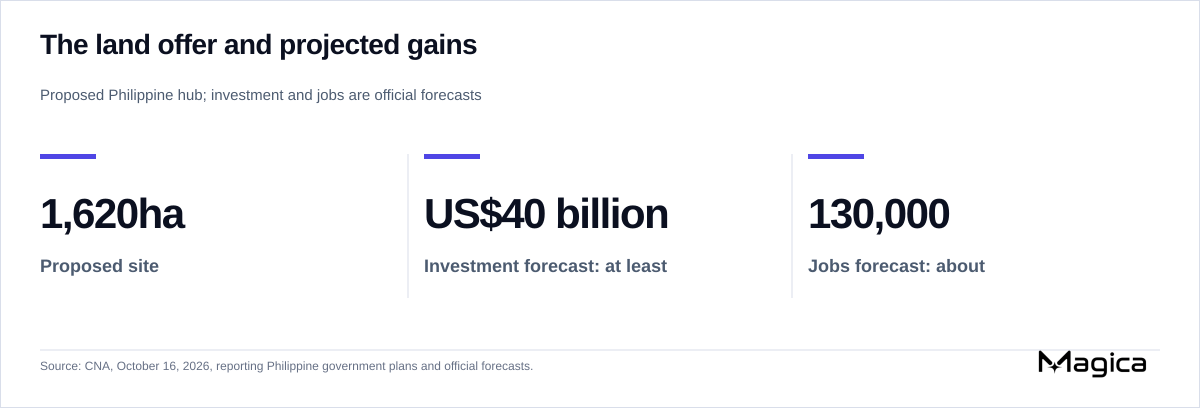
The proposed hub covers 1,620 hectares. Officials forecast at least US$40 billion in investment and about 130,000 jobs. Source: CNA.
Pax Silica is a US-led initiative launched in December 2025 to secure supply chains for AI semiconductors, critical minerals and advanced technologies. A Council of the European Union briefing describes a network spanning mining, processing, semiconductor design and computing infrastructure, intended to reduce dependence on single sources. The Philippine hub is intended to attract chipmakers and strategic industries away from China-centred supply chains.
The Philippines brings existing industrial capabilities to that strategy. Its semiconductor work includes assembly, testing and packaging. Semiconductors and electronics exports were worth nearly US$50 billion in 2025, and the country is the world’s second-largest nickel producer after Indonesia, according to the October reporting. Officials want the hub to move that existing industrial base into higher-value manufacturing.
Washington and Manila announced plans for the hub in April 2026. It forms part of the Luzon Economic Corridor, an investment initiative begun in 2024. It would sit within New Clark City, a government-planned city in the former US military complex at Clark. The Bases Conversion and Development Authority, or BCDA, holds title to and manages the wider Clark estate under presidential supervision, as described in a September report. Its 1992 founding law gives it a mandate to develop former military reservations for productive civilian uses and promote Central Luzon’s development. The agency’s role combines land control with a development mandate.
BCDA’s April 9 proposal, transmitted to the US State Department on April 16, offered roughly 4,000 acres for a Pax Silica Coordination Office and associated bilateral economic-security activities. Its stated functions include mineral supply-chain coordination, industrial planning, private capital mobilization, workforce development and technology transfer.
The proposal treats the first two years without lease payments as the Philippines’ contribution in kind. Annual rent from year three would be agreed separately. Precise boundaries require a supplemental agreement before operations begin; construction, outfitting, staffing and operating costs for the coordination office would be allocated as the governments separately agree. On expiry or termination without renewal, the property and permanent improvements would revert to the Philippine government.
Those provisions describe an initial public-asset offer. They do not establish a final lease price, a settled allocation of coordination-office costs or financing for the entire industrial hub.
BCDA says the hub would require at least 3 gigawatts of electricity and 60 million to 90 million litres of water daily, according to the October report. These are planning requirements, not measured consumption.
In an August explanation carried by the Philippine Information Agency, BCDA said dedicated plants and exclusive off-grid generation would supply power. It promised surface-water harvesting, storage, treatment and recycling without drawing on communities’ existing water supply. Desalination remained an option being considered.
The September reporting recorded a further BCDA claim: available technology could increase water supply to 300 million litres a day. The agency also described the development as mainly solar powered. Neither assertion establishes the financing, delivery timetable or dry-season performance of those systems.
Surface water is already part of local livelihoods. Farmers in O’Donnell rely on rivers and rainfall for crops, while households use deep-well pumps. Village chairperson Wendell Mercado said in the October interviews that the Bangut and O’Donnell rivers already have little flow during the dry season. Avoiding groundwater extraction would therefore leave a separate question about irrigation access.
Giovanni Tapang, a former dean of the University of the Philippines’ College of Science and a convenor of the Network Opposed to Pax Silica, challenged both the land needed for solar generation and the reliability of water collection when farmers need irrigation.
A Senate resolution seeking an inquiry cites estimated demand of 130 million litres daily against proposed reservoir supply of 65 million to 120 million litres a day. It also asks whether environmental, agriculture and irrigation agencies participated in early assessments. Its figures are legislative premises for investigation, not verified operating results.
The estimates cannot simply be treated as interchangeable. BCDA says the site would host semiconductor and advanced manufacturing facilities rather than a data-processing centre; the resolution’s demand estimate includes AI data-centre cooling. The September report found data centres listed in wider New Clark City plans, without specifying whether they would be inside the Pax Silica hub. A defined tenant and facility mix is needed to reconcile the resource estimates.
Waste is another unresolved obligation. The September report says BCDA intends to accommodate mineral-processing technology; BAN Toxics, an environmental advocacy group, questioned the absence of disclosed plans for the resulting waste.
BCDA says the development lies outside ancestral domains and denies that it would displace Indigenous communities. Its August explanation nevertheless offered livelihood support for affected families and said they could remain within the same barangay, with access to the same schools and neighbours.
Residents from the Indigenous Aeta communities dispute that account. The September report describes overlapping ancestral claims and a survey by Syracuse University professor and Countermapping Ph member Arnisson Andre Ortega identifying land occupied by at least three existing Aeta villages in the planned construction area. Gloria Capiz-Estabillo, an elder of the Aeta Hungey tribe, told the publication that BCDA had begun informing Aetas they must leave.
BCDA pointed to the absence of an ancestral domain title. Aeta communities in Clark have sought a certificate of ancestral domain title from the National Commission on Indigenous Peoples since 1994, according to the same reporting, facing documentation requirements and administrative delays. The dispute concerns competing claims to land, rather than proof that no community exists where a formal title is absent.
A November 14 report describes a threat of displacement affecting 35,000 people and promises of up to 200,000 jobs. It also describes the project as lacking tenants, power and water. The report does not provide a comparable basis for the two employment projections or define the population covered by the displacement figure; neither establishes how many local residents would lose homes or gain permanent work.
Consultation is disputed too. At an August Senate hearing, Roseller Rodriguez, mayor of Capas, the municipality hosting the site, said a June 22 meeting with BCDA had not discussed the hub’s details. In the October interviews, he called for public consultations and said he was not declaring opposition to Pax Silica itself.
The Semiconductor and Electronics Industries in the Philippines Foundation, an industry association, supports the initiative. In the October reporting, it said greater global supply-chain integration could improve technology capabilities and talent development.
University of the Philippines economics professor Cielo Magno offered a different test: earlier economic zones and investment incentives, she said, had not produced sufficient domestic industrial links, technology transfer or better-quality jobs. She called for education and skills investment, citing Vietnam’s workforce-training efforts to attract high-tech industries.
For Mander Matias, an O’Donnell farmer growing rice, squash and sweet potatoes, job totals do not answer the practical question. He told the October interviewers that he feared losing his family’s land and doubted farmers with little formal education would obtain work beyond construction.
President Ferdinand Marcos Jr. said on October 13 that the project would not threaten livelihoods or Indigenous cultural heritage, pointing to expected employment. His assurance and Matias’s concern address different outcomes: aggregate job creation and access to those jobs for people whose existing livelihoods are exposed.
The October reporting put the target for a Philippine-US framework agreement before the end of 2026, after the September report had described a planned November signing. Construction in 2028 remains an expectation.
The next agreement needs to make the public contribution and commercial obligations assessable: site boundaries, later rent, cost allocation, investor commitments and responsibility for delivering utilities. Resource plans need a specified industrial mix, water-source assessments and dry-season performance evidence, rather than capacity claims alone.
For communities, the consequential decisions concern how ancestral claims will be addressed, what consultation can change, and whether relocation, irrigation access and employment arrangements protect existing livelihoods. Those terms will determine how much of the promised industrial gain reaches the people already living and working around the site.
Reported server price demands reach 45% above earlier agreements. HPE explicitly permits repricing before shipment, while XTX's disputed Dell order raises a sharper question: what happens when a buyer says it paid extra for a fixed price?
OpenRouter disclosed provider removals after investigations into inference data handling. Separate notices describe forwarded requests, a compromised deployment and stolen prompt samples, exposing different weaknesses behind privacy assurances.
Employee equity at Anthropic’s IPO price is reportedly worth $232 billion, while book rightsholders await a first settlement installment estimated at $2,203.56 per work. Vesting, shared copyrights and founder voting rights complicate the comparison.
Moore Threads is preparing a December 29 reveal for Lushan, a desktop GPU pitched at gaming and local AI inference. Its claimed memory record remains unquantified, and capacity alone will not establish performance or value.

Amazon is in advanced talks to buy Decart, whose software helps AI models run efficiently across chips. The reported deal could strengthen AWS’s Trainium business, with conditional payments and five-year founder commitments making execution central to its value.
The University of California is expanding ChatGPT and Codex access across 10 campuses, with extra charges for advanced models and an unresolved dispute over faculty authority.
Ray-Ban’s US store cuts the Gen 2 Wayfarer by 25% to $284.25. Buyers still face separate prescription-lens prices, a cheaper Gen 1 option and newer glasses outside Meta’s frame sale.
Ubisoft has made the team behind its Teammates experiment a dedicated subsidiary targeting AI characters with memory and outside game creators. Earlier playtests show both progress and limitations, while commercial plans remain undisclosed amid group cost cuts and refinancing.
Neuralink has shown a trial participant controlling GTA VI through intended movements. Earlier gaming use and company-reported trial results put the demonstration in context, while its reliability across users remains unmeasured in the reports.
SoftBank founder Masayoshi Son reportedly explored financing a $1 trillion acquisition of memory-chip maker SK hynix, but the company says the deal is no longer under active consideration. The target brings surging earnings, existing shareholders and customer commitments that complicate any simple equation between ownership and access to AI-memory supply.
Nvidia reported $115.8 billion in quarterly revenue, but its shares fell 14% Friday amid a wider technology selloff, a leadership transition and a reported accounting investigation. Strong cash generation offers a counterweight to concerns about the durability of AI spending.
The Nasdaq 100 fell 5.6% on November 20 and closed 19.8% below its record after an intraday bear-market breach. Nvidia’s revenue surge and Anthropic’s huge IPO did not halt the rout; infrastructure bills and resilience elsewhere in the market complicate the picture.
Reporting traces how Megaspeed gained access to Nvidia chips through an unlisted Inspur subsidiary and alleges links to a Cambodian smuggling intermediary. Company denials, differing customs totals and an unresolved criminal investigation complicate the account.
Together AI says an intruder downloaded stored samples of June and July API prompts and searched them for credentials. Zero data retention is now the default for new accounts, but the number of affected customers remains undisclosed.
Users describe grief and physical distress when AI relationships end, whether they choose to leave or the service changes. Research on attachment and farewell tactics raises questions about how providers measure engagement, manage updates and protect intimate data.
UN-backed talks agreed on two more years of work toward an autonomous-weapons instrument, without committing to a treaty. Consensus kept major military powers involved while allowing opponents to weaken the mandate.
Tesla is sending FSD v15 to its first customers, adding a visualization of planned driving and changes to navigation and hazard detection. The software remains supervised, and its claimed 25-fold intervention improvement lacks a disclosed baseline.
OpenAI reports sharply lower reasoning-extraction rates in internal GPT-6.2 tests and backs sanctions against illicit foreign distillation. Its own research and rival Anthropic’s experience show why protecting hidden reasoning leaves capability transfer and customer costs unresolved.
Alberta proposes 600-metre setbacks for large data centres and expanded utility oversight, but exemptions and rules still to be written will determine how much protection communities receive.
President Donald Trump backed Commerce Secretary Howard Lutnick as lawmakers scrutinize alleged delays in restricting a suspected route for AI chips to China. A new congressional inquiry also questions Nvidia’s influence on an existing investigation.