Editorial Team
7 min read
San José has halted data-center and other large energy-use project approvals until uniform standards are adopted. The pause closes a potential permitting gap, while leaving residents’ demands for cumulative health and environmental studies unresolved.
San José’s City Council unanimously approved a temporary pause on data-center and other large energy-use project approvals on November 17, closing a window in which pending projects could have gained permission before new development standards were adopted.
The decision covers land-use approvals, including 12 proposed projects under city review. It lasts until the council approves uniform standards, scheduled for consideration on December 8. Residents and environmental advocates sought more time: a moratorium long enough to investigate the cumulative health, environmental, climate and financial effects of concentrating these facilities in the city.
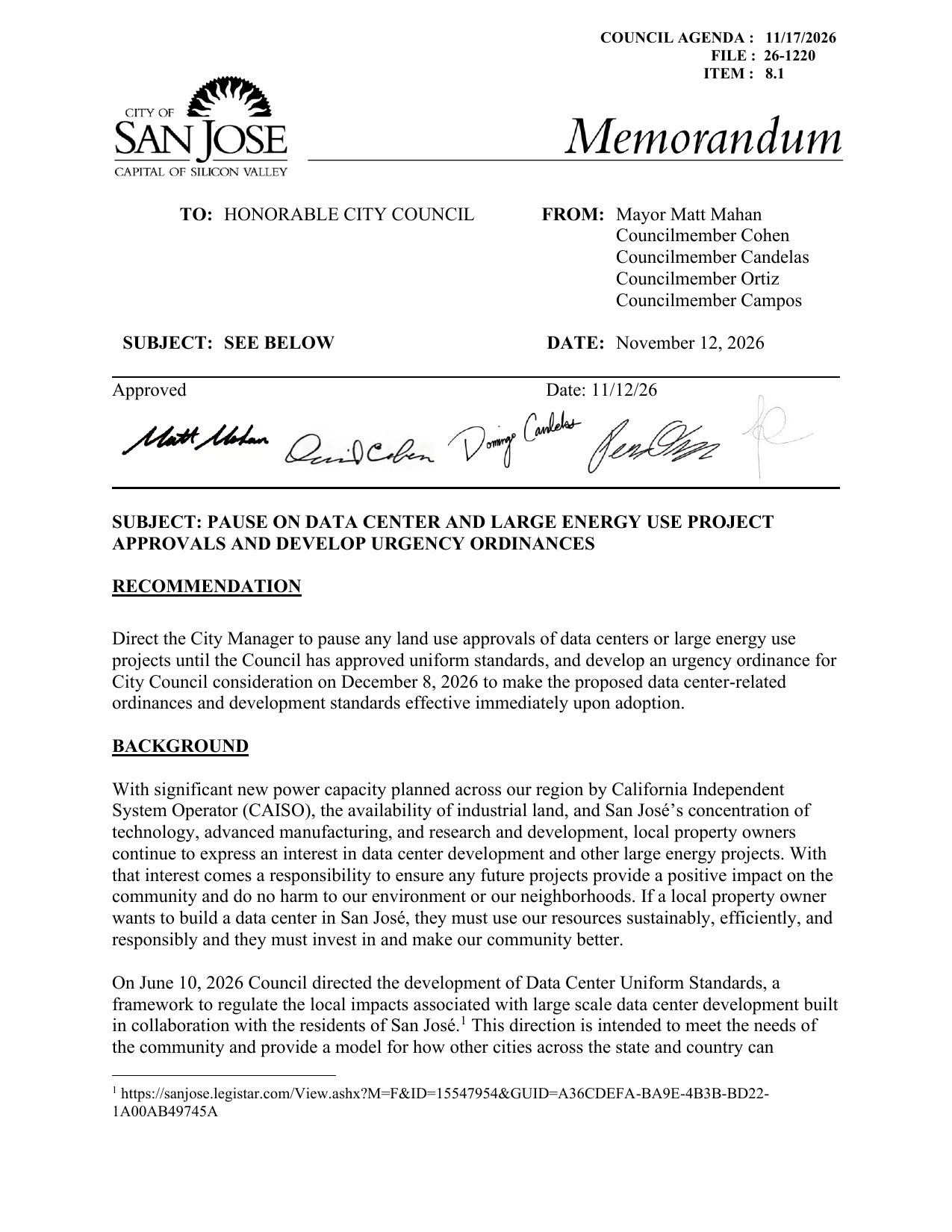
The November 12 memorandum recommended pausing approvals until uniform standards were approved and preparing an urgency ordinance for December 8 consideration. Source: City of San José. Source: City of San José — File 26-1220.
Data centers house computing equipment used for internet services and artificial intelligence. San José is setting conditions on an industry it has actively recruited. Mayor Matt Mahan, who joined four councilmembers in proposing the pause, had spent more than a year promoting power availability through a deal with utility PG&E and dedicated city staff support for developers, according to a pre-vote account of the proposal.
The immediate concern was whether all pending applicants would face the same rules. City officials identified Google’s planned research and development facility in Alviso, in north San José, as one of two projects that could have won approval before the standards took effect. Officials put its prospective power demand at 250 megawatts. That is a planned power requirement, not measured electricity consumption from an operating facility.
The council’s proposal directed the city manager to pause approvals until uniform standards were approved and prepare an urgency ordinance for December 8. That mechanism would let the new requirements take effect immediately upon adoption, avoiding the usual implementation delay. The measure appeared as item 8.1 on the November 17 council agenda.
Mahan had opposed a broader ban or moratorium. Before the vote, he said he would accept losing projects unwilling to meet the city’s standards. Environmental groups also supported closing the permitting gap without endorsing the draft rules: Alice Kaufman, policy and advocacy director of the environmental preservation group Green Foothills, said the pause was a positive step while criticizing proposed protections against air and noise pollution.
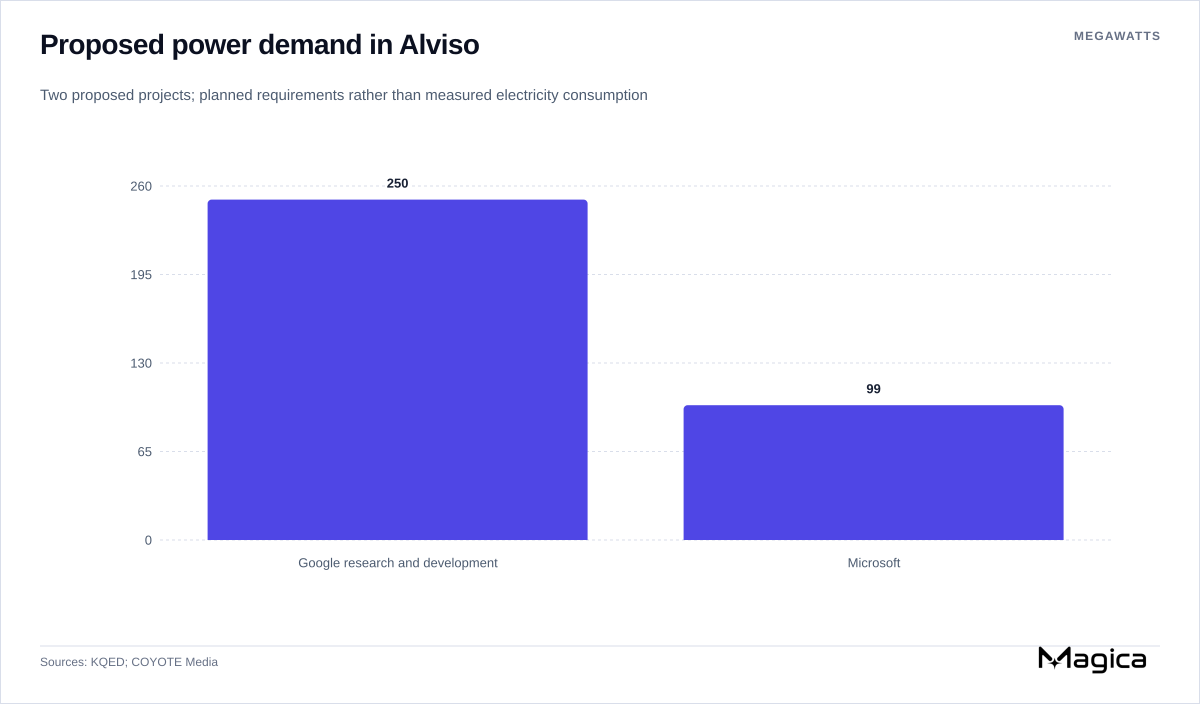
Proposed power requirements for two Alviso projects: 250 megawatts for Google and 99 for Microsoft. These are planned requirements, not measured electricity consumption. Source: KQED.
Alviso illustrates why residents want more than uniform requirements for individual applicants. The majority-Latinx neighborhood along the Bay faces both Google’s proposal and a proposed 99-megawatt Microsoft project with its own substation and 224 backup generators, according to a November examination of local development. Those figures describe proposed infrastructure, not operating capacity or generators running simultaneously.
Marcos Espinoza, president of the neighborhood group Alviso in Action, questioned how projects would affect families who wanted to remain there for generations. Residents’ concern is the combined burden of facilities near their homes, rather than whether each one can pass an individual review.
The same examination found that the draft did not call for a cumulative impact assessment beyond the existing project-by-project review under the California Environmental Quality Act. McKenna Beck, a policy analyst at the Natural Resources Defense Council, warned that concentrated electricity demand could create reliability risks and increase reliance on diesel backup generators if supply became constrained. That is a warning about possible operation, not evidence that the proposed facilities have already caused those effects.
At the November 17 meeting, Dashiell Leeds, conservation coordinator for the environmental group Sierra Club’s Loma Prieta Chapter, called for a longer moratorium to study cumulative public-health, environmental, climate and financial impacts.
Even the existing inventory is uncertain. The November examination cites a city estimate of about 20 operating data centers, while citing an email to San Jose Inside in which the city acknowledged that it did not track them all and lacked an exact count. It also counted four already-approved projects as of early November. The new pause concerns further land-use approvals; it does not supply that missing baseline for a cumulative study.
The draft presented at an October 15 community meeting contains substantive restrictions on construction and operation. The reported proposal would:
A city spokesperson said in October that the standards would apply to new development already in the pipeline, according to the broader examination. That account also describes sound barriers, annual reports demonstrating compliance with city noise limits, and third-party verification of large energy projects’ water and energy use every five years.
Advocates dispute whether those measures address the risks adequately. At the October meeting, Leeds criticized the absence of heat-island and low-frequency-noise studies, as well as the role of the planning director rather than the council in approving projects. Other residents questioned water-quality protections and the combined effects of diesel emissions.
The distinction matters for enforcement: showing that a facility meets an existing limit does not itself answer whether that limit protects people living near several facilities. The dispute is over both compliance and the adequacy of the standards being enforced.
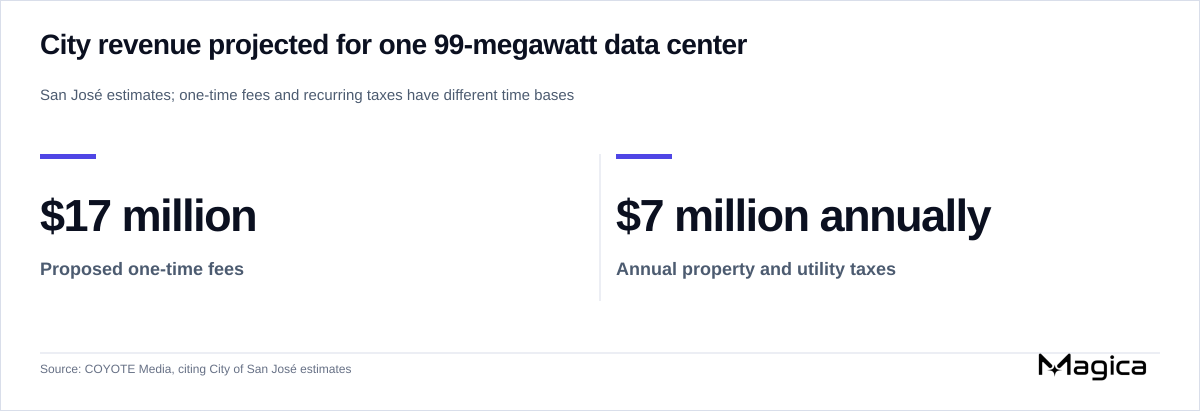
San José projects $17 million in one-time fees and $7 million annually in property and utility taxes for one 99-megawatt project. These are gross estimates, not net public benefit. Source: COYOTE Media.
The city has a financial stake in allowing projects to proceed under new conditions. The November examination cites a city estimate that one 99-megawatt data center would bring $17 million in proposed one-time fees and $7 million annually in property and utility taxes. Those are projected gross receipts for a project of that size, not money already collected or a calculation of public revenue after costs. They do not establish the net financial benefit of the 12 pending proposals.
Labor advocates brought another interest to the October meeting: construction work, fair wages and local hiring. Jean Cohen, executive officer of the South Bay Labor Council, said local and union hiring should be mandatory rather than encouraged. The same report said November planning documents indicated movement toward that requirement.
Cohen explained that labor’s advocacy focused on shaping enforceable requirements for projects likely to be considered for approval. Support for stronger safeguards therefore does not imply agreement on a longer halt: environmental organizations sought more study time, while labor representatives emphasized the terms on which development could proceed.
There is also a limit to municipal action. Iris Stewart-Frey, a Santa Clara University environmental studies professor who co-authored a May report on data centers’ water and environmental-justice implications, argued in the examination that broader state rules could reduce developers’ incentive to seek more vulnerable communities with fewer protections. A San José approval pause alone cannot settle where that demand goes.
The council is scheduled to consider the standards on December 8. Officials said after the November 17 vote that approvals could remain paused into the new year because of the December and January public-meeting recess, even after the moratorium lapses when the standards take effect.
That calendar delay does not provide the research commitment residents requested. The next decision is whether the final rules require evidence about combined neighborhood impacts, how compliance will be independently verified, and what enforceable environmental and workforce conditions applicants must meet. A clearer inventory of existing facilities and an assessment of their collective effects would address questions the temporary pause leaves unresolved.
Z.AI’s next flagship model is reportedly behind schedule as rival providers tighten distillation defenses. US licensing rules for overseas computing threaten further delays, with Moonshot forecasting longer release cycles if its access is cut off entirely. Interim releases and alternative suppliers complicate the picture.
Capita is seeking fresh equity and creditor support after replacing its chief executive. Pension recovery costs are only part of its profit downgrade, while government figures show unresolved cases still growing.
Provisional CBS figures show AI use more than doubled among Dutch businesses with at least two workers in 2026. Text generation spread rapidly, while reported productivity gains leave the size of the economic payoff unresolved.
The Global Electronics Association says AI servers are absorbing scarce circuit-board materials and crowding out other industries. New factories are coming, but upstream constraints and uncertain demand complicate the response.
Google says Gemini Live’s Guided Vision is available on iOS, extending visual descriptions and spoken camera-framing help to iPhone users. Device eligibility and regional coverage remain unclear, and Google warns against using it for navigation.
The Dutch government wants Congress to keep the MATCH Act out of its annual defence bill. The proposal would tighten controls on ASML’s China business, including servicing, despite existing Dutch restrictions on advanced chipmaking equipment.
The London startup’s pre-seed round backs research and testing for patient-facing AI. Its founders bring medical-device deployment experience, but benchmark findings and customer submissions do not yet establish real-world safety.
Switzerland’s cybersecurity chief says five confirmed AI-agent attacks affected businesses including three critical-infrastructure operators. Four attacks breached systems, but no major outages were reported, and the public evidence leaves the attackers and specific consequences unknown.
SemiAnalysis reports that Amazon’s Trainium3 delivers up to 2.28 times the tokens per modeled dollar of Nvidia’s GB300 NVL72 in an AgentX preview. The result expands public evidence for custom AI chips, but validation, model matching and customer pricing still determine its practical value.
Microsoft says Chinese and North Korean hacking groups have adopted ARTEX, an AI penetration-testing framework that coordinates existing tools. Its spread across models and software forks complicates efforts to contain abuse through a single provider.
Neuralink says its LINK pivotal study is recruiting people with severe paralysis from ALS to assess digital device control, daily independence and long-term safety. Earlier participant gains and technical setbacks frame the test; the implant remains investigational.
India’s IT secretary says Sarvam’s commercial hosting of foreign AI models does not conflict with its publicly supported domestic model development. Eligibility for proposed inference support remains unresolved.
Manufacturing partners have reportedly told buyers that Nvidia will not permit server orders to ship to Malaysia, Singapore, Thailand and Indonesia as they assess new US export controls. The uncertainty is already reaching cloud-project financing.
Trustly’s existing owners are funding new AI payment products after job cuts. New quarterly results show rising payment volumes and revenue, but weaker earnings than a year earlier.
The Pentagon denies reports that officials weighed production powers to pressure Nvidia to restore Jensen Huang. Nvidia confirms senior government input, but its board’s foreign-intelligence investigation remains open.
Perplexity says users are choosing Google's new model over rival offerings, with daily token volume doubling in three days. The 120-billion figure is cumulative, and the early demand leaves retention and task economics unresolved.
Kioxia says a proof of concept paired Nvidia software with about 1.1 PB of raw SSD capacity to expand the datasets GPUs can access. The demonstration establishes a capacity proposition, while workload performance and deployment economics remain undisclosed.
Google’s November 25 update adds Familiar Face alerts and remote siren controls to two Walmart Onn outdoor cameras. The expansion makes inexpensive Nest alternatives more capable, while the value depends on subscription access and reliable video playback.
OpenAI is testing a combined Chat and Work experience with a small group of Pro subscribers. A shared allowance arriving more broadly in December will put advanced conversations and delegated tasks on the same budget, but the size of any resulting loss of access remains unknown.
Sellers are seeking buyers for thousands of Nvidia B300 chips, while Asian data centers try to replace Chinese customers affected by U.S. controls. Rental prices have fallen, but short contracts remain scarce and operators face demanding financing terms.