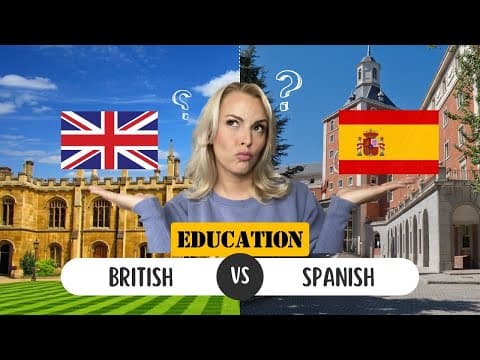
This article provides a detailed comparison of the educational systems in the UK and Spain, covering curriculum structure, teaching methodologies, assessment methods, and cultural influences that shape the school experience in both countries.
Have you ever wondered what it would be like to study in Spain versus in the UK? Having spent the past nine years immersed in both educational systems, I aim to provide an unbiased and accurate comparison of the two. This article will cover curriculum structure, teaching methodologies, cultural aspects, and overall experiences in schools in the UK and Spain.
In the UK, the educational system follows a national curriculum divided into several key stages:
At the end of Key Stage 2, students take the SATs (Standard Assessment Tests). The primary subjects include English, Math, and Science, along with foundation subjects like History, Geography, Art, PE, Music, and Languages.
After primary education, students transition to secondary school, which includes:
At the end of Key Stage 4, students take the GCSEs (General Certificate of Secondary Education). Following this, students can pursue Key Stage 5 (Post-16 education) where they focus on A Levels or vocational paths.
Spain's educational system is organized into three main cycles:
Unlike the UK, Spain does not have a national curriculum in the same sense. The educational structure is governed by laws that outline subjects and academic offerings. In primary education, students study subjects such as Spanish Language, Math, Science, PE, Art, and Music. Secondary education culminates in the Selectividad exams, which are similar to A Levels in the UK.
In the UK, assessments are continuous, with a focus on ongoing evaluation rather than final exams. In contrast, Spain has a more rigid structure where students must pass a certain number of subjects to progress to the next year. Failing multiple subjects can result in repeating the entire year.
British schools emphasize independent thinking, creativity, and critical thinking. The teaching approach encourages continuous learning and positive reinforcement, fostering teamwork and motivation among students.
Spanish schools traditionally focus on theoretical learning, often requiring students to memorize information. However, there has been a shift towards more modern methodologies, integrating practical skills into the curriculum. Despite this, many schools still rely heavily on structured curriculums and foundational knowledge.
In the UK, schools are categorized into state-funded and independent schools. In Spain, there are public schools, private schools, and semi-private schools (concertados), which are partially state-funded and often religious.
The school day typically starts at 9:00 AM and ends around 3:30 PM, with breaks throughout the day. Students have around 13 weeks of holidays per year, with additional breaks during the school year.
In Spain, primary school students often have a split schedule, attending school from 9:00 AM to 1:00 PM, returning from 3:00 PM to 5:00 PM. Students enjoy approximately 11 weeks of summer holidays, along with breaks for Christmas and Easter.
British schools generally require uniforms, which are strictly enforced. In contrast, Spanish schools have a more relaxed approach to dress codes, with some schools opting for no uniforms at all.
Extracurricular activities vary widely between schools in both countries. In the UK, there is often a greater emphasis on participation in clubs and sports, while in Spain, the availability of such activities can depend on the type of school.
In conclusion, both the British and Spanish educational systems have their strengths and weaknesses. The UK system promotes independent thinking and creativity, while the Spanish system offers a more structured approach with a strong emphasis on foundational knowledge. Ultimately, the choice between the two may depend on personal preferences regarding teaching styles, assessment methods, and cultural influences. Where would you prefer to learn or teach: in a Spanish school or in a British school?