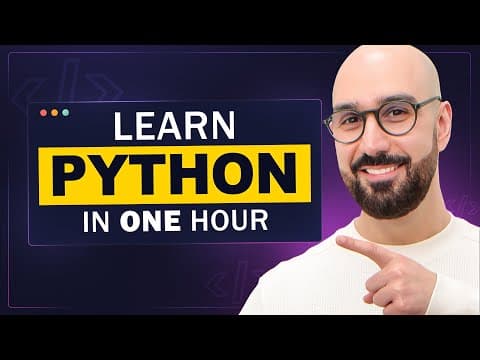
This blog post provides a detailed overview of Python programming for beginners, covering installation, basic syntax, data types, control structures, functions, and more, making it an ideal starting point for anyone looking to learn Python.
Python is a versatile programming language that has gained immense popularity due to its simplicity and wide range of applications. Whether you're interested in data science, machine learning, web development, or automation, Python is an excellent choice. In this guide, we will cover everything you need to know to get started with Python programming.
Python is a multi-purpose programming language that can be used for various tasks, including:
To begin programming in Python, you need to install it on your computer. Follow these steps:
A code editor is essential for writing and executing your Python code. One of the most popular editors is PyCharm. Here’s how to install it:
Once you have Python and a code editor set up, you can write your first program. Here’s how:
app.py.print("Hello, World!")
Variables are used to store data in memory. Here’s how to declare and use variables in Python:
age = 20
print(age)
Python has several built-in data types:
10)10.5)"Hello")True or FalseYou can receive input from users using the input() function:
name = input("What is your name? ")
print("Hello, " + name)
Sometimes, you need to convert data types. For example, converting a string to an integer:
birth_year = input("Enter your birth year: ")
age = 2023 - int(birth_year)
print("You are " + str(age) + " years old.")
Conditional statements allow you to execute code based on certain conditions. Here’s an example using if, elif, and else:
temperature = 25
if temperature > 30:
    print("It's a hot day.")
elif temperature > 20:
    print("It's a nice day.")
else:
    print("It's a bit cold.")
Loops are used to repeat a block of code. The while loop continues until a condition is false:
i = 1
while i <= 5:
    print(i)
    i += 1
The for loop is used to iterate over a sequence:
for number in range(1, 6):
    print(number)
Functions are reusable blocks of code. You can define a function using the def keyword:
def greet(name):
    print("Hello, " + name)

greet("Mosh")
Lists are used to store multiple items in a single variable:
names = ["John", "Bob", "Mosh"]
print(names[0])  # Output: John
Tuples are similar to lists but are immutable:
tuple_example = (1, 2, 3)
Dictionaries store data in key-value pairs:
dict_example = {"name": "Mosh", "age": 20}
print(dict_example["name"])  # Output: Mosh
This guide provides a solid foundation for beginners looking to learn Python programming. By understanding the basics of installation, syntax, data types, control structures, and functions, you are well on your way to becoming proficient in Python. As you continue your learning journey, consider exploring more advanced topics and projects to further enhance your skills.