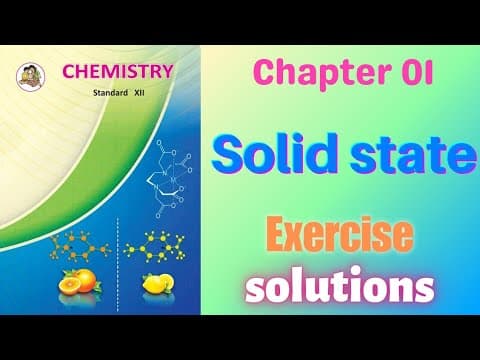
This blog post provides detailed solutions to the exercises in Chapter 1 of Class 12 Chemistry, focusing on the solid state. It covers key concepts, problem-solving techniques, and examples to enhance understanding of the topic.
In this blog post, we will delve into the solutions for the exercises presented in Chapter 1 of Class 12 Chemistry, which focuses on the solid state. This chapter is crucial for students as it lays the foundation for understanding the properties and behaviors of solids in chemistry.
The solid state is characterized by a fixed shape and volume, with particles that are closely packed together. Understanding the arrangement of these particles is essential for grasping the properties of solids, including their density, melting point, and conductivity.
Before we dive into the exercise solutions, let’s briefly review some key concepts related to the solid state:
A unit cell is the smallest repeating unit in a crystal lattice. Understanding unit cells is crucial for determining the properties of crystalline solids.
This refers to the fraction of volume in a crystal structure that is occupied by the constituent particles. It is an important factor in determining the density of a solid.
Now, let’s proceed to the solutions for the exercises in this chapter. Each solution will be explained step-by-step to ensure clarity and understanding.
Question: Classify the following substances as crystalline or amorphous: diamond, rubber, table salt, and glass.
Solution:
Question: A cube of metal has a mass of 100 grams and a side length of 5 cm. Calculate its density.
Solution:
Density = Mass/Volume
Volume of the cube = side³ = 5 cm × 5 cm × 5 cm = 125 cm³
Density = 100 g / 125 cm³ = 0.8 g/cm³
Question: What is packing efficiency and how is it calculated?
Solution:
Packing efficiency is the ratio of the volume occupied by the particles to the total volume of the unit cell. It is calculated using the formula:
Packing Efficiency = (Volume of particles in unit cell / Total volume of unit cell) × 100%
Understanding the solid state is fundamental for students of chemistry, especially in Class 12. The exercises in this chapter not only test knowledge but also enhance problem-solving skills. By working through these solutions, students can gain a deeper insight into the properties and behaviors of solids, preparing them for more advanced topics in chemistry.
As you continue your studies in chemistry, remember that practice is key. Regularly revisiting these concepts and exercises will help solidify your understanding and prepare you for exams. Keep exploring and questioning the fascinating world of chemistry!