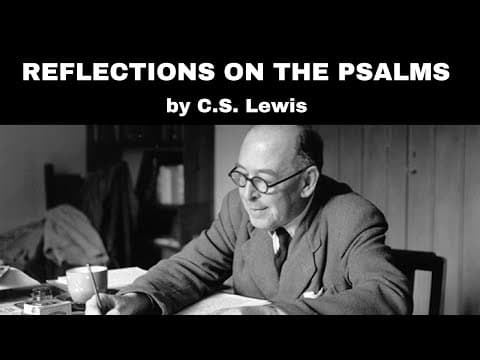
C.S. Lewis's "Reflections on the Psalms" offers an insightful exploration of the Psalms as poetic expressions of faith, emphasizing their literary qualities, the nature of God's judgment, and the complexities of human emotions in relation to divine love and justice.
In his book "Reflections on the Psalms," C.S. Lewis presents a personal and engaging exploration of the Psalms, emphasizing their poetic nature rather than treating them as mere doctrinal texts. Lewis acknowledges his own amateur status in biblical scholarship, aiming to share insights and reflections that may resonate with other readers who approach the Psalms without extensive theological training.
Lewis begins by asserting that the Psalms are fundamentally poems meant to be sung, not doctrinal treatises or sermons. He argues that to truly understand the Psalms, one must read them as poetry, appreciating their emotional depth, parallelism, and lyrical qualities. He highlights the importance of recognizing the literary devices used in the Psalms, such as parallelism, which enhances their beauty and meaning.
One of the most notable features of Hebrew poetry is parallelism, where the same idea is expressed in different words across two lines. Lewis provides examples from the Psalms to illustrate this point, noting that understanding this structure is crucial for grasping the intended meaning. He argues that failing to recognize parallelism can lead to misinterpretations or a sense of absurdity in the text.
Lewis delves into the theme of judgment in the Psalms, noting that it is often portrayed as a cause for rejoicing rather than fear. He contrasts the Jewish understanding of judgment with the Christian perspective, suggesting that while Christians may view judgment as a terrifying prospect, the ancient Jews saw it as a civil matter where they hoped for justice and vindication.
In the Psalms, God's judgment is depicted as a righteous act that brings joy and restoration. Lewis points out that the psalmists often express a longing for God's judgment, viewing it as a means of righting wrongs and delivering the oppressed. This perspective highlights the psalmists' faith in God's justice and their desire for divine intervention in their lives.
Lewis acknowledges the emotional intensity present in the Psalms, including expressions of anger, despair, and vindictiveness. He reflects on the so-called "cursing Psalms," which may seem troubling to modern readers. However, he argues that these expressions of raw emotion are part of the human experience and reflect the psalmists' struggles with injustice and suffering.
Lewis emphasizes that the Psalms capture the full range of human emotions, including the desire for revenge and the longing for justice. He suggests that these emotions, while not always aligned with Christian teachings on forgiveness, are nonetheless valid expressions of the human condition. The psalmists grapple with their feelings, often oscillating between anger and a desire for divine mercy.
Amidst the complexities of judgment and human emotion, Lewis highlights the overarching theme of divine love present in the Psalms. He argues that the Psalms ultimately point to a God who desires a relationship with humanity, inviting individuals to experience His love and grace.
Lewis discusses the significance of worship in the Psalms, noting that the act of praising God is not merely a duty but a natural response to experiencing His goodness. He reflects on the joy and delight expressed in the Psalms, suggesting that true worship arises from a genuine appreciation of God's character and actions.
C.S. Lewis's "Reflections on the Psalms" invites readers to engage with the Psalms as profound poetic expressions of faith. By emphasizing their literary qualities and emotional depth, Lewis encourages a deeper understanding of the complexities of human experience in relation to divine love and justice. The Psalms, as Lewis illustrates, are not just ancient texts but living expressions of the human soul's longing for connection with the divine.