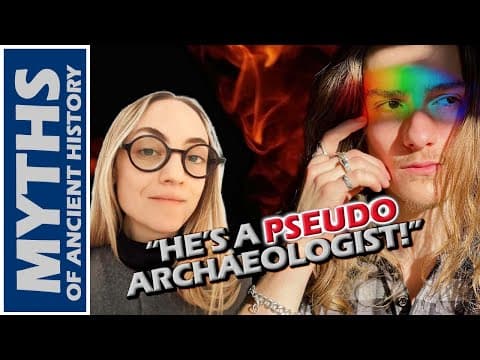
This blog post addresses Holly Lasko Skinner's criticisms of Milo Rossi, known as Miniminuteman, arguing against her claims that he is a pseudoarchaeologist. It clarifies definitions of pseudoarchaeology, discusses the importance of methodology over titles, and defends Rossi's approach to archaeology.
In recent discussions surrounding ancient cultures and archaeology, a notable controversy has emerged involving Milo Rossi, better known as Miniminuteman, and Holly Lasko Skinner, a contributor to Graham Hancock's website. Skinner's article, which attacks Rossi's credibility as an archaeologist, has sparked significant debate. This post aims to clarify the misunderstandings presented in Skinner's critique and to defend Rossi's position against the label of pseudoarchaeologist.
Milo Rossi has gained recognition for his series debunking Graham Hancock's Netflix show, Ancient Apocalypse. His critiques have garnered a substantial audience, leading to personal attacks from Hancock's supporters, including Skinner. Hancock himself endorsed Skinner's article, prompting Rossi to respond to the inaccuracies and misinterpretations within it.
Skinner's primary argument is that Rossi qualifies as a pseudoarchaeologist based on his self-identification and lack of formal training. However, the definition of pseudoarchaeology is crucial to this discussion. In a previous video, I defined pseudoarchaeology as practices that misapply or misinterpret archaeological material in a non-scientific manner. This definition emphasizes methodology rather than mere titles or qualifications.
Skinner claims that Rossi contradicts himself regarding his status as an archaeologist. She cites a livestream where Rossi expresses discomfort with labeling himself as an archaeologist due to his lack of field experience. However, Rossi acknowledges his training and research background, stating:
"I don’t want to claim that, when in reality that title requires a lot of, you know, research and a lot of time and investment to say that."
Skinner misrepresents this by suggesting that Rossi outright denies being an archaeologist due to inadequate training. In reality, Rossi's hesitance stems from a nuanced understanding of what it means to be an archaeologist, which includes practical experience in the field.
Skinner attempts to define pseudoarchaeology by breaking down the term into its components, focusing on qualifications rather than methods. She suggests that a pseudoarchaeologist is someone who claims the title without adequate training. However, this definition is overly simplistic and fails to capture the essence of pseudoarchaeology, which is rooted in the misuse of scientific methods.
The distinction between a genuine archaeologist and a pseudoarchaeologist lies in the adherence to scientific methods. A true archaeologist employs rigorous methodologies to analyze data, while a pseudoarchaeologist may mimic these practices superficially but ultimately violates scientific principles. Skinner's definitions do not adequately address this critical aspect.
Skinner critiques Rossi's analysis of the Baghdad Battery, claiming he misinterpreted the artifacts due to poor data collection. While it is true that archaeologists can make mistakes, this does not automatically categorize them as pseudoarchaeologists. Mistakes in analysis do not equate to a consistent pattern of pseudoarchaeological practice.
An important factor in distinguishing between genuine archaeological practice and pseudoarchaeology is the acknowledgment of errors. Rossi has admitted to mistakes in his interpretations, which is not typical behavior for a pseudoarchaeologist, who would likely deny or ignore their errors.
In conclusion, Holly Lasko Skinner's critique of Milo Rossi as a pseudoarchaeologist is based on misunderstandings and misinterpretations of both his statements and the definition of pseudoarchaeology. It is essential to focus on the methodologies employed in archaeological practice rather than solely on titles or qualifications. Rossi's approach, which emphasizes research and acknowledgment of mistakes, does not fit the criteria for pseudoarchaeology. This discussion highlights the need for clarity in defining terms and understanding the complexities of archaeological practice.