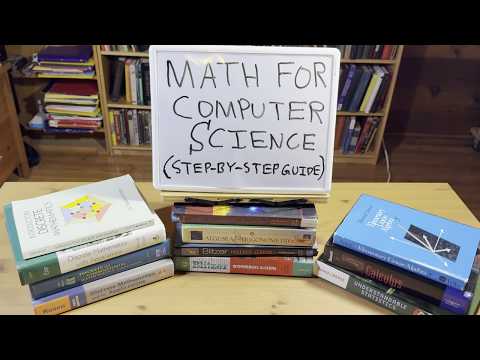
This blog post outlines the essential math courses required for a computer science degree, including recommendations for textbooks and study strategies, while also addressing the challenges students may face in mastering these subjects.
In this post, we will explore the various math courses that are essential for obtaining a computer science degree in the United States. Whether you are just starting your journey in computer science or are currently a student facing challenges in math, this guide will provide you with a comprehensive overview of the necessary subjects, recommended textbooks, and effective study strategies.
For those who are new to mathematics or need a refresher, the first step is to study Intermediate Algebra. A highly recommended textbook for this subject is Intermediate Algebra by Blitzer. This book covers fundamental topics such as factoring, adding rational functions, and algebraic manipulations. It includes answers to odd-numbered questions, making it a great resource for self-study.
Once you have a grasp of intermediate algebra, the next course is College Algebra. This course is mandatory for all computer science majors. A popular textbook used in many colleges is College Algebra, which delves deeper into functions, graphing, and polynomial theory. This book also provides answers in the back for self-assessment.
After completing college algebra, students typically take Pre-Calculus and Trigonometry. These subjects are often combined into a single textbook, such as Algebra and Trigonometry. Trigonometry can be particularly challenging, so it is crucial to perform well on the first test. Memorizing key concepts early on can set the tone for success in the course.
Following pre-calculus and trigonometry, students are required to take Calculus 1 and Calculus 2. Some institutions may also require Calculus 3. A widely used textbook for these courses is Calculus by James Stewart, which covers all three levels of calculus. Depending on your school, you may also need to take Differential Equations, which is often considered easier than Calculus 2.
In addition to calculus, computer science majors typically take a basic Statistics course. Unlike engineering students, who may take a specialized statistics course, computer science students usually take a general statistics course. A recommended textbook for this subject is one that provides clear explanations and practical applications of statistical concepts.
One of the most critical subjects for computer science majors is Discrete Mathematics. This course is often taught by the computer science department rather than the math department and covers a variety of topics that are essential for understanding algorithms and data structures. Recommended textbooks include works by Balakrishnan and by Epp, which cater to different levels of understanding. Discrete mathematics is often a challenging course, and many students find it difficult, so it is important to approach it with dedication.
In addition to discrete mathematics, students may also take courses in Combinatorics or Graph Theory. These subjects are closely related and often use similar textbooks. They provide valuable insights into the mathematical foundations of computer science.
Another important area of study is Linear Algebra, which is highly recommended for computer science majors. A good textbook for this subject is one that covers computational linear algebra, as this is the focus of most computer science programs.
To excel in these mathematics courses, it is essential to develop effective study habits. One strategy is to create extra time in your daily schedule for studying math. For example, consider waking up an hour earlier each day to focus on math problems. Consistent, small study sessions can lead to significant knowledge accumulation over time.
In addition to math textbooks, there are two classic computer science books that every aspiring computer scientist should consider:
In summary, the path to a computer science degree involves a series of math courses that build upon each other, starting from basic algebra and progressing through calculus, statistics, and discrete mathematics. By utilizing the recommended textbooks and adopting effective study strategies, students can navigate these challenges successfully. Remember, persistence is key, and many students have overcome difficulties in math to achieve their goals in computer science. Good luck on your journey!