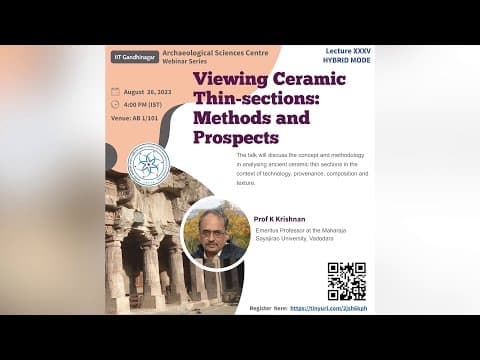
Professor K. Krishnan's lecture on ceramic thin sections highlights the significance of ceramics in archaeology, the methodologies for analyzing them, and the implications for understanding ancient societies. His work integrates traditional and scientific approaches to reveal insights into technology, craft specialization, and cultural processes in South Asia.
In the 35th lecture of the Archaeological Sciences Center webinar series at IIT Gandhinagar, Professor K. Krishnan delivered an insightful talk on the methods and prospects of viewing ceramic thin sections. With a distinguished background in archaeology and ceramic studies, Professor Krishnan emphasized the importance of ceramics as chronological indicators and their role in understanding ancient societies.
Ceramics are not merely artifacts; they serve as crucial indicators of settled communities and their lifestyles. They provide insights into:
Professor Krishnan's approach focuses on analyzing thin sections of ceramics, which allows for a detailed examination of their composition and manufacturing techniques.
A ceramic thin section is a transparent slice of ceramic material, typically around 30 microns thick, prepared for microscopic analysis. This process involves:
Ceramics are primarily composed of clay, which is an aluminosilicate hydrate. When heated, clay undergoes several transformations:
To prevent cracking during firing, potters incorporate non-plastic inclusions (such as sand) into the clay, which helps maintain the structural integrity of the ceramic.
The analysis of ceramics typically involves:
The primary goals of conducting thin section analysis include:
The study of ceramic thin sections is relatively new in India, with roots tracing back to the late 19th century. Early researchers, such as British geologists, began interpreting ceramic sections from a sedimentological perspective. Over time, the focus shifted towards understanding the technological and cultural implications of ceramics.
In India, the analysis of fine ceramics presents unique challenges due to the small size of mineral grains, often less than 30 microns. This necessitates the development of specialized methodologies to accurately analyze and interpret the data.
Professor Krishnan highlighted several future directions for ceramic studies, including:
Professor K. Krishnan's lecture provided a comprehensive overview of the methodologies and significance of ceramic thin section analysis in archaeology. His work not only sheds light on the technological advancements of ancient societies but also emphasizes the intricate relationship between ceramics and cultural processes. As research in this field continues to evolve, it promises to unveil deeper insights into the lives of our ancestors and the societies they built.
The lecture concluded with gratitude towards Professor Krishnan for his invaluable contributions to the field of archaeology and ceramic studies, inspiring future generations of researchers to explore the complexities of ancient technologies and cultures.