Isabelle Robinet's introduction to Daoism presents it as a complex and evolving religion, emphasizing its cosmology, anthropology, and societal role. Key themes include the significance of Chi, the cyclical nature of existence, the pantheon of gods, and the relationship between Daoism and society, highlighting its influence on Chinese culture and thought.
In the study of Daoism, one of the foundational texts is the introduction to "Daoism: Growth of a Religion" by renowned scholar Isabelle Robinet. This introduction serves as a crucial starting point for understanding the complexities of Daoism, a religion that is often difficult to define due to its diverse manifestations. Robinet's approach invites readers to engage deeply with the themes that will recur throughout the course.
Robinet begins by situating Daoism among the three primary teachings of China: Daoism, Buddhism, and Confucianism. However, she notes that Daoism is not a unified tradition. Instead, it is best understood through its concrete expressions and historical evolution. This perspective sets the stage for a deeper exploration of Daoism as a religion, rather than merely a philosophical system.
Robinet discusses various proposed boundaries for understanding Daoism, such as its texts, historical timeline, and distinctions between philosophical and religious Daoism. However, she critiques these boundaries as inadequate. Instead, she proposes common traits that characterize Daoism, which will be essential for our understanding throughout the course.
One of the first common traits Robinet identifies is the cosmology and anthropology of Daoism. She introduces the concept of Chi (also spelled Qi), the animating force in the universe, and discusses the duality of Yin and Yang. These elements are foundational to Daoist thought and are reflected in the five elements that govern both the cosmos and human existence.
Robinet emphasizes the circular nature of Daoist cosmology, where beginnings and endings are interconnected. This contrasts sharply with the hierarchical structure of Confucianism, which presents a more linear worldview. In Daoism, everything is in constant motion, creating a dynamic interplay of multiple worlds.
According to Robinet, Daoists find themselves at the center of these dynamic worlds. Spiritual and physical health are intertwined, and returning to this center is essential for achieving balance. This notion of a systematic whole, animated from the center, is a recurring theme in Daoist practice.
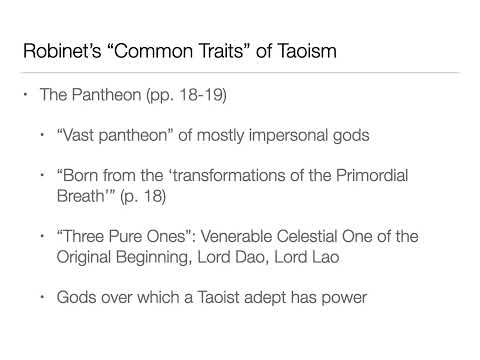
Daoism features a vast pantheon of gods, primarily impersonal in nature. Robinet notes that these gods are manifestations of primordial breath, Chi, and highlights the three pure ones: the Venerable Celestial One, Lord Da, and Lord Lao. The relationship between Daoists and these gods is complex, with practitioners often having the ability to interact with them.
Robinet argues that Daoism transcends mere belief; it is a way of life that prioritizes nature over societal constructs. She asserts that Daoists have significantly influenced Chinese culture, particularly in the appreciation of landscapes and nature, which is evident in Chinese art and poetry.
The natural and social worlds are intricately linked in Daoism. Public rituals performed by Daoist masters serve as a bridge between these realms. Furthermore, the relationship between Daoism and the emperor is highlighted, as both occupy central roles in their respective worlds.
Robinet points out that Daoism is inherently popular, with many practitioners engaging in its practices. This accessibility allows Daoism to act as an intermediary between rulers and the populace, often providing legitimacy to governance.
In a surprising conclusion, Robinet posits that despite its mystical elements, Daoism is fundamentally rational. The systematic organization of its beliefs and practices allows for a coherent understanding of the world. This rational framework has enabled Daoism to influence various aspects of Chinese culture, including medicine and the reception of Buddhism.
Isabelle Robinet's introduction to Daoism offers a rich and nuanced perspective on this complex tradition. By examining its cosmology, societal role, and rational underpinnings, we gain valuable insights into how Daoism has shaped Chinese culture and thought. As we progress through the course, these themes will continue to resonate, deepening our understanding of Daoism's enduring legacy.