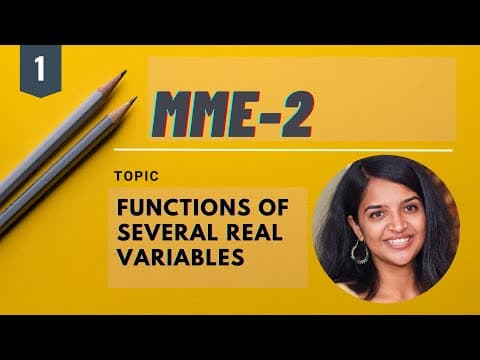
This blog post provides an overview of a course on Mathematical Methods for Economics, focusing on functions of several real variables, multivariate optimization, and their applications in economics. It outlines the course structure, topics covered, and the importance of these mathematical concepts for students pursuing economics.
In this blog post, we will delve into the course titled "Mathematical Methods for Economics - 2," which is designed for undergraduate students at Delhi University. The course aims to equip students with essential mathematical tools necessary for understanding economic theories and applications. The instructor, Poonam Kumari, shares her background and the course structure, emphasizing the importance of mathematical methods in economics.
Poonam Kumari holds a Bachelor's degree in Economics from the College of Commerce, Delhi University, and a Master's degree from the Indian Statistical Institute, Delhi. With experience as a data scientist and a full-time economics teacher, she brings a wealth of knowledge to the course.
The course is tailored for Semester 2 students of Delhi University but is also beneficial for anyone interested in the fundamentals of economics mathematics. The course will be conducted in a bilingual format, primarily in English, with some use of Hindi to ensure clarity and understanding.
The course syllabus includes several critical topics:
Students will learn about functions that depend on multiple variables, moving beyond the single-variable functions typically encountered in earlier studies. This section will cover:
This section focuses on optimizing functions with multiple variables, which is crucial for resource allocation in economics. Key concepts include:
Students will explore linear programming, a method for achieving the best outcome in a mathematical model whose requirements are represented by linear relationships. This topic is particularly relevant for operational research and resource management.
Understanding how economic variables evolve over time is essential. This part of the course will cover:
Students will learn about integration techniques, including definite integrals, which are vital for calculating areas under curves and understanding economic models.
Mathematical methods are foundational for students pursuing higher studies in economics. The ability to model economic phenomena using mathematical functions allows for better analysis and understanding of complex economic systems. The course emphasizes the application of these methods in real-world scenarios, preparing students for future academic and professional endeavors.
The course on Mathematical Methods for Economics - 2 offers a comprehensive introduction to essential mathematical concepts that underpin economic theory and practice. With a focus on functions of several real variables, optimization techniques, and practical applications, students will gain valuable skills that will aid them in their academic and professional journeys in economics.
For those interested in pursuing economics further, this course serves as a critical stepping stone, providing the necessary tools to tackle complex economic problems effectively.