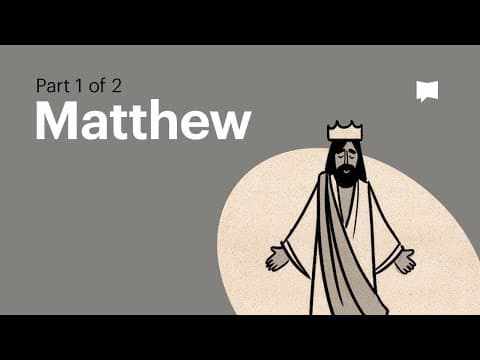
The Gospel of Matthew presents Jesus as the fulfillment of Old Testament prophecies, emphasizing his lineage, teachings, and the establishment of God's Kingdom. This overview covers the first half of the book, highlighting key themes, Jesus's role as a new Moses, and the varied responses to his message.
The Gospel according to Matthew is one of the earliest official accounts of Jesus of Nazareth, detailing his life, death, and resurrection. Although the book itself is anonymous, early traditions attribute it to Matthew, the tax collector and one of the twelve apostles. For approximately 30 to 40 years, the apostles orally transmitted their eyewitness accounts of Jesus and his teachings. Matthew compiled and arranged these narratives into a cohesive work, emphasizing specific themes about Jesus.
Matthew's Gospel aims to demonstrate that Jesus is the continuation and fulfillment of the biblical narrative concerning God and Israel. The book highlights three primary themes:
The structure of Matthew's Gospel is intentional, featuring an introduction and conclusion that frame five distinct sections, each concluding with a significant block of Jesus's teachings.
The opening chapters of Matthew connect Jesus's story to the Old Testament. The genealogy presented highlights Jesus's descent from David and Abraham, indicating his role in bringing God's blessings to all nations. The narrative of Jesus's birth fulfills various Old Testament prophecies, including the announcement of his name, Immanuel, which signifies that God has become human.
Matthew also draws parallels between Jesus and Moses. Just as Moses emerged from Egypt, Jesus passes through the waters of baptism and enters the wilderness for 40 days. This parallel positions Jesus as a greater figure than Moses, destined to deliver Israel from sin and establish a new covenant with God.
In the first major section, Jesus announces the arrival of God's Kingdom, which represents God's rescue operation for the world through King Jesus. He confronts evil, particularly spiritual oppression, and seeks to restore God's reign by forming a community of followers who adhere to his teachings.
Jesus's first significant teaching, known as the Sermon on the Mount, outlines the characteristics of life in God's upside-down Kingdom. Here, Jesus emphasizes inclusivity, inviting everyone—regardless of social status—to repent and follow him. He clarifies that he has not come to abolish the Old Testament laws but to fulfill them, transforming the hearts of his followers to genuinely love God and their neighbors.
Following the Sermon on the Mount, Matthew presents nine stories showcasing Jesus's miraculous acts, which illustrate the power of God's Kingdom in the lives of those who are suffering. These narratives are organized into three groups of three, emphasizing Jesus's compassion and authority. In between these triads, Matthew includes stories about Jesus calling individuals to follow him, reinforcing the idea that experiencing Jesus's grace requires discipleship.
After demonstrating the Kingdom's power, Jesus sends out his twelve disciples to continue his mission. In this section, he instructs them on how to announce the Kingdom and prepares them for the challenges they will face, particularly from Israel's leaders who are resistant to his message.
Matthew collects stories reflecting the varied responses to Jesus's ministry. While some individuals embrace him as the Messiah, others, including John the Baptist and even Jesus's family, express uncertainty. The religious leaders, however, outright reject him, accusing him of blasphemy. In response to these mixed reactions, Jesus shares parables about the Kingdom, illustrating its ultimate value and the inevitability of its spread despite opposition.
As you read through the first half of Matthew, consider the following:
The tension between Jesus and Israel's leaders sets the stage for the second half of Matthew, where these conflicts will further unfold. This overview of the first half of the Gospel of Matthew reveals a rich tapestry of themes and teachings that continue to resonate today.