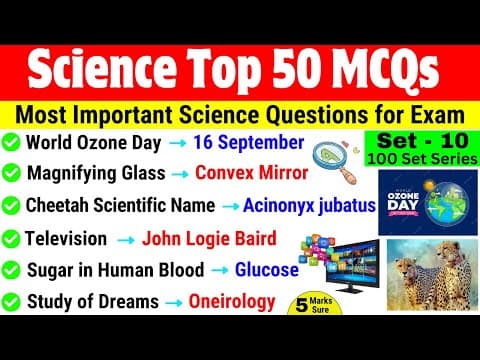
This blog post covers a series of 50 important science questions, including topics on metals, national science days, mirrors, plant transportation, famous quotes in science, and significant inventions, providing essential knowledge for exam preparation.
Hello everyone, welcome to Ravi Aditi Classes. In this blog post, we will explore the 10th set of our series on the top 50 science questions. We have already covered nine parts, and if you missed those videos, you can find all of them on our channel. For those preparing for exams, these questions are crucial as they are frequently asked.
Question: Which metal is extracted from sea water?
Options:
A. Sodium
B. Potassium
C. Magnesium
D. Calcium
Correct Answer: C. Magnesium
Magnesium is extracted from sea water, primarily in the form of magnesium chloride (MgCl2).
Question: On which day is National Science Day observed?
Options:
A. February 28
B. March 23
C. April 7
D. October 16
Correct Answer: A. February 28
This day is celebrated to honor the discovery of the Raman Effect by C.V. Raman.
Question: Which type of mirror is used in automobiles to see traffic on the rear side?
Options:
A. Concave Mirror
B. Convex Mirror
C. Plane Mirror
D. None of the above
Correct Answer: B. Convex Mirror
Convex mirrors are used in vehicles for a wider field of view.
Question: What does transportation in plants help with?
Options:
A. Absorption of water
B. Movement of minerals
C. Temperature regulation
D. All of the above
Correct Answer: D. All of the above
Transportation in plants is essential for the absorption of water and minerals, as well as regulating temperature.
Question: Who said, "Everything is theoretically impossible until it is done"?
Options:
A. Albert Einstein
B. Robert A. Heinlein
C. Richard Dawkins
D. Adam Smith
Correct Answer: B. Robert A. Heinlein
This quote emphasizes the importance of perseverance in scientific endeavors.
Question: What is the scientific name of the goat?
Options:
A. Bos taurus
B. Equus ferus
C. Capra aegagrus
D. Canis lupus
Correct Answer: C. Capra aegagrus
Understanding scientific names is crucial for biology studies.
Question: Who invented the mobile phone in 1973?
Options:
A. Alexander Graham Bell
B. Martin Cooper
C. Thomas Edison
D. Nikola Tesla
Correct Answer: B. Martin Cooper
Martin Cooper is credited with the invention of the first mobile phone.
Question: Which of the following is a nitrogen-fixing bacteria?
Options:
A. Rhizobium
B. Azotobacter
C. Both A and B
D. None of the above
Correct Answer: C. Both A and B
These bacteria play a vital role in the nitrogen cycle.
Question: Which instrument is used to measure heat radiation?
Options:
A. Thermometer
B. Barometer
C. Bolometer
D. Altimeter
Correct Answer: C. Bolometer
Bolometers are sensitive devices used to measure the power of incident electromagnetic radiation.
Question: In which direction does the Earth rotate?
Options:
A. East to West
B. West to East
C. North to South
D. South to North
Correct Answer: B. West to East
The Earth rotates from west to east, which is why the sun rises in the east.
This concludes our exploration of the top 50 science questions. These questions are not only important for exams but also enhance our understanding of the scientific world. Make sure to review these concepts thoroughly as they are frequently repeated in various examinations.
Feel free to comment below with your answers to the test questions provided in this post. For more resources, visit our website at Ravi Books PDF.