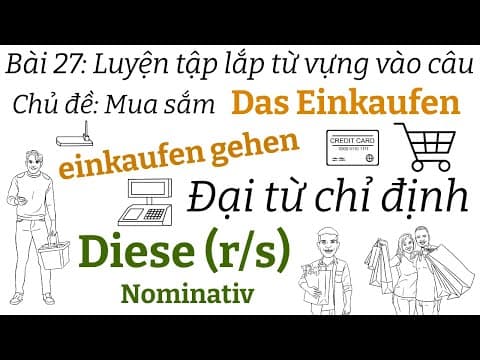
This blog post explores essential German grammar related to shopping, focusing on demonstrative pronouns, vocabulary, and practical sentence construction for effective communication while shopping in German-speaking countries.
Shopping is a beloved activity for many, especially among women. It is often considered one of the easiest skills to navigate while living abroad. Many travelers can shop without knowing the local language, and some residents have lived in Germany for decades without speaking German fluently. However, for those of us aiming to conquer the German language, it is essential to practice the grammar we have learned by incorporating new vocabulary into sentences.
Before diving into shopping vocabulary, let's explore a new concept: demonstrative pronouns. You might be wondering what demonstrative pronouns are. These are words that indicate specific nouns, similar to definite articles, and they play a crucial role in the German language.
Demonstrative pronouns serve both as articles and as substitutes for nouns. For instance, when a demonstrative pronoun replaces a noun mentioned earlier, it is referred to as a demonstrative pronoun. Essentially, these pronouns emphasize a person or object and typically precede nouns or replace them entirely.
In German, nouns change form based on their grammatical case, and since demonstrative pronouns represent these nouns, they also undergo changes. There are only a few important types of demonstrative pronouns in German. One of the new pronouns we will introduce today is "dieser," which means "this." For example, you might say, "Dieser Tisch ist alt" (This table is old).
The form of the demonstrative pronoun changes depending on the noun it refers to. For masculine nouns, you add an "-er" ending, while for feminine nouns, you add an "-e" ending. For plural nouns, the ending is "-e" as well. Here are some examples:
Now that we have a grasp of demonstrative pronouns, let's move on to some essential vocabulary related to shopping. Many learners have requested vocabulary lists, indicating a strong interest in expanding their lexicon. However, simply memorizing vocabulary without knowing how to use it can lead to frustration and ineffective communication.
To build a robust vocabulary, it is crucial to learn words in context. Here are some key verbs and phrases related to shopping:
With vocabulary in hand, the next step is to practice constructing sentences. For example, if you want to say, "I am going shopping at the supermarket," you would say, "Ich gehe im Supermarkt einkaufen."
To enhance your learning, try replacing the shopping location with different places:
When shopping, knowing how to ask about prices is essential. The common question structure for inquiring about prices in German is:
For example, if you want to ask the price of a computer, you would say, "Wie viel kostet dieser Computer?" (How much does this computer cost?).
Mastering German grammar and vocabulary related to shopping is a vital step in becoming proficient in the language. By practicing demonstrative pronouns and constructing sentences with relevant vocabulary, you will enhance your ability to communicate effectively while shopping in German-speaking countries. Remember, the key to fluency is consistent practice and application of what you learn. Keep challenging yourself with exercises and real-life scenarios, and soon you will feel confident navigating the world of shopping in German!